TL;DR — Key Takeaways
- Anthropic’s Model Hardware Standard (MHS) is designed to give AI agents a standardized way to discover, connect to and control programmable physical equipment.
- MHS could reduce hardware integration work from weeks to hours or minutes by replacing vendor-specific interfaces with standardized drivers.
- The framework allows agents to coordinate multiple devices and generate deterministic scripts for lengthy or time-sensitive physical tasks.
Anthropic has unveiled the Model Hardware Standard (MHS), a framework to enable AI agents to operate physical equipment, extending agentic AI beyond software applications and into real-world environments.
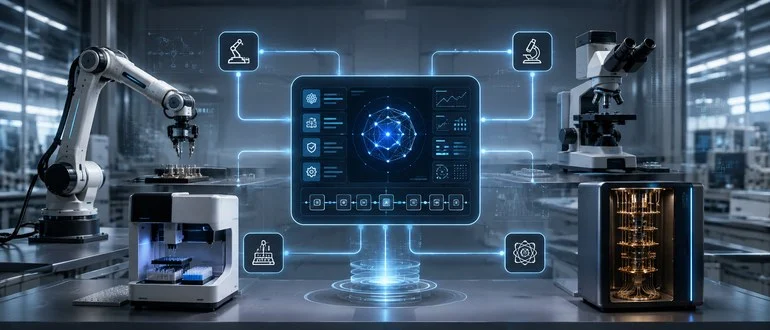
Released as a research preview, MHS provides a common method for connecting AI agents with programmable hardware. The standard supports equipment ranging from robotic arms and microscopes to liquid handlers and quantum computing systems. Anthropic developed MHS initially in collaboration with HHMI Janelia Research Campus.
MHS’s major goal is to reduce the work required to connect equipment from different vendors. Integrating laboratory and manufacturing devices can currently require weeks or longer because individual machines use different programming interfaces. Anthropic claims MHS can cut some of this integration work to hours or minutes.
The framework uses standardized software drivers that give agents a common method of discovering and controlling hardware. Basic commands can instruct equipment to read a value, like temperature, or change a setting. Device information can include physical characteristics and operating limits that an AI system needs to safely perform a task.
MHS follows Anthropic’s development of Model Context Protocol, the protocol that the company created to standardize connections between AI models and software.
“Anthropic put the safety boundary in the device driver rather than the model. That might be the right architectural call, and it shifts the governance decision to whoever defines those limits, but they cannot go undefined,” said Mitch Ashley, VP and Practice Lead at The Futurum Group.
“Agents operating lab and factory equipment will move only as fast as teams can prove those limits hold. Buyers evaluating this should ask who writes the driver’s constraints, who reviews changes, and how change control is implemented and reported.”
Creates a Deterministic Script
Once connected, an agent can coordinate several machines and modify parameters as conditions change. For lengthy or speed-sensitive processes, agents can generate code that lets equipment execute a sequence without requiring the AI model to reason through every specific action.
In one Anthropic test, Claude adjusted a laser while monitoring its position with a camera. After learning how the system responded, the model created a deterministic script that automated the alignment process.
Hardware and tech companies are already testing the framework. Doosan Robotics is evaluating MHS for automated quality assurance and coordination between robotic arms. QIAGEN has developed a proof of concept using its QIAsymphony Connect nucleic acid purification platform, and Tecan is adding MHS support to its Fluent liquid handling systems.
Other early participants include Amazon Web Services, Automata, Danaher, MBF Bioscience and Universal Robots. Hugging Face is adding support to its LeRobot robotics library, and Raspberry Pi is working on MHS integration across several products.
Physical AI Raises Safety Concerns
Giving AI software direct access to physical machinery raises safety concerns beyond those created by chatbots and AI agents. A faulty action could damage equipment or potentially injure people. Anthropic also acknowledges that Claude’s understanding of spatial and physical environments remains limited.
Researchers at Genentech, for example, needed to help Claude understand that foaming in protein samples represented a physical problem rather than a software error. Such limitations mean expert oversight remains necessary for some applications.
Anthropic is initially restricting MHS to a group of research labs, manufacturers and tech partners while it creates additional safety evaluations and operating practices. The company is also preparing a physical safety roadmap to address potential misuse.
For now, MHS works only with devices equipped with programmable interfaces. Anthropic says it is working with manufacturers to develop MHS drivers for equipment that lacks these interfaces.