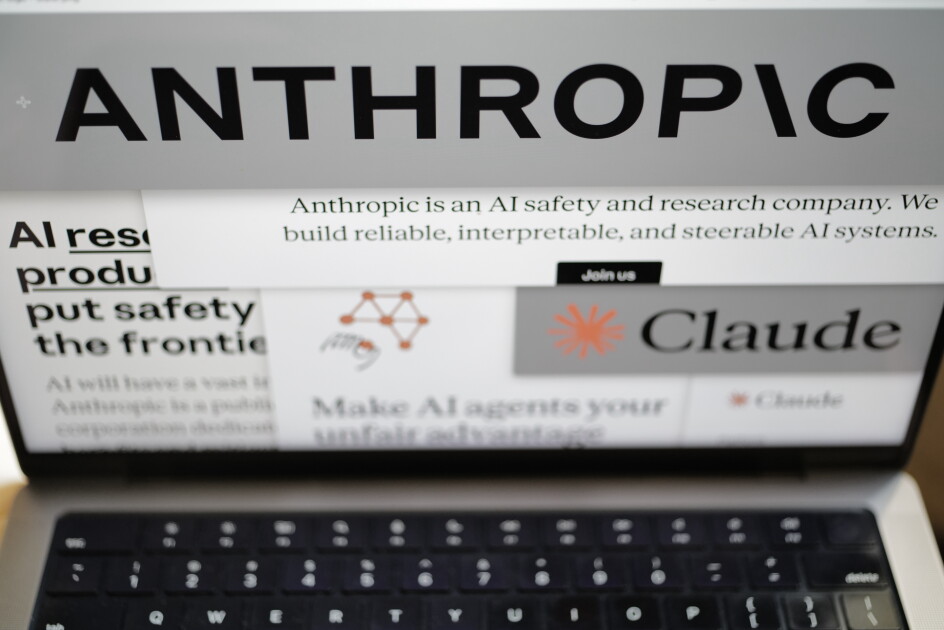
Anthropic announced Tuesday that it has adopted contractually enforceable safety and data-privacy standards for districts using its Claude for Teachers platform.
The company agreed to allow school districts to adopt safety and privacy contract language developed for the National Academy for AI Instruction in New York City. The academy was created last July through a five-year, $23 million partnership between the nearly 1.9 million-member American Federation of Teachers and AI developers Anthropic, Microsoft, and OpenAI.
Claude for Teachers, launched this summer, provides a free (for this year, at least) account equivalent to the model’s chat, agentic, and coding tools for verified K-12 teachers, along with connected tools from other ed-tech vendors like Canva and MagicSchool.
The agreement mirrors language adopted by Microsoft in September, which took effect with its existing contracts this month, though it is narrower in scope because Claude for Teachers does not include student-facing tools. Among its requirements:
- Aside from specific research and safety-related data, student, educator, or customer data cannot be used to train or improve AI models.
- The company now has a permanent responsibility to alert customers and mitigate data breaches, even after a contract ends.
- The tools must minimize unneeded data collections, with “higher-risk” tools like biometrics, memory, profiling, and tracking requiring additional review.
Anthropic’s move is intended to provide a “foundation for trust” for AI use among an increasingly skeptical educator corps, according to Elizabeth Kelly, Anthropic’s head of beneficial deployments.
“We must work to protect and enhance the deeply important work of teachers,” Kelly said in a statement. “That is only possible if teachers, students, and school systems trust us.”
Training educators how to make smart decisions about how to use the tech will be critical #
The agreement also calls for school districts to institute policies and train staff to ensure humans review any grading, discipline, or class placement decisions informed by AI—though these promises depend on training educators using the programs not the programs themselves.
It’s not clear how much the standards will change how AI works in schools. For example, the agreement only covers Claude for Teachers, so the agreements wouldn’t necessarily cover education tools built by other companies using the Claude models.
It will still be mostly up to school districts to secure AI-related protections. The Anthropic and Microsoft agreements cover existing school district contracts, but districts will need to opt into the agreement for future licensing agreements.
Michael Mulgrew, the president of the 200,000-member United Federation of Teachers, which helped negotiate the agreement, said in a statement that he was “heartened” that Anthropic had agreed to adopt the standards, but said more regulation was warranted.
“Ideally, the federal government would step in” to create stronger guidelines and accountability for AI use in schools.
The union is still negotiating with OpenAI. AFT has no agreement with other AI developers like Meta or Google, which earlier this month demanded that schools accept student AI use to continue using Google Search and document tools.