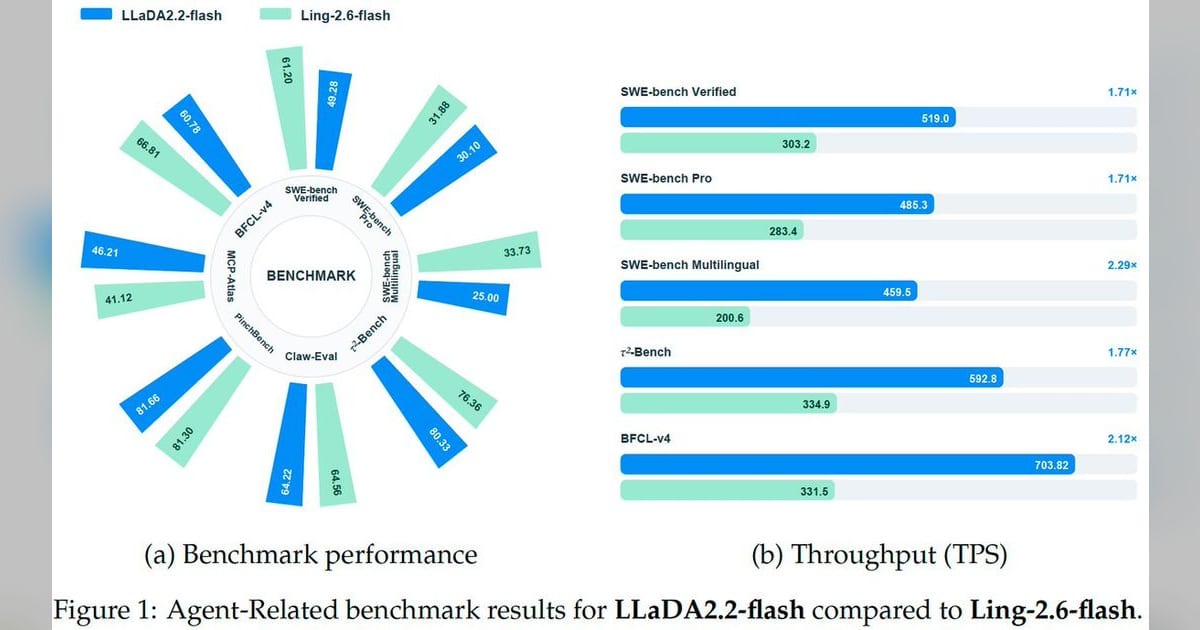
On July 24th 2026, Ant Open Source announced the availability of LLaDA2.2‑flash, describing it as “the first agent‑oriented MoE Diffusion LLM.” The brief X post highlighted a novel decoding technique called Levenshtein editing—the ability to delete, insert, or substitute tokens during generation, enabling the model to correct itself without halting the decoding process. The announcement linked to a short demo video hosted on the same post.
LLaDA2.2‑flash builds on the mixture‑of‑experts (MoE) paradigm, in which a large language model routes each token through a subset of specialized sub‑networks rather than a monolithic architecture. MoE designs have been praised for scaling parameter counts while keeping inference cost manageable, because only a few experts are activated per token. By pairing MoE routing with a diffusion‑style generation process, the model treats text generation as a stochastic refinement problem: an initial noisy token sequence is progressively denoised toward a coherent output. This diffusion approach, originally popular in image synthesis, has recently been explored for text because it can produce more diverse continuations and mitigate exposure bias.
What sets LLaDA2.2‑flash apart, according to the post, is its agent‑oriented orientation. Traditional language models generate tokens in a left‑to‑right order, which makes it difficult to revise earlier decisions once they have been emitted. The Levenshtein editing framework sidesteps this limitation by allowing the model to modify any part of the partially generated sequence, akin to how a human editor might delete a typo or rephrase a clause mid‑sentence. Ant Open Source frames this capability as “a more elegant solution to model collapse than forcing diffusion back into left‑to‑order generation.” Model collapse—where a diffusion‑based decoder degenerates into repetitive or nonsensical output—has been a recurring obstacle for diffusion‑based text generators. By permitting arbitrary token edits, LLaDA2.2‑flash can intervene when the diffusion trajectory veers off course, preserving coherence without re‑starting the entire generation.
The announcement does not include benchmark numbers or a formal research paper, but the tweet’s language suggests the project is positioned as a proof‑of‑concept for integrating self‑correction into large‑scale generative models. The open‑source nature of Ant Open Source means the code and model checkpoints are likely to be hosted publicly, inviting community contributions and independent validation. If the implementation lives up to the description, it could provide a testbed for researchers studying dynamic decoding strategies and for developers seeking more reliable text generation in downstream applications.
The timing of the release aligns with an industry‑wide focus on controllable and trustworthy AI. Over the past year, several leading labs have published work on self‑editing and re‑ranking mechanisms that attempt to catch and fix errors post‑generation. LLaDA2.2‑flash’s approach differs by embedding the edit capability directly into the diffusion decoding loop, rather than applying a separate post‑hoc filter. This integration could reduce latency and simplify pipelines, a practical advantage for real‑time systems.
While Ant Open Source has not disclosed a roadmap or a detailed technical paper, the concise tweet indicates that the team is actively experimenting with the interplay between MoE scaling, diffusion dynamics, and edit‑based correction. The community will likely scrutinize the released model for both performance gains and potential trade‑offs, such as increased memory usage from maintaining multiple expert sub‑networks and the computational overhead of evaluating edit operations at each diffusion step. In the broader AI landscape, LLaDA2.2‑flash represents a concrete step toward more adaptive language models that can revise their own output on the fly. If the open‑source implementation proves robust, it may inspire a new class of agents that blend generation and reasoning, reducing the gap between static language models and interactive AI assistants that need to handle clarification, correction, and iterative instruction.
The announcement was posted on X by the account Ant Open Source and garnered modest engagement—52 likes, 33 retweets, and 21 replies—within a few hours of publication. The accompanying image (see hero image) shows a schematic of the diffusion‑based decoder with edit arrows indicating deletion, insertion, and substitution pathways.
Ant Open Source has not issued a formal press release beyond the X post, and no external commentary was available at the time of writing.