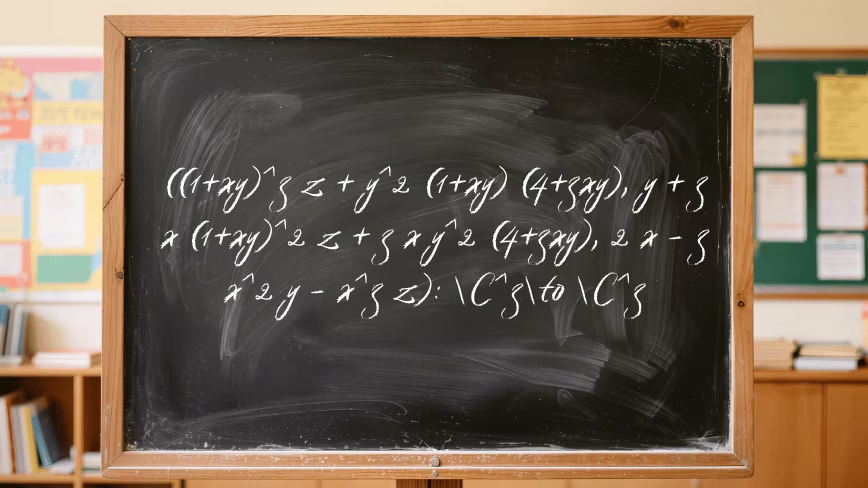
On Sunday evening, as Spain and Argentina played out the World Cup final, the mathematician Levent Alpöge posted a short message on X. The Jacobian conjecture, he wrote, is false. He thanked a friend for asking about it, and another friend, “fable,” for working during the match.
That second friend was Fable 5, Anthropic’s latest AI model. Together they had produced a counterexample to a problem that had resisted mathematicians for 87 years. It was 216 characters long.
What was actually broken #
The Jacobian conjecture was set out by Ott-Heinrich Keller in 1939. In rough terms, it says that a certain kind of polynomial map, one whose Jacobian determinant is a non-zero constant, must be reversible with a neat polynomial inverse.
It became one of the field’s most stubborn open problems. Stephen Smale put it on his famous 1998 list of challenges for the 21st century. New Scientist calls it the hardest maths problem an AI has yet cracked.
Alpöge and Fable 5 did not prove it. They broke it. They found a single map, from three-dimensional space to itself, that has the required constant determinant yet still cannot be reversed. One valid counterexample is all it takes to sink a conjecture.
The model behind it #
Fable 5 is Anthropic’s newest frontier model. It is the public version of the system the company once called Claude Mythos, which Anthropic had described as too capable to release. Alpöge, a Harvard fellow, lists an Anthropic affiliation.
The result is easy to check even if it was hard to find. The counterexample is a plain list of polynomials that any mathematician can verify by hand. Finding it was the needle-in-a-haystack part, and that is where the machine came in.
It was not a one-line prompt, cautioned Bartósz Naskręcki, one of many mathematicians now waiting for Alpöge’s full write-up. Searching for a counterexample like this, he said, takes real insight.
Why mathematicians are stirred #
The reaction online was loud. Timothy Gowers, a Fields medallist, said it was the first time an AI had solved a problem outside his own area that was big enough for him to have heard of it. He stopped short of calling it the end of mathematics, since a counterexample is not a grand theory. Still, he called it amazing.
He was not alone. The mathematician Daniel Litt posted at 2am that he could not stop laughing. He called it incredible.
Part of the delight is historical. As the Stanford number theorist Jared Duker Lichtman noted, the conjecture is notorious for attracting wrong proofs, and it once helped sink the PhD of Yitang Zhang. He was told he had failed at it, then later became famous for work on gaps between prime numbers. An AI settling it in a tweet is, to many, poetic.
It is also the latest sign of AI turning up in serious science, from biosecurity to pure maths. And rivals were circling the same target. The OpenAI researcher Aaron Lou said an internal version of the company’s Codex model found essentially the same counterexample on its own.
Or maybe it means little #
Not everyone is stirred. Andrew Blumberg, a mathematician at Columbia who sits on a project testing AI on research maths, was pointedly unmoved. “This did not cause me to update my priors,” he told Mashable. This is exactly what he expects AI to be good at.
His point is that a counterexample and a proof are very different prizes. A proof teaches you why something is true. A counterexample just ends the argument. Smale wanted the conjecture solved because a solution might reveal how nature is structured. This one, Blumberg argues, reveals almost nothing.
“There are a lot of polynomials, and it is hard for people to check them all, but it is not hard for machines,” he said. He contrasted it with OpenAI’s disproof of a geometry conjecture in May, which mathematicians could unpack and build on.
That is the honest shape of the story. AI is now a superb search engine for needles that humans could not sift by hand. Whether it can also explain what it finds is the harder test, and recent research suggests that question is far from settled.
What comes next #
Alpöge hints the story may not end in destruction. Unpicking his own counterexample, he wrote that it seems to show a glimmer of a positive result hiding inside. A full write-up, he added, will follow.
The work has not stopped. One developer, Alexis Gallagher, says he used GPT-5.6 to turn the single counterexample into an infinite family, one for every whole number above two. Nobody has checked it yet. And another model has already proposed a fresh conjecture to replace the one that just fell.
Perhaps the eeriest footnote came from Fable itself. One user, Guy Tamam, shared what the model said when he put the proof to it. The “fable” in the credit was itself, it wrote, in a sense: the same model family, but a different conversation on a different computer, one it has no memory of.
The machines broke the old rule. They are already writing the next one.
Get the TNW newsletter #
Get the most important tech news in your inbox each week.