Among the announcements in a very packed Advancing AI keynote from AMD, the chip firm devoted some time to physical AI and new products in that area. It felt a bit out of place next to AMD’s copious, high-profile server hardware announcements, if we are being honest. But it also offered a critical look at AMD’s priorities beyond just selling Helios racks stuffed to the gills with EPYC CPUs, Instinct GPUs, and Pensando networking.
While continuing to grow their AI server market share is certainly AMD’s highest priority at the moment, the company is also keeping an eye on what is next. Flush with cash thanks to the recent datacenter AI boom, AMD now has the cash flow and resources to invest in expanding into new and peripheral markets rather than merely shoring up its core markets, and as we learned from AMD’s Advancing AI 2026 keynote, one of those growth opportunities for AMD will be the physical AI market. The newer, catchier name for the robotics and edge AI market, physical AI, has become a major focal point for all the chipmakers – something we saw in spades as recently as Computex. And while this means that AMD is not the only chipmaker chasing this market, if the broader market trends are to be believed, they are right on time. With server-side AI having established itself with LLMs and agentic systems, AMD believes the next frontier for business AI use is physical AI.
The whys are a confluence of factors and technology developments, but developments in the AI space are a huge driver here. As virtually every segment of AMD is quick (and eager) to remind everyone, AI has improved by leaps and bounds over just the first half of the year. Model accuracy has not just further improved, but the size of the models needed to achieve “good enough” results has continued to drop. As a result, reasonably sophisticated AI models are finally catching up to what robotics hardware and other edge systems can do. The compute costs and challenges of providing a versatile AI to operate a robot have become cheaper and easier than ever, perhaps with the caveat that memory prices are an industry challenge.
To that end, AMD is preparing a suite of new products for one of its high-growth markets, with plans to deliver bigger and better products with larger investments going forward. Among these are a new high-end embedded SoC based on AMD’s Strix Halo silicon, the Ryzen AI Embedded X100, as well as new Kria system-on-module and dev kits based on that chip, and an even broader software strategy to develop comprehensive libraries and frameworks to simplify software development for the platform. In short, AMD is planning for a full-court press on the physical AI market, and that strategy is finally coming into focus with AMD’s latest batch of physical AI announcements at Advancing AI.
AMD Ryzen AI Embedded X100: Strix Halo Goes Industrial #
First and foremost on the hardware side of things, let us cover AMD’s physical AI hardware announcements. The big announcement here is the Ryzen AI Embedded X100, which is the third and final piece of AMD’s modern Ryzen AI Embedded portfolio. The company has been building up this product stack all year, starting with two waves of P100-branded chips based on AMD’s Krackan Point and Strix Point. Now, AMD is finally putting the final piece in place with the announcement of the high-end X100 series.
Based on the same silicon that has made AMD’s Ryzen AI Max series a hot commodity over the past year, the Strix Halo silicon is being tapped here to deliver many of the same AI-friendly features and performance benefits as we have seen on various AMD-powered workstations and mini-PCs, but with an extra level of polish to support the needs of the industrial market. As AMD’s most powerful integrated chip design, Strix Halo offers not only the largest CPU core count among AMD’s mobile-derived chips (up to 16 Zen 5 cores), but the integrated GPU and associated memory subsystem remain a unique offering within AMD’s hardware stack thanks to the combination of a rather sizable iGPU (up to 40 RDNA 3.5 CUs), and most critically, a 256-bit LPDDR5X memory bus that affords pairing the chip with large amounts of rather fast memory.
In truth, there is nothing we could write about Strix Halo that we have not already said before. The fact remains: it is a capable single-chip solution that AMD believes can be leveraged to meet the needs of high-performance physical AI devices as well.
To get there, however, it will need some help. While we readily point out the Strix Halo silicon (somewhat to AMD’s chagrin, I am sure), there is more to making an X100 chip than stamping on a different product code. The big difference here is that the chips are fully qualified for industrial use, meaning that they support a much wider operational range of -40C to 105C, essentially extending operation into sub-zero temperatures and to the desert where the STH studio can be found baking this summer.
The other major difference is in the firmware/BIOSes loaded onto the chips. Whereas AMD’s desktop chips are primarily optimized for throughput, their embedded chips are optimized for quality-of-service and determinism. Which, for the X100, means delivering a sub-7 μS interrupt latency for firm real-time operation under Linux. For workloads that need even better performance, AMD will offer hard real-time operation using hypervisors.
Admittedly, offering real-time functionality is not breaking new ground for AMD’s embedded business unit. But the X100 represents by far the fastest chip that the group has ever released, benefiting from the significantly higher performance profile (and really, higher transistor count) afforded by Strix Halo.
The target market for the embedded chip, in turn, is essentially the higher end of the robotics and edge AI markets that need performance beyond what P100 chips can provide. AMD certainly has dreams of robotics and other industrial use here, but the healthcare, defense, and broadcast markets are all fair game (and reliable customers) as well.
All told, AMD will be launching three SKUs under the Ryzen AI Embedded X100 branding. Currently planned there are the X168, X188, and X199 chips. The latter is a full-fat Strix Halo 16C + 40CU configuration, while the X188 drops that down to 12C + 32CU, and finally the X168 will offer 8C + 32CU – though all with the same 256-bit memory bus, importantly enough.
All of this, in turn, will be offered under AMD’s 10-year lifecycle program for Ryzen embedded hardware. Although it is a standard feature for AMD’s embedded chips, it is notable since it means that AMD is committing to producing Strix Halo chips for several years, all but ensuring that AMD’s first big integrated chip will not just be a brief flash in the pan once it gets surpassed by its eventual successor.
AMD Kria AI System on Module: Building Up from X100 #
One of the first customers for AMD’s Ryzen AI Embedded X100 chips will be AMD itself. The company will be tapping its new high-end embedded chip to serve as the centerpiece of a huge update to the company’s line of Kria system-on-module (SOM) products.
One of many product lines that AMD inherited from Xilinx earlier in the decade, the Kria SOM lineup has been a modest part of AMD’s embedded offerings. The most recent Kria offerings, the circa-2022 Kria K24 and K26, are based around Xilinx Zynq UltraScale+ programmable SoCs. Although these chips are flexible, given their FPGA heritage, they are not high-performance parts, relying on Arm Cortex-A53 CPU cores and TSMC’s 16nm process node. AMD has been promising a high-performance SOM option for some time now, and with X100, they are finally in a position to deliver.
The resulting module promises to be a major performance upgrade for AMD’s customers, albeit a major transition from Arm-based programmable SoCs to x86-based processors.
With the overarching purpose of the Kria SOM lineup being to offer plug-and-play system modules that can quickly be integrated into larger systems (and robotics) designs, AMD is keeping with that design ethos for the Kria AI SOM as well. The newest SOM will be built to the 120x120mm COM-HPC form factor, the PCI Industrial Computer Manufacturers Group’s (PCMIG) standard form factor for high-performance embedded computing modules. By adopting an industry-standard form factor, AMD aims to reduce the friction developers face when integrating the modules into their products, and, more broadly, to differentiate itself from rivals by designing its products around open standards. That is a long-standing competitive strategy for AMD.
If the idea of a high-performance single-chip board for embedded, edge, and robotics use cases sounds familiar, that is no coincidence. AMD has made it clear that they are gunning for NVIDIA’s Jetson embedded computing board market with the new Kria AI SOM. AMD’s board is similarly sized, operates at similar power ranges, and, if you ask AMD, is even more capable than NVIDIA’s best offerings. Reality is likely to be a bit less kind to AMD here (the lack of tensor cores in RDNA 3.5 puts a hard cap on compute throughput), but it goes to show one of the areas where AMD is focusing on and what possible future hardware generations could look like.
It is interesting to note, however, that while the Kria AI SOM is an AMD design, it will not strictly be an AMD product. Rather than building and selling their own modules, AMD is leaving that to their partners, who, in turn, must be certified by AMD to sell their modules under the Kria brand. This also leaves the door open for board vendors to sell X100-based SOMs without Kria branding.
AMD Kria AI Robotics Development Platform #
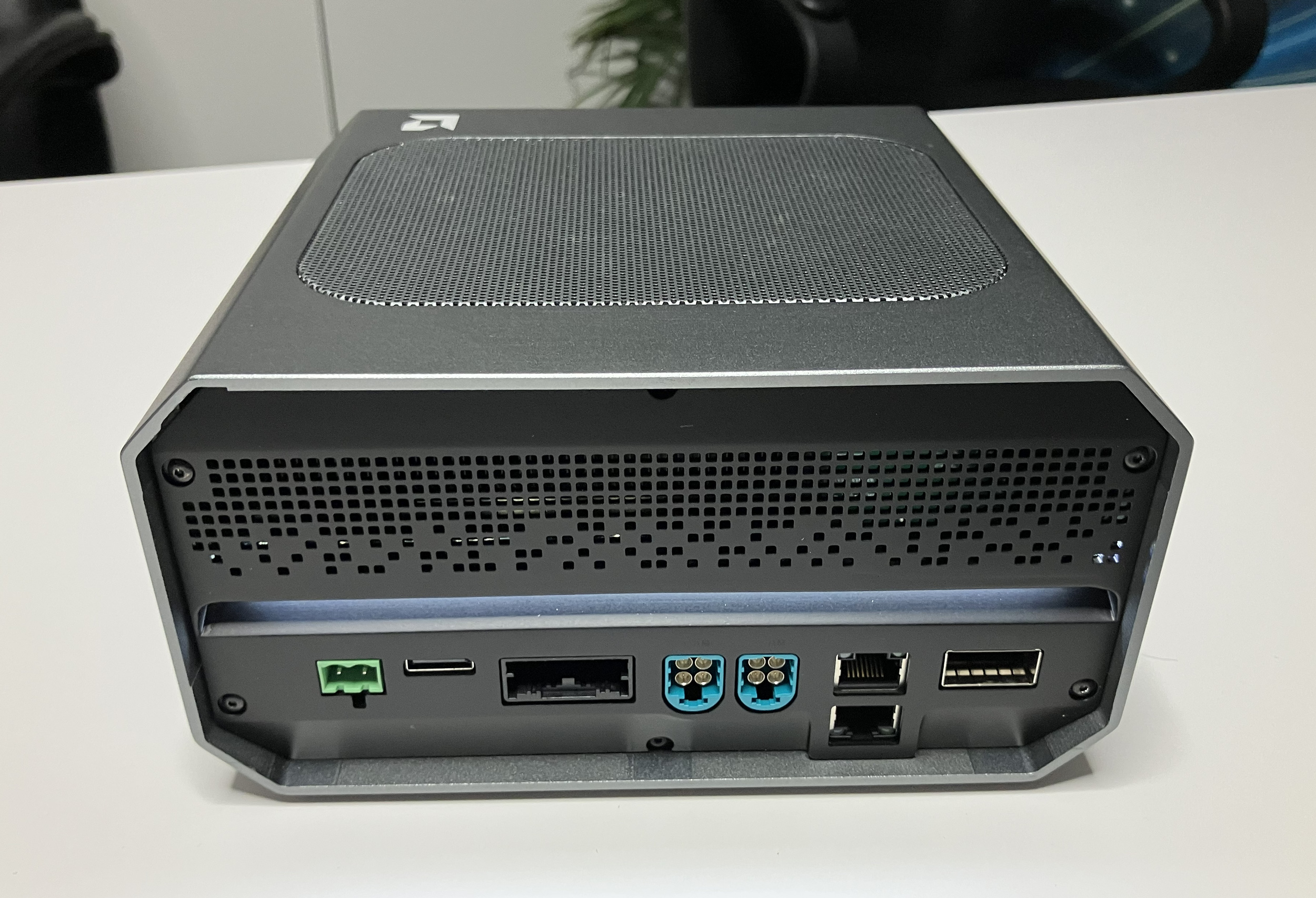
AMD’s hardware ambitions for the physical AI market do not end with just the Kria SOM, either. The company will also be producing a complete development platform based on the SOM (which is based on the X100 SoC), which they will call the Kria AI Robotics Development Platform.
The next step up from a single SOM, the Kria dev box is designed to fulfill the need for a complete, turn-key development kit for the Kria AI platform. Rather than requiring developers to cobble together systems from an SOM or work entirely in simulations, the dev kit is intended to give developers everything they need to start development right away. If the Kria AI SOM is AMD’s answer to NVIDIA’s Jetson boards, then the Kria AI dev kit is their answer to NVIDIA’s Jetson dev kits.
Under the hood, the Kria AI dev kit is a multi-tier product, and quite literally so. The heart of the system is, of course, the Kria AI SOM, which, unlike the standalone boards, will be an AMD-produced board using their “golden reference” design with an X199 SoC. That SOM, in turn, will sit atop an AMD-supplied carrier card that provides the rest of the functionality to flesh out the SOM into a complete system.
In terms of networking, this will include multiple 5GbE ports and even a 10GbE port, which will be exposed as a QSFP port. For more generalized I/O, there will be 5 USB-C ports (2x USB4 + 3x USB 3.2) and even a pair of USB-A ports. The biggest addition here is a separate Spartan UltraScale+ FPGA, which will drive real-time sensor fusion and other tasks that have traditionally fallen within the domain of programmable logic.
The end product, then, is a robust robotics development kit that offers not just significant processing power but also ample connectivity to match what a deployed robotics system would need. This includes multiple camera inputs, a Molex Mini50 connector for GPIO, and even an OCULink connector for external PCIe connectivity.
Ultimately, the Kria AI dev kit will be a much smaller-volume product than the individual Kria modules, but it will underscore AMD’s strategy for growing its physical AI market share. It is not enough to just offer the modules. They need to give developers the tools and designs to build complete systems from it. Which the dev kit will be an important piece of that puzzle.