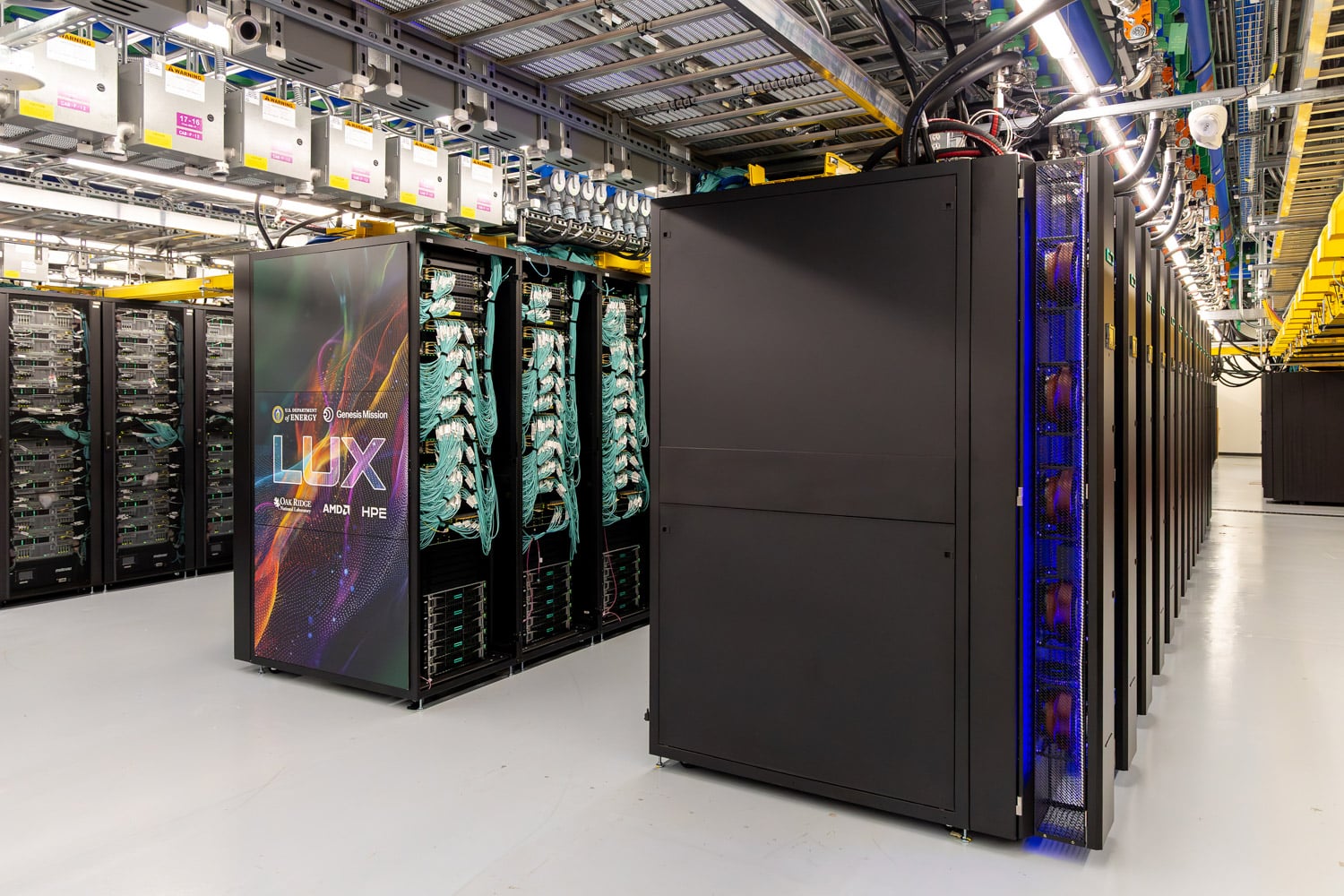
AMD has outlined its role in two planned Oak Ridge National Laboratory supercomputing platforms, Lux and Discovery, positioned to support the U.S. Department of Energy’s Genesis Mission. The initiative brings together national laboratories, industry, academia, and other partners to apply AI, simulation, and scientific data to energy, discovery science, and national-security research.
Lux, under construction at Oak Ridge National Laboratory in Tennessee, is expected to become the first fully operational Genesis Mission platform. Funded projects are expected to begin using the system in October 2026. The system is intended to provide a unified environment for conventional high-performance computing workloads and cloud-native AI services.
Combining AMD GPUs, CPUs, and Networking
Lux will combine AMD Instinct MI355X GPUs, AMD EPYC CPUs, and AMD Pensando networking. AMD said the platform will support scientific workflows from instrument data capture through model development, simulation, and AI-assisted analysis. Planned integrations include the American Science Cloud, autonomous laboratory environments, digital twins, persistent AI services, and future workflows spanning CPUs, GPUs, and quantum processors.
The architecture reflects a broader DOE objective of shortening the path from experimental data and large-scale simulations to usable scientific insights. Initial target areas include energy research, materials science, medicine, advanced manufacturing, and national security. Potential use cases cited by AMD include critical-mineral recovery, fusion energy, hydropower, flood response, and electrical-grid resilience.
AMD also highlighted Frontier, the existing AMD-powered system at Oak Ridge, as an example of how to combine AI and HPC resources for research workflows. According to AMD, researchers have reduced a plant-imaging analysis workflow from 168 hours to less than one minute on Frontier. The system is also supporting materials research related to tritium production for future fusion-energy systems.
Discovery is planned as a subsequent exascale-class platform developed with the DOE, Oak Ridge National Laboratory, and HPE. Per ORNL, it will run 6th Gen AMD EPYC “Venice” CPUs and AMD Instinct MI430X GPUs on a DAOS-based HPE Cray Supercomputing platform, with delivery expected in 2028. That makes Discovery the flagship home for the MI430X, the sovereign-AI and HPC member of the MI400 series, paired with the same Venice CPUs coming to the broader server lineup. AMD described it as a long-term system that will extend the work of Frontier and Lux by more tightly integrating large-scale simulation, AI, and data-intensive scientific workflows.
Thomas Zacharia, senior vice president at AMD, characterized Lux and Discovery as open and interoperable platforms designed to combine simulation, AI, data, and emerging computing approaches. AMD said it is working with funded research teams to identify workloads suited to Lux and establish measurable, repeatable outcomes for Genesis Mission projects.