AMD capitalizes on AI momentum with systems strategy for open-source and hybrid technologies
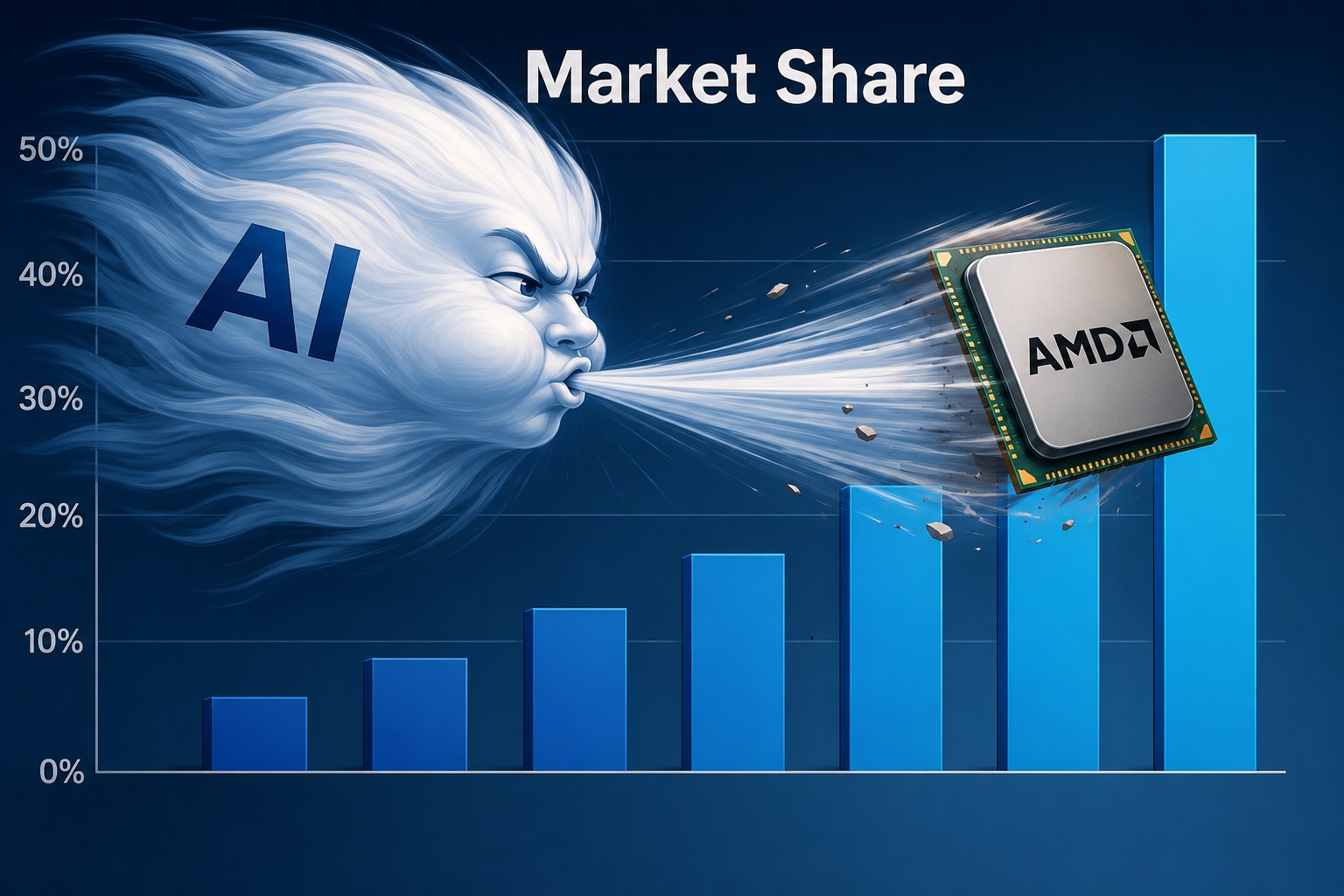
For Advanced Micro Devices Inc., artificial intelligence has provided a significant tailwind in the server processor market. Five years ago, AMD’s slice of the x86 server processor business stood at 8%. Today, the chipmaker claims a robust 46% revenue share, and it continues to grow. Leaps such as this don’t happen because of mere luck. While the tide of enterprise adoption of AI has lifted many boats, AMD’s current strength in the market is the result of a deliberate strategy to make the transition from a chip designer into a rack-level system optimizer.
This required an ability to support an emerging operating model based on hybrid AI. AMD’s understanding of systems-level thinking, and its execution of new products that capitalize on the need for open infrastructure, have positioned it as a legitimate competitor to Nvidia Corp.’s AI dominance.
“Hybrid AI is often described as a deployment model, but for enterprise buyers it’s really an operating model,” said Krista Case, principal analyst and practice lead of cyber resilience and security for theCUBE Research. “Organizations are deciding where sensitive data lives, how models are governed, and how AI-enabled business processes recover when something goes wrong. AMD’s growing ecosystem across servers, networking, storage, and software positions it to participate in that broader enterprise conversation instead of competing only on silicon.”
This feature is part of SiliconANGLE Media’s exploration of the architectural shifts powering continuous, production-grade AI. Be sure to check out SiliconANGLE’s exclusive coverage of the AMD Advancing AI 2026 event, featuring conversations with AMD executives, customers, developers and partners focused on enterprise AI infrastructure, open ecosystems and AI deployment. ( Disclosure below.)*
Key provider for server processor market
AMD’s rapid climb has written a new chapter of success that tech companies with its kind of longevity seldom see. Founded in 1969, the firm’s early years were marked by the “boom and bust” cycles that plagued semiconductor startups in the 1970s and ’80s.
Competition from Japan and rivalries with Intel Corp. and National Semiconductor Inc. forced AMD to diversify its product offerings early and fostered a successful move into the nascent microprocessor market. However, the company faced mounting financial pressure in the years between 2007 and 2016 as it struggled to integrate a costly acquisition and compete against Intel’s Core Processor lineup.
In 2014, the company’s valuation was barely $3 billion, and it was losing market share to Intel and a graphics card upstart named Nvidia. All of that began to change with the appointment of Dr. Lisa Su as AMD’s next president and CEO.
“AMD’s history is one of the epic stories in the technology industry,” said theCUBE Research Chief Analyst Dave Vellante. “This early pioneer was a highflier that, at one point, stood on the brink of disaster. It became a premier provider of x86 silicon and was the David to the Intel Goliath, setting new performance and cost efficiency standards for general-purpose computing. Under Dr. Su’s leadership, it has transformed into a premier player in high-performance and AI computing, and is now knocking on the door of the trillion-dollar market valuation club.”
Embracing ROCm flexibility
AMD’s rise to prominence in the AI industry has been fueled by a series of astute business decisions. One of these was a commitment to the Radeon Open Compute or ROCm open-source software stack.
ROCm is geared to harness and program AMD GPUs for AI and high-performance computing. It is the firm’s answer to Nvidia’s CUDA architecture, supporting AI and high-performance computing across a growing range of data center and client platforms. It provides enterprises with a path to route workloads to the most cost-efficient compute tier without replacing existing x86 infrastructure.
This level of flexibility has turned out to be a key differentiator in enterprise AI adoption. TheCUBE Research AppDev findings reveal that 92% of organizations are now integrating AI into at least one stage of the software development lifecycle, while 72% report that open, interoperable ecosystems accelerate production deployment by reducing integration complexity and minimizing dependency on proprietary platforms.
“AMD’s evolution in the AI market reflects a broader transition from competing solely on silicon performance to delivering an integrated AI platform that combines accelerated compute, open software, and ecosystem partnerships,” according to Paul Nashawaty, practice lead and principal analyst of application development, modernization and cloud-native at theCUBE Research. “The company’s continued investment in the ROCm software stack, expanding GPU portfolio, and commitment to open standards positions AMD as a credible alternative for enterprises seeking greater flexibility in AI infrastructure.”
Developing hybrid architectures
The company’s embrace of ROCm open-source software will become particularly important as enterprises seek to run AI in multiple locations. With the vast majority of data being created at the edge, enterprises are increasingly adopting hybrid IT models to power agentic AI.
AMD’s approach is to develop hybrid AI architectures that can efficiently balance CPU and GPU resources within an infrastructure that meets power envelopes. The company’s Helios rack-scale AI platform offers a prime example of this strategy.
Introduced at the Open Compute Project Summit in the fall of 2025, Helios features 72 MI450 GPUs and delivers 1.4 exaFLOPs of FP8 performance, supported by 31 terabytes of HBM4 memory and 1.4 petabytes per second of aggregate memory bandwidth. Helios is viewed as a market rival to Nvidia’s Grace Blackwell and Vera Rubin systems, and OpenAI Group PBC and Meta Platforms Inc. have committed to large-scale deployments of MI450-based infrastructure, with initial systems built on AMD’s Helios rack-scale architecture.
The Helios open AI reference platform will be powered by AMD Instinct GPUs, EPYC CPUs and Pensando advanced networking. It represents the positioning of AMD’s portfolio to meet what is expected to be major demand for agentic AI support.
“In the agentic flow, where you’re running multi-system agents, the first step you do when an agent request comes in [is] you need to start planning … that’s a combination of CPU and GPU,” according to Suresh Andani, corporate vice president for compute and enterprise AI at AMD, in a recent interview with theCUBE. “Then you’ve got to go execute that plan, which involves a lot of orchestration, which is a serial job — it’s not a parallel job that GPUs do well. All of that tool execution is optimized on a serial architecture like a CPU versus a massively parallel architecture like a GPU. If you don’t do that, your very expensive GPUs are sitting idle, and that is a waste of money.”
Growing partner ecosystem
As it has positioned its product set for the agentic AI era, AMD has also pursued an expansion of its partner ecosystem.
In February, AMD announced a multiyear strategic partnership with Nutanix Inc. to jointly develop a full-stack AI infrastructure platform for powering agentic AI applications. The initiative included a $150 million investment in Nutanix common stock and up to $100 million in additional funding for joint engineering and go-to-market initiatives, along with optimization of Nutanix Cloud and Nutanix Kubernetes Platforms on AMD CPUs and GPUs.
AMD has also continued to expand its 20-year collaboration with Dell Technologies Inc. In May, AMD released its Instinct MI350 PCIe card, which offered customers a way to leverage large GPU accelerators for AI inferencing within existing data center infrastructure. The announcement paired the new PCIe card with Dell PowerEdge servers, offering more AI compute power and performance, according to Melissa Crichton, vice president of server and AI solutions at Dell.
“We’re seeing a heavy opportunity within enterprise for PCI-based GPU workloads,” Crichton told theCUBE. “The announcement that we’re making with AMD fits right into that … using the right tech for the right workload.”
The right tech for the right workload is also a key element in AMD’s alliance with Hewlett Packard Enterprise Co. The two companies built a supercomputer for the U.S. government that can provide 16.7 exaflops of performance for artificial intelligence processing. AMD and HPE are now collaborating on a system that will provide three times the performance, using circuits based on AMD’s latest CDNA 4 GPU architecture.
Initiatives and partnerships such as these highlight the future direction of the IT industry and the evolving role of silicon systems. AMD’s development of infrastructure that can support the operational demands of AI is also defining how enterprise AI will evolve in the months ahead.
“The next phase of enterprise AI will be defined less by model selection and more by operational execution,” said theCUBE Research’s Krista Case. “Organizations need infrastructure that supports governance, resilience, and continuous adaptation as models, applications, and business requirements evolve. Vendors that combine open architectures with a strong ecosystem strategy will be well positioned as AI becomes part of the enterprise operating model rather than a standalone technology initiative.”
( Disclosure: TheCUBE is a paid media partner for the AMD Advancing AI event. Neither AMD, the sponsor of theCUBE’s event coverage, nor other sponsors have editorial control over content on theCUBE or SiliconANGLE.)*
Image: SiliconANGLE/ChatGPT
Support our mission to keep content open and free by engaging with theCUBE community. Join theCUBE’s Alumni Trust Network, where technology leaders connect, share intelligence and create opportunities.
15M+ viewers of theCUBE videos, powering conversations across AI, cloud, cybersecurity and more** 11.4k+ theCUBE alumni**— Connect with more than 11,400 tech and business leaders shaping the future through a unique trusted-based network.
About SiliconANGLE Media
theCUBE AIand theCUBE SuperStudios — with flagship locations in Silicon Valley and the New York Stock Exchange — SiliconANGLE Media operates at the intersection of media, technology and AI.
Founded by tech visionaries John Furrier and Dave Vellante, SiliconANGLE Media has built a dynamic ecosystem of industry-leading digital media brands that reach 15+ million elite tech professionals. Our new proprietary theCUBE AI Video Cloud is breaking ground in audience interaction, leveraging theCUBEai.com neural network to help technology companies make data-driven decisions and stay at the forefront of industry conversations.