Seth Godin (@ThisIsSethsBlog) attacked Amazon's search-ad model on August 18th after his publisher began paying roughly $1 per click to advertise his new book against the query "Seth Godin The Knot" - the words a customer would type when already looking for it.
Godin, the author and entrepreneur who founded Yoyodyne and Squidoo, called the system "legal theft" in a post on his blog. His argument is straightforward: Amazon controls product discovery, moves paid listings into that discovery layer, and leaves merchants buying ads to protect demand their brands created elsewhere. Godin's own marketing campaign supplied the example. His publisher found that the highest-yielding search term was the exact combination of his name and book title. (seths.blog)
The number is bigger, and less precise, than Godin says
Godin wrote that Amazon makes nearly $1 billion in profit from search ads each week and more than $50 billion annually. Amazon's disclosures support the scale of his case, though they do not support that description of the money.
Amazon reported $19.81 billion in advertising-services revenue for the quarter ended June 30th, up 26% from a year earlier. That works out to roughly $1.52 billion in revenue per week during the quarter. Advertising services generated about $76.1 billion across the four quarters ended June 30th. (ir.aboutamazon.com)
Those figures cover Amazon's broader advertising operation, including sponsored ads, display and video. Amazon does not separately report search-ad revenue or advertising profit. Godin's nearly $1 billion weekly profit figure therefore cannot be verified from Amazon's filings. His annual estimate, meanwhile, understates the revenue flowing through the broader ad business.
Godin also argued that Amazon could give each employee a $35,000 bonus with one year of ad proceeds. Amazon reported 1.595 million full- and part-time employees at the end of the second quarter. Its trailing four-quarter advertising revenue equaled about $47,700 per employee, although revenue is not distributable profit. (ir.aboutamazon.com)
Amazon sells the first screen twice
Amazon describes Sponsored Products as cost-per-click listings that can appear at the top of, alongside or within shopping results. Advertisers select products and keywords, set bids and pay when shoppers click. The ads also run on product pages and, in some cases, beyond Amazon's own store. (advertising.amazon.com)
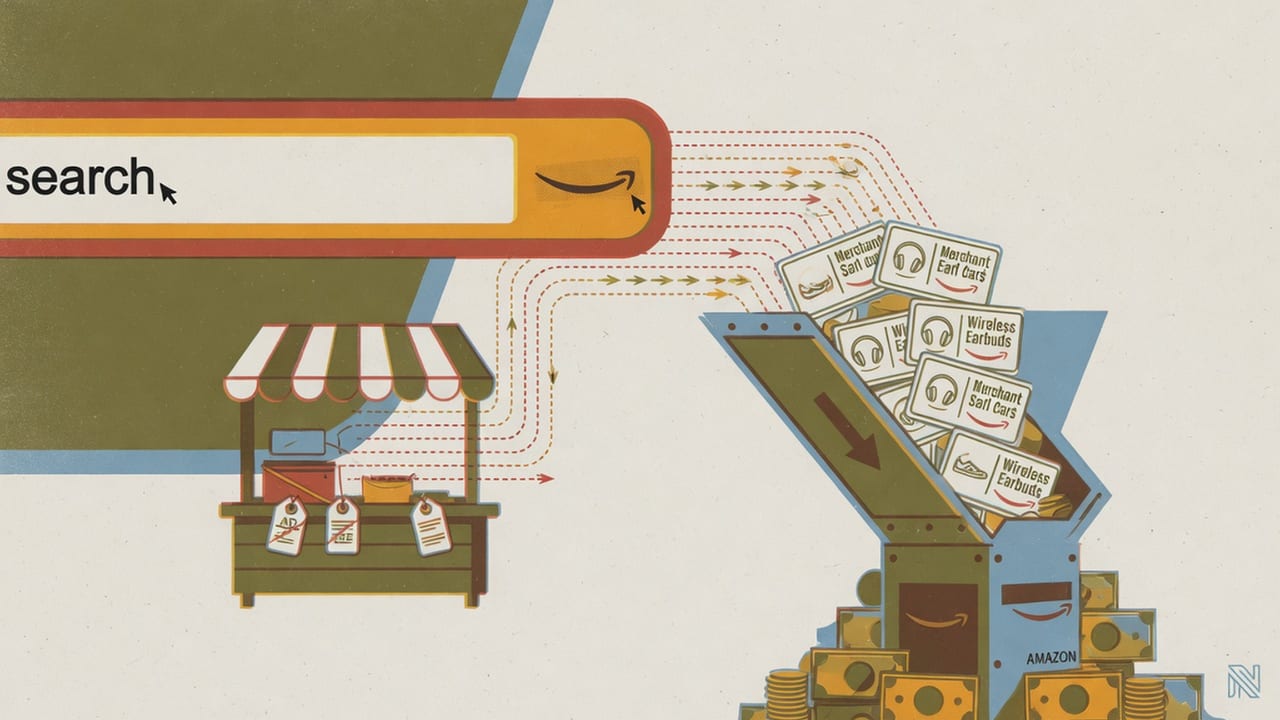
That structure creates the defensive auction Godin described. A merchant can build awareness through product quality, reviews, distribution or marketing, then face a second charge when a customer searches for the resulting brand demand on Amazon. Competitors can bid for that query. The brand can decline to bid and risk losing the most visible placement, or pay Amazon for a sponsored position above or among the organic results.
The Federal Trade Commission made a related allegation in its antitrust case against Amazon. The agency said sponsored listings had taken over highly visible search positions and pushed organic results farther down the page. A later version of the complaint cited an internal Amazon study that found sponsored products were frequently priced above neighboring organic results. Those are government allegations in ongoing litigation, rather than judicial findings. (search.ftc.gov)
Independent research has found similar effects. A 2024 study of more than 2,000 Amazon Marketplace searches found that the three most-clicked ads were, on average, 17% more expensive and one-third less relevant than comparable organic listings. The researchers found placement strongly influenced clicks, giving Amazon the ability to steer attention toward paid results. (sciencedirect.com)
Godin also cited a Management Science study based on an unnamed e-commerce platform. In a field experiment that removed sponsored search advertising for 3% of visitors, researcher Sarah Moshary found that ads shifted transactions away from organic listings and reduced total transaction volume. The ads still benefited the platform because advertising revenue exceeded the commissions lost from fewer transactions. The paper does not identify the platform as Amazon, so its results cannot be assigned directly to Amazon's marketplace. (pubsonline.informs.org)
Amazon is making the tollbooth easier to use
Amazon's incentives are visible in its product roadmap. In its July 30th earnings release, Amazon said it had expanded Ads Agent, an AI system for planning and managing campaigns, into 11 additional countries during 2026. Amazon claims advertisers using the software see an 8% lower cost per impression and a 6% lower cost per acquisition. The figures are company-supplied and Amazon did not publish the underlying sample in the release. (ir.aboutamazon.com)
The automation reduces the work required to enter and optimize Amazon's auctions. It also gives Amazon another route to capture merchant margin from the same marketplace where it controls search placement, product rankings and the transaction itself.
Godin's book campaign puts a clean price on that arrangement: about $1 for a click from a shopper who typed the author's name and exact title. Amazon can argue that the publisher chose the bid and received a measurable placement. The publisher's choice came after Amazon placed an auction inside the path between an existing customer intention and the product that matched it.
For brands built on Amazon, advertising is increasingly part of the cost of remaining visible. For brands that create demand elsewhere, Godin's example shows that bringing a customer to Amazon may still produce another acquisition charge at the final search box. Amazon gets paid either way.