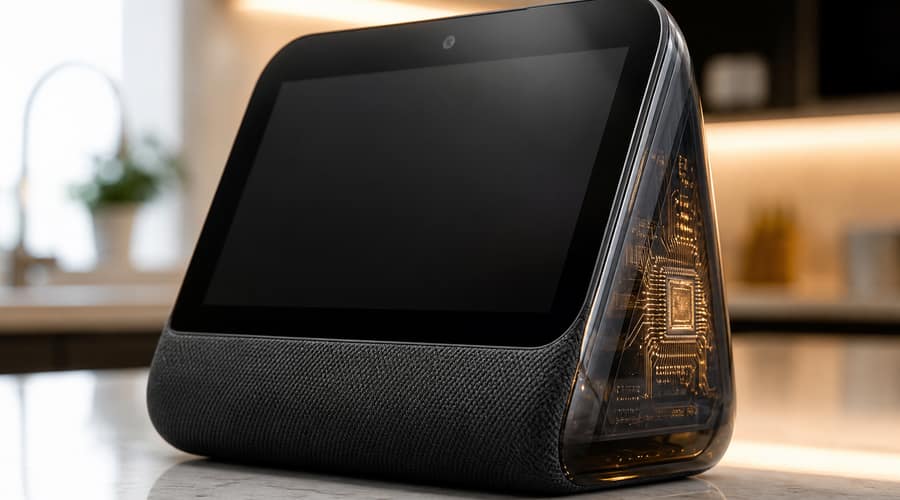
Amazon just confirmed what it has been building quietly for years: its own silicon, purpose built to run AI on your kitchen counter instead of in a data center hundreds of miles away.
Panos Panay, Amazon's head of devices and services, told CNBC's "The Tech Download" podcast this week that the company designs its own chips end to end for the hardware it ships. "We do make our own end-to-end silicon for the devices that we ship," he said, naming the Echo Show 8, the Echo Show 11 and Fire TV as devices already running on it. That's not a small admission. It puts Amazon in the same conversation as Apple, a company that spent a decade convincing the industry that owning your silicon is how you own your product.
The chips in question are the AZ3 and AZ3 Pro, which Amazon introduced in October 2025. You won't find them marketed on a spec sheet the way a processor speed used to be bragged about in a laptop ad. Instead they sit quietly inside the newer Echo lineup, doing work that used to require a round trip to Amazon Web Services.
Take wake word detection, the unglamorous but critical job of figuring out when someone actually said Alexa instead of just clearing their throat. Amazon says the AZ3 chip, paired with a new microphone array in the Echo Dot Max, improves that detection by more than 50%. The more capable AZ3 Pro, running in the Echo Studio, Echo Show 8 and Echo Show 11, goes further, adding support for vision transformers and language models so the device can process what its cameras and microphones pick up without shipping raw data to the cloud first.
All of that feeds Omnisense, Amazon's sensor fusion platform. It pulls together camera, audio, radar and ultrasound data on the device itself, which is what lets an Echo Show notice you walked into the room and adjust what it's doing, rather than waiting for a spoken command it has to send off for interpretation.
Panay's comments would be a modest story on their own. What makes it bigger is a separate report from analyst Ming-Chi Kuo, who tracks the electronics supply chain closely and has a strong record on hardware sourcing. Kuo reports that Amazon has picked Taiwan's Alchip as its exclusive partner for back-end chip design and testing, a deal that lets Alchip earn both engineering fees and a cut of processor shipment revenue. The plan, according to Kuo, is to extend custom silicon well past Echo and Fire TV into Kindle, Alexa-enabled hardware, Blink cameras and Ring doorbells, with the rollout beginning in 2027 and annual shipments eventually reaching 40 million units.
Forty million chips a year is not a hobby project.
Kuo also points to a number that gives the whole strategy a different flavor: Amazon's free cash flow fell 95% year over year in the first quarter of 2026. Custom silicon is expensive to design but cheap to run at scale once it ships, and it cuts the ongoing cost of leaning on cloud inference for every wake word and every camera frame. Frankly, that math matters more to Amazon's board than any line about smarter speakers.
Qualcomm and other silicon vendors have supplied processors inside Echo and Fire TV devices for years, and they aren't being cut off overnight. But the direction is clear, and it mirrors what Google concluded when it built its own Tensor chips for Pixel phones, and what Apple concluded a decade earlier with the Mac. Whoever controls the chip controls the latency, the cost per device, and how much of the AI workload has to touch the cloud at all. Amazon is late to that decision compared to Apple. It's making it at a scale few others can match, given how many Echo and Fire TV devices already sit in people's homes.
For consumers, the near-term effect is speed and a bit more privacy: fewer data trips for the assistant to hear you correctly, faster response on camera-based features. For the smart home business, it changes who has leverage. A company that designs its own chips doesn't need a processor vendor's roadmap to match its own, and it doesn't pay margin on someone else's silicon at 40 million units a year. Amazon has talked about ambient computing for a decade. This is what it looks like when a company decides to build the chip itself, rather than wait for someone else to. Also read: Macron and Modi Are Personally Courting Tech CEOs to Win the AI Infrastructure Race • Startups Are Racing to Put AI Data Centers in Orbit Before Big Tech Gets There • Micron Breaks Ground on a $9.3 Billion Bet to Crack SK Hynix's Grip on AI Memory