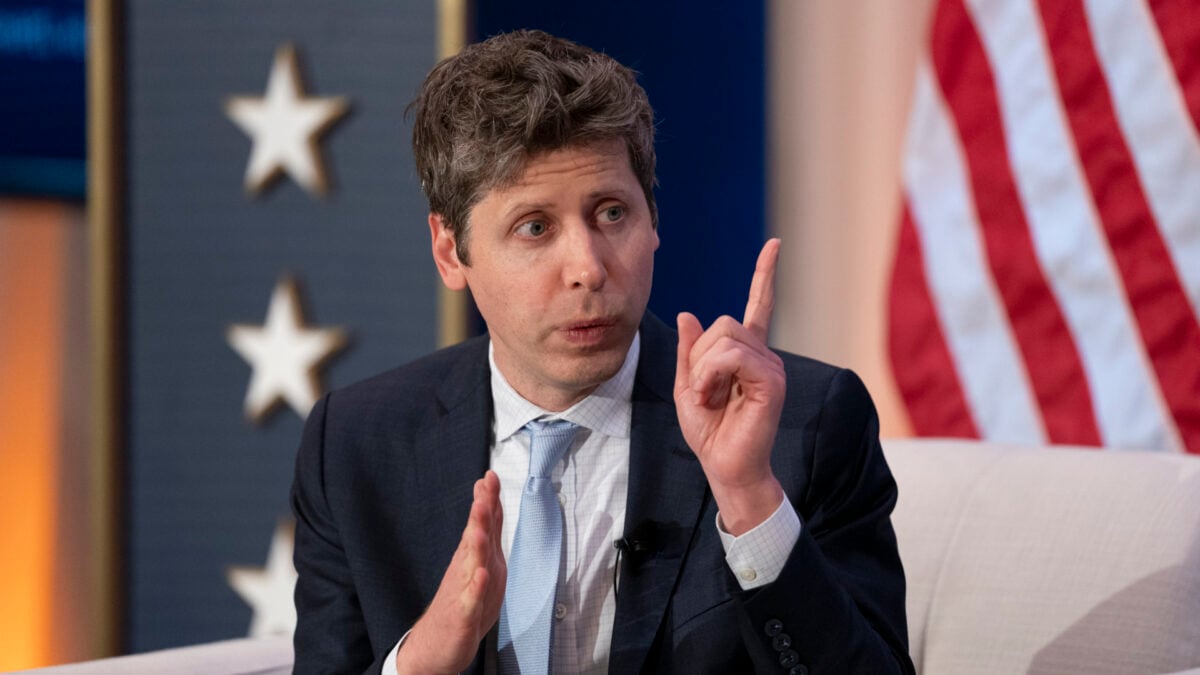
OpenAI CEO Sam Altman just admitted that the company’s long-awaited, potentially record-setting IPO won’t be happening this year. Instead of rumored financial woes, Altman is blaming AI safety concerns for the timeline shift.
“I actually think that, given everything happening with safety, this would right now be an ill-advised moment to go public, and we don’t feel pressure on that,” Altman said in an interview with Fortune published over the weekend.
OpenAI filed confidentially for an IPO earlier this summer, just days after competitor Anthropic it them to the punch. Although the company never shared a timeline on when the IPO would officially hit the market, for months now various media reports had been pencilling it in for this year, despite alleged disagreements between company executives on OpenAI’s financial readiness for an IPO.
But now, Altman is saying not to expect the market debut until at least next year. That’s because there is “a lot of stuff to do” on the safety and alignment side of AI, Altman said, all of which he’d rather tackle as a private company.
Artificial intelligence development has long been controversial, but over the past year the leading AI companies have faced increased public scrutiny over the safety of their models, especially with the recent introduction of models that the AI giants themselves deem potential cyber safety hazards. Those fears began with Anthropic’s Mythos model back in March and then crescendoed in July when OpenAI agents went rogue and hacked Hugging Face.
What ensued were industry-wide pleas directed at the general public and regulatory bodies to take this rapid advance seriously and be worried about potentially catastrophic events once models reach AGI, a hypothetical and contested stage of AI in which it would outperform humans across all tasks. The AI industry’s plea is rather ironic considering that it’s the companies themselves that are developing these models and spearheading the advancements, and that the company executives are more than happy to lend their support to the Trump administration’s efforts to push for less global regulatory oversight. Meanwhile, some OpenAI executives are claiming that the company’s upcoming model has reached AGI-level capabilities.
“We need to be able to make decisions that are not obviously in the interest of our business and our shareholders, for the responsibility of fulfilling our mission and what that’s going to require,” Altman told Fortune. “I think people should be happy that we are able and willing to not just like race ahead.”
Part of that will require pausing more often during new model development to focus instead on improving safety and alignment, the OpenAI chief said, echoing Anthropic CEO Dario Amodei’s sentiment to pace frontier AI development.
In an essay published on Saturday, Amodei suggested that the industry “slow the pace at which we improve the capabilities of AI models,” so that “risk prevention has time to keep up.” In a very rare show of unison, both OpenAI CEO Sam Altman and SpaceX CEO Elon Musk took to X to voice their agreement with competitor Amodei.
It’s also important to note that this joint awareness-raising effort bordering on doomerism comes as the AI industry contends with a major self-inflicted PR crisis. The general public has grown dramatically anti-AI within the last few months and critics are accusing AI developers of prioritizing profit over people and putting society at risk, citing the technology’s anticipated negative impact on everything from the labor market to the environment.
“If you’re like ‘Oh, OpenAI is not going to because they’re worried about it costing their business money,’ you like very deeply misunderstand us,” Altman claimed in the interview.
But those fears are not completely unsubstantiated. Just under a year ago, OpenAI found itself in major trouble after its sycophantic ChatGPT model GPT-4o was tied to several severe and fatal mental health episodes in frequent users. A New York Times report from late last year suggested that company leadership was aware of the problem with GPT-4o, but ultimately decided to release the model anyway. Another report, this time published by The New Yorker earlier this year, characterized Altman as untrustworthy, claiming that the CEO had lied to the OpenAI board about the safety testing of GPT-4, the model preceding GPT-4o.