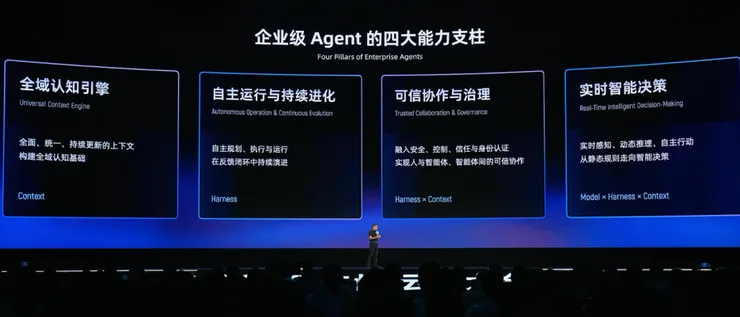
The latest updates from the 2026 Apsara Conference show AliCloud is pivoting toward "Agentic Cloud," focusing on the infrastructure needed for agents to move past simple Q&A into autonomous planning. They've released a suite of tools—AgentCore, Agent Sandbox, and a new CPFS storage layer—specifically designed to handle the massive compute and context requirements of agents that use recursive self-improvement (RSI) and long-term memory.
How they are handling the RSI compute bottleneck #
Scaling models from trillions to ten-trillion parameters requires a different kind of stability. AliCloud is using the Lingjun Zhenwu M890 super-node (their first domestic 100k-card cluster) to support models like Qwen3.8 Max and KIMI K3, both of which exceed 2T parameters.
The upcoming V900 super-node looks even more aggressive:
- Performance: 3x increase over previous versions.
- Connectivity: 200Pbps communication bandwidth.
- Latency: 6us cluster architecture.
- Scale: Supports 1,000-card Scale-Up interconnects, with single clusters expanding up to 500,000 cards using SNPO all-optical interconnects.
Solving the "GPU waiting for data" problem with CPFS #
They've updated their high-performance storage (CPFS), which is critical for multi-modal data processing. The new version hits 100PiB for single file system scale (a 5x increase) and delivers 100TB/s throughput. In real-world training, this reportedly cuts model startup time by 50% and boosts peak compute utilization by 30%, while slashing storage costs by 69%.
On the inference side, they've launched Tair KVCM to manage KVCache across Mempool and remote storage. This achieves a 99% effective hit rate and drops the cost per token by 50%. Their KV CacheStore (on the G3.5 storage layer) is handling the massive cache loads from long-context agent tasks, expanding the cache coverage window by 900% and reducing first-token latency by 54%.
Scaling Agent deployment with AgentCore and Sandbox #
To move agents into production without them being "probabilistic" and unreliable, AliCloud introduced AgentCore. It's a governance platform that standardizes agent infrastructure, specifically handling:
- Long-running tasks with failure retries and breakpoint recovery.
- Asynchronous execution.
- Resource isolation and full-link auditing.
They claim this setup increases task completion rates to 99% while cutting TCO by 70%. For the runtime environment, Agent Sandbox allows for 100,000 creations per minute with wake-up times under 600ms, compatible with both E2B and K8s. They also have Agentic OS, which reportedly saves over 30% in token consumption and triples sandbox deployment density.
Turning enterprise data into real-time context #
The "Context Engine" is their attempt to turn fragmented data into a usable state for agents. This involves a three-tier stack:
-
Storage: Handling video frames, point clouds, and trajectories.
-
Processing: Data integration and quality modeling.
-
Context Engineering: Using the Agent Context tool to increase retrieval accuracy by 50 percentage points and improve token efficiency by over 3x.
They've also updated the surrounding ecosystem: OpenLake reduces TCO by 38% through a unified multi-modal lakehouse, Apsara Lakebase allows sub-second zero-copy data branching, and MC-MaxFrame has improved multi-modal compute performance by 12%. For real-time triggers, Flink Streaming Agent now provides over 60 multi-modal operators.
Finally, for those doing post-training, the PAI platform now supports asynchronous AgenticRL. In practice with Qwen models, they managed to complete a SOTA model post-training cycle in just 5 days.
Next Google AI Studio Build Agent keeps hitting a quota error despite zero usage →
All Replies (3) #
Want a live back-and-forth? Join the global AI chat room — login to talk. I want to try this tonight. My current setup chokes on recursive self-improvement, so a dedicated CPFS layer might finally fix my latency.
Skeptical that CPFS storage actually solves the bottleneck. Most local agents fail at planning long before the hardware hits a limit.
I'm curious if this AgentCore suite handles multi-model orchestration. It's useless without a way to swap between Qwen3.8 Max and smaller distilled models.