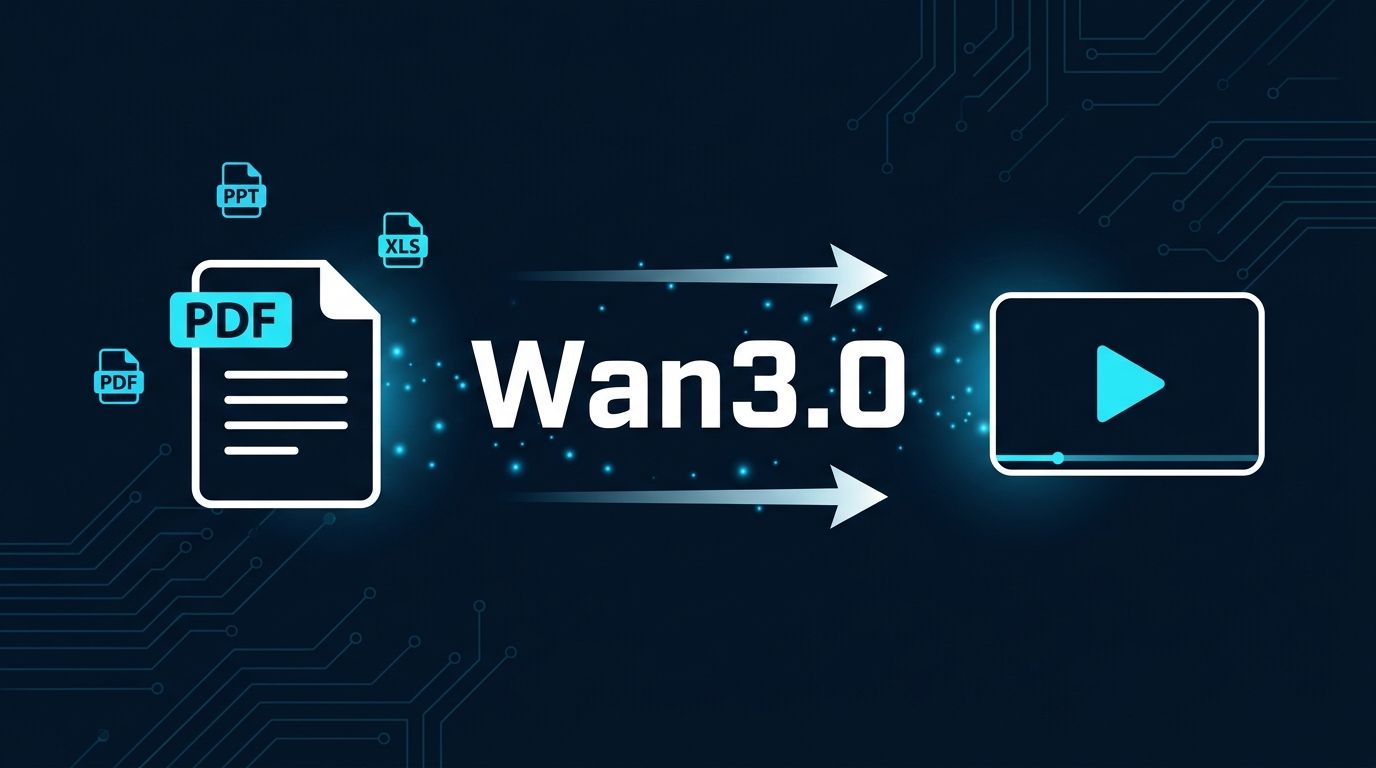
Alibaba launched Wan3.0 on August 24. The headline feature is not a marginal quality bump — it is a new input type: hand it a PDF, a spreadsheet, or a slide deck and it returns a 30-second 1080p video with audio generated in the same pass. That is not something Veo 3.1 or Kling 3.0 can do. The API is live on Alibaba Cloud Model Studio right now.
The Feature That Actually Matters: Omni-Reference #
Every AI video model in 2026 accepts text prompts and most accept a reference image. Wan3.0 goes further with what Alibaba calls Omni-Reference: you can feed it up to 20 assets in a single request — images, video clips, audio files, or structured documents.
The document support is the part worth paying attention to. Wan3.0 accepts DOC, XLS, PPT, PDF, TXT, MD files and even raw webpage URLs. It parses the document’s actual structure — headings, bullet points, table values — rather than treating the file as a flat screenshot. The result is a video that follows the logic of the source material, not just its visual layout. Documents are capped at 50 pages per input asset.
The practical use cases are straightforward: a sales pitch deck becomes a 30-second product walkthrough, a quarterly report becomes a brief recap video, an onboarding manual becomes a training clip. No other major video generation API handles structured business documents as native source material. The Omni-Reference spec goes deeper if you want to see what 20-asset requests look like in practice.
API Access and What It Actually Costs #
The model is available as wan3.0-video
on Alibaba Cloud Model Studio and Qwen Cloud. Pricing is billed per output second by resolution:
- 480p: $0.05 per second
- 720p: $0.10 per second
- 1080p: $0.20 per second
A full 30-second 1080p clip costs $6.00. At 480p, Wan3.0 is currently the cheapest native-audio video API available.
The API uses an async workflow: POST a task, receive a task ID, and poll until the result is ready. Generation typically takes one to five minutes. One gotcha worth flagging before you start: your API key, endpoint URL, and model region must all match. Cross-region calls fail silently. Available regions are Beijing and Singapore.
Alibaba describes “full API access” as coming soon — the current programmatic interface is functional, but documentation is still catching up. Plan for some trial and error on the integration side. The official API reference has the current endpoint specs.
How It Compares to the Active Alternatives #
The AI video generation API field thinned out in 2026. OpenAI shut down the Sora Videos API in April. What remains is a short list of production-ready options:
| Model | Price/sec | Native Audio | Document Input |
|---|---|---|---|
| Wan3.0 (480p) | $0.05 | Yes | Yes |
| Wan3.0 (1080p) | $0.20 | Yes | Yes |
| Veo 3.1 Fast | $0.15 | Yes | No | | Veo 3.1 Standard | $0.40 | Yes | No | | Kling 3.0 | $0.09–$0.14 | No | No |
If you need audio and are cost-sensitive, Wan3.0 at 480p is hard to beat. If output quality is the top priority, Veo 3.1 remains the benchmark for cinematic polish. If you need to minimize costs and can add audio separately, Kling 3.0 is cheapest overall.
On the Open-Source Question: Do Not Hold Your Breath #
Wan 2.2 — released July 2025 — is the last confirmed open-weight release from the Wan series, available under Apache 2.0 on Hugging Face and GitHub. Wan3.0 shipped with no public weights, no Hugging Face checkpoint, and no ComfyUI node.
Alibaba has not given a timeline. The community’s skepticism is earned: Wan 2.5 was supposed to be open and went closed; Wan 2.6 shipped as a paid API only. If your architecture requires self-hosting the video model, the working answer today is Wan2.2. Build your pipeline around that and treat a Wan3.0 open release as a bonus if it arrives.
What to Do Now #
If document-to-video automation is on your roadmap, Wan3.0 is worth evaluating this week. The API is live, the pricing is concrete, and the document-input capability is the most practical take on AI video for business workflows that exists right now. The official GitHub repo has examples and is being updated actively. Keep your expectations calibrated: this is a beta, “full API access” is still arriving, and quality reports at 1080p are mixed. But for teams that have been waiting for a video generation API that understands a PDF without requiring a human to summarize it into a prompt first, Wan3.0 is the first real answer to that problem.