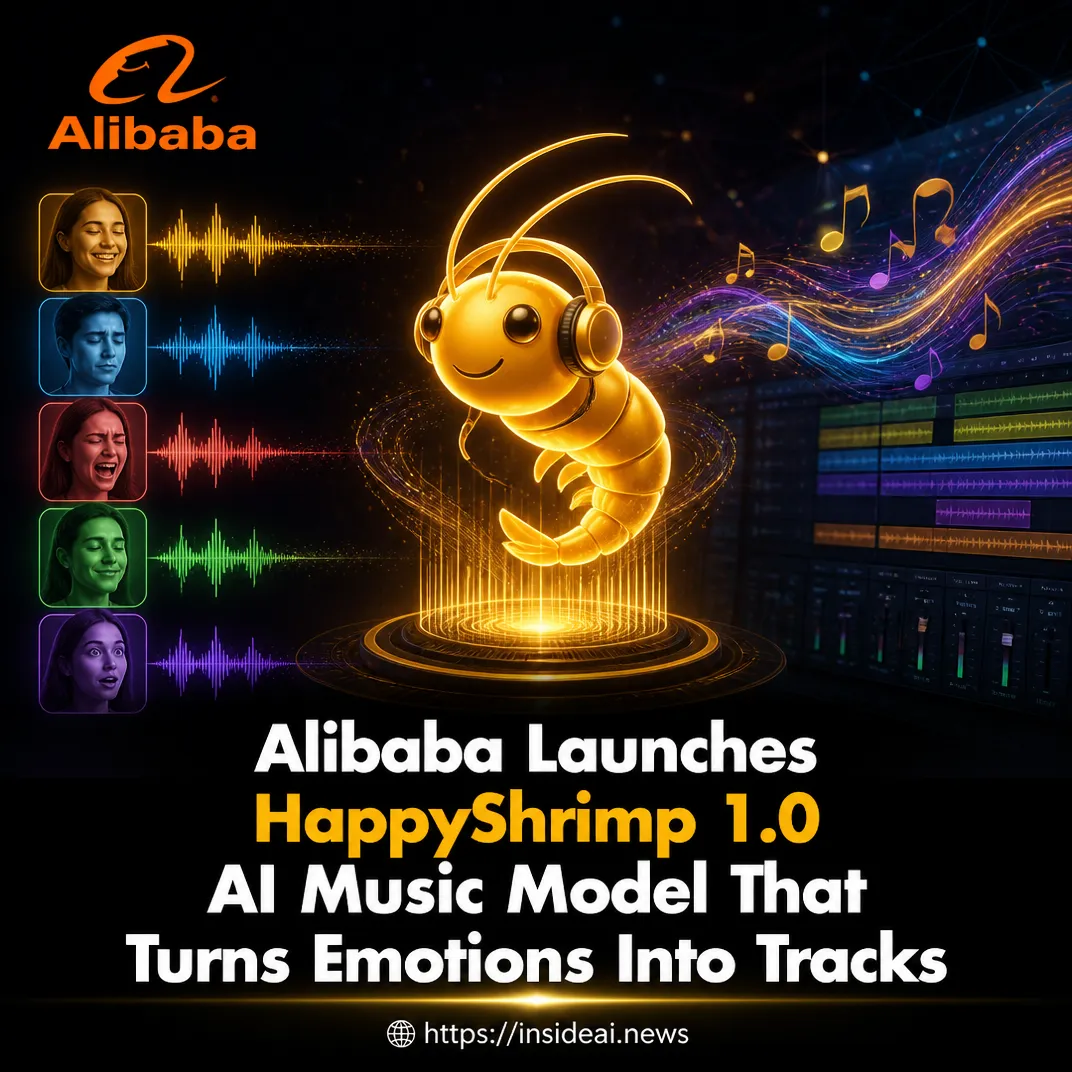
August 18, 2026, (Inside AI) — Alibaba has officially launched HappyShrimp 1.0, an AI music model that converts emotions, stories, or memories into complete music tracks through natural-language prompts. The launch moves HappyShrimp from an earlier reported project into a publicly available product.
Alibaba has not disclosed detailed information about the model's technical architecture, usage limits, or commercial pricing. The announcement came through Chinese tech media, but the company has kept key specifications under wraps.
The model's core promise is emotional translation. A user can type a sentence like "the quiet sadness of a rainy afternoon in Shanghai" and receive a full musical composition. This marks a shift from traditional AI music tools that rely on genre tags, tempo settings, or reference tracks.
HappyShrimp enters a crowded field. Google's MusicLM, Meta's MusicGen, and Stability AI's Stable Audio have all demonstrated text-to-music generation. But Alibaba's focus on emotional and narrative prompts suggests a different product philosophy, one aimed at casual creators rather than professional composers.
The name itself is unusual for a serious AI product. "HappyShrimp" evokes playfulness, perhaps a deliberate contrast to the technical seriousness of competitors. It also follows Alibaba's pattern of whimsical naming, like its Tongyi Qianwen large language model, which translates to "seeking truth through a thousand questions."
Alibaba's quiet push into creative AI tools #
Alibaba has been steadily expanding its generative AI portfolio. The company already offers Tongyi Wanxiang for image generation and Tongyi Tingwu for audio understanding. HappyShrimp adds music generation to that stack.
This launch also reflects a broader trend among Chinese tech giants. Tencent has invested heavily in AI music through its QQ Music platform. ByteDance has explored AI-generated background music for short videos. Alibaba's entry signals that music generation is now a strategic priority, not an experiment.
The timing is notable. Chinese regulators have been tightening rules around AI-generated content, requiring clear labeling and content moderation. Alibaba's decision to launch publicly suggests it has addressed compliance concerns, though the company has not detailed its moderation approach for music that could carry emotional or political subtext.
Pricing remains a critical unknown. If HappyShrimp is free or low-cost, it could quickly attract a large user base in China's massive short-video and livestreaming economy. If it is tied to Alibaba Cloud credits or enterprise contracts, adoption may be slower.
What HappyShrimp must prove to survive #
The technical challenge is real. Generating music that genuinely reflects a specific emotion or memory requires more than melody generation. It demands an understanding of cultural context, harmonic conventions, and even lyrical meaning across languages.
Alibaba has not published a technical paper or benchmark results for HappyShrimp. Without that transparency, it is impossible to compare its output quality against Suno, Udio, or other leading music models. That silence may be strategic, but it also invites skepticism.
Copyright is another unresolved issue. AI music models are often trained on large datasets of existing songs, raising questions about derivative works. Alibaba has not disclosed its training data sources or whether it has licensing agreements with music publishers.
The launch also raises questions about artist displacement. China's music industry employs hundreds of thousands of composers, arrangers, and session musicians. A tool that turns a sentence into a finished track could disrupt that labor market, especially for background music in games, ads, and short videos.
For now, HappyShrimp is a product without a public demo, a pricing page, or a technical whitepaper. The name is memorable, the concept is compelling, but the substance remains unproven. Alibaba has entered the AI music race. Whether it can compose a hit remains to be heard.