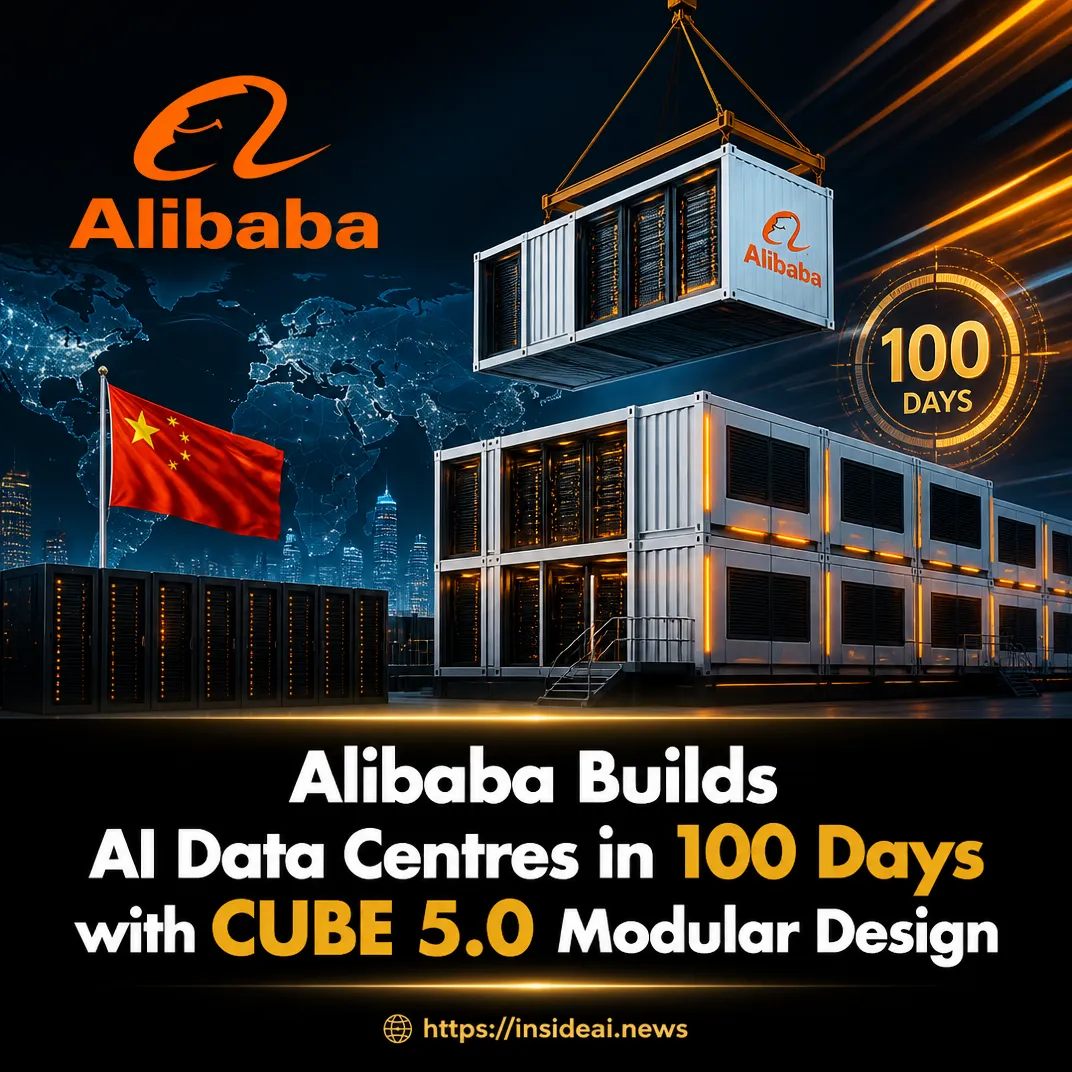
August 11, 2026, (Inside AI) — Alibaba Cloud can now build large-scale AI data centres in just 100 days, slashing traditional timelines by up to 85 percent while cutting construction costs by 10 percent. The breakthrough comes from its proprietary modular architecture, CUBE 5.0, which boosts prefabrication rates to 90 percent across five critical systems.
This speed disrupts an industry where domestic Chinese builds typically take six to 12 months, and US projects stretch from 12 to 18 months. The acceleration addresses a global bottleneck: AI compute demand is outpacing data centre supply, delaying model training and deployment for enterprises and cloud providers alike.
Alibaba’s modular approach splits infrastructure into factory-built components manufactured simultaneously, then shipped in container-like units and assembled on-site like building blocks. This contrasts with traditional sequential construction, where power, cooling, and IT systems are installed step by step, often causing cascading delays.
How CUBE 5.0 rewires data centre physics #
CUBE 5.0 modularises power supply, cooling, security, intelligent management, and fire protection. The leap from 30 percent modularity in earlier versions to 90 percent means nearly the entire facility is prefabricated. Factory production eliminates weather dependencies and reduces on-site labour, which has been a persistent constraint in both Asian and North American markets.
Alibaba first unveiled CUBE 5.0 in 2024, but the 100-day delivery claim, reported by state-backed China Securities Journal, signals operational maturity. The system likely integrates liquid cooling directly into modules, a necessity for high-density GPU clusters from Nvidia and domestic Chinese alternatives. Pre-integrated cooling loops avoid the retrofitting headaches that plague legacy data centres trying to support H100-class hardware.
Cost savings of 10 percent may seem modest, but they compound at hyperscale. A single 100-megawatt campus can cost over $1 billion; a 10 percent reduction frees up capital for additional compute. Alibaba’s approach also aligns with China’s push for domestic AI infrastructure independence amid US chip export controls, making rapid deployment a strategic imperative.
The hidden risks of speed at scale #
Modular data centres are not new. Microsoft experimented with prefabricated “IT PACs” over a decade ago, and Google has used modular designs internally. However, achieving 90 percent modularity for AI-specific facilities introduces fresh challenges. Factory-built power and cooling modules must perfectly match on-site grid connections and water availability, variables that differ wildly by region.
Supply chain fragility also looms. Simultaneous factory production requires a steady flow of transformers, chillers, and switchgear. Any disruption, like the ongoing global shortage of medium-voltage equipment, could idle factory lines and erase time savings. Alibaba’s integrated supply chain in China may mitigate this, but the model’s exportability to other regions remains unproven.
Thermal validation is another concern. AI clusters generate concentrated heat loads exceeding 50 kilowatts per rack. Prefabricated cooling modules must be tested at full load before shipping, but on-site assembly tolerances can create micro-leaks or airflow imbalances that degrade efficiency over time.
Alibaba’s announcement intensifies competition with Huawei and Tencent, both investing heavily in modular infrastructure. It also pressures Western hyperscalers to rethink construction timelines as AI capital expenditure balloons. Whether CUBE 5.0 becomes a blueprint for global AI infrastructure or remains a China-specific solution depends on real-world deployment data, which Alibaba has yet to share publicly.