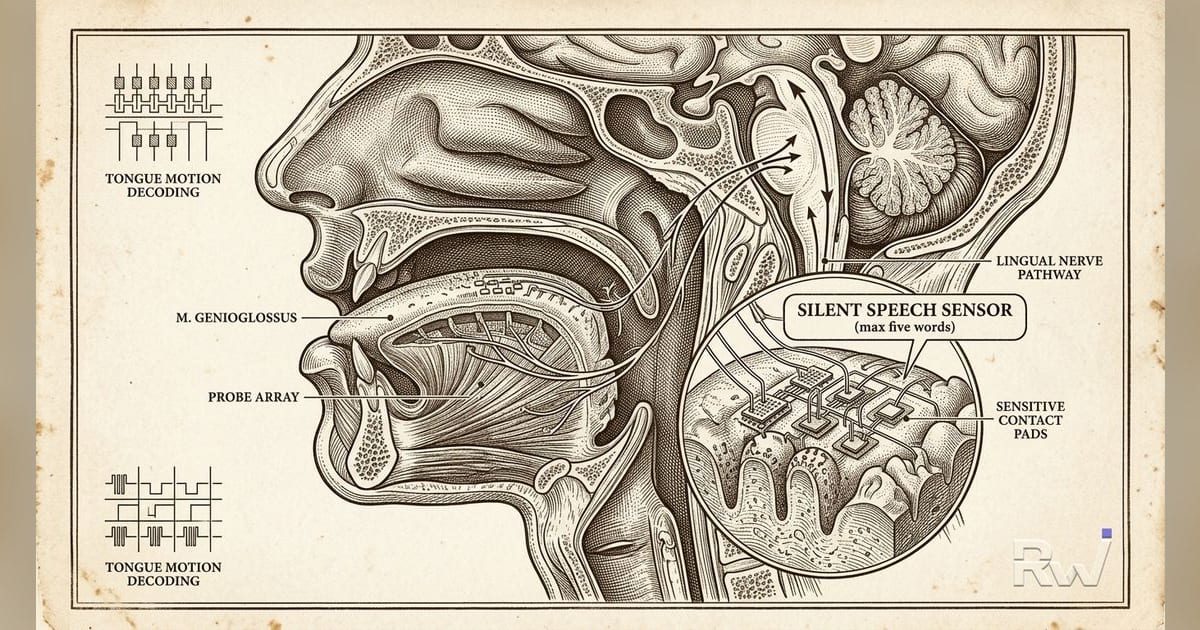
Aleph published a July 7 blog post and an accompanying thread on X showing a silent-speech prototype that places an ultrasound probe under the chin, images the tongue, and converts that motion into text.
Aleph on X: silent speech thread The team behind the post is not presented as a formal founder roster. The byline names Vadims Casecnikovs, Gimran Abdullin, Thomas Ribeiro, Jeff Brown, Marley Xiong, Raffi Hotter and Lev Chizhov. Casecnikovs' personal site says he is working on Vox Lab, described as multimodal training data for AI, and lists prior work that includes a 2.5 million-download game, an algorithmic trading project and computer vision projects using YOLOv4 and generative models. In the X thread, Aleph says the demo feels like "an earlier version of telepathy."
The important correction to the headline number is simple: Aleph's 95% accuracy claim came from an early, restricted test, not the open-vocabulary system the lab is now emphasizing. In the X thread, Aleph says it first collected a 1-hour dataset with 20 phrases and trained a simple classifier that reached 95% accuracy. The fuller July 7 post says the later prototype used about 50 hours of ultrasound tongue data and reached a 15.6% word error rate on Aleph's internal open-vocabulary, cross-speaker validation set.
That distinction matters because silent speech has a long history of impressive demos that work inside narrow phrase banks and then fall apart when users can say arbitrary words. Aleph is trying to move the problem from command recognition toward dictation. The prototype still remains an internal research system, and Aleph calls it an early prototype rather than a consumer product.
What Aleph actually measured
Aleph says the project began after the team heard about the silent-speech problem in December and asked why it remained unsolved. The initial experiment was almost physical comedy: put a transducer under the chin and see whether the tongue is visible. It was. The follow-on project, which Aleph says it ran last month, collected a 50-hour dataset designed to cover a broad vocabulary.
The system watches the tongue with submental ultrasound. Instead of decoding electrical activity from facial muscles or using a front-facing camera to read lips, Aleph's method directly images the tongue as it forms speech. The blog argues that the tongue carries a large share of speech information, saying it forms around 34 distinct phoneme classes across 40 English phonemes, compared with roughly 10 to 14 visually distinguishable lip shapes.
Aleph's training setup used vocalized speech for data collection because audio made quality control easier. Participants read synthetically generated short stories aloud while holding the probe. Aleph says its recordings showed similar tongue movement between silent and vocalized speech, so the team used audible speech plus ultrasound video to train a model that could generalize back to silent speech.
The machine-learning stack is pragmatic. Aleph says it used ResNet-18 2+1d for the ultrasound video encoder and Whisper Base for the speech decoder. The model was trained to map tongue-video embeddings into Whisper's audio-embedding space, then decode those embeddings as text. Aleph says training became meaningfully phonetic after about 20,000 samples, when errors began resembling sound-alike confusions rather than random language-model guesses.
The reported curve is the reason Aleph is publishing now. The blog says word error rate fell from 102% at 15,000 examples to 15.6% at 50,000 examples, with no sign in the chart that the curve had flattened. Aleph also compares its 15.6% WER with lip-reading at 12.5% WER on a 1 million-hour dataset, while noting that many silent-speech systems use fixed command sets, visible lip video or implanted sensors.
The benchmark should be read as Aleph's internal number. The material Aleph published does not include a peer-reviewed paper, outside replication or a downloadable evaluation set. That does not make the result meaningless. It does set the burden of proof for the next milestone: a reproducible benchmark across accents, speakers, probe placements and real silent use.
The bet is privacy
Aleph's thesis is that speech is one of the fastest ways to communicate with computers, while ordinary speech breaks down in public. Voice interfaces have improved, and AI systems are increasingly designed around natural language, but speaking to a computer in an office, train or coffee shop creates a privacy problem.
That is why the silent-speech race has pulled in several approaches at once. AlterEgo describes a non-invasive wearable that detects intentional silent speech through its Silent Sense system. Altavo is developing an AI-based artificial voice for voiceless patients using non-invasive radar sensors and closed a EUR 3 million Series A2 in January 2026. Augmental is using the mouth differently: its MouthPad is smart mouthwear for cursor and click control through tongue and head gestures.
The closest commercial pressure point is voice dictation. Wispr Flow raised a $30 million Series A led by Menlo Ventures in June 2025 after pivoting away from silent-mouthing hardware toward software dictation. In November 2025, Wispr said it had raised a $25 million Series A extension led by Notable Capital, bringing total funding to $81 million. That funding history is a market read on the same interface problem Aleph is attacking from the hardware side: keyboards are slow, voice is socially exposed, and AI assistants need an input method people will actually use all day.
Aleph's ultrasound route has one clean technical appeal. It looks at the articulator directly. EMG and radar infer speech from indirect signals. Lip reading needs a camera pointed at the user's face. Ultrasound under the chin can, in principle, capture tongue motion without making the user's silent speech visible to others.
The hardware gap is still the company-building problem
The demo, as published, uses a handheld ultrasound probe and ultrasound gel. Turning that into a wearable without messy coupling material is the core hardware challenge. Until that is solved, this is research apparatus with a product-shaped thesis.
There is also an accent problem. Aleph says the model generalized to new people during filming as long as they had an American accent. The team singled out that caveat in the blog and the X thread, which is the right kind of early honesty. A silent-speech device that works only for a narrow accent group would be useful in a lab and limited in the market. A device that can handle accents, changing probe placement, fatigue, whispered or mouthed articulation, and everyday movement would be a different category of interface.
Aleph has not disclosed funding, investors, pricing, a launch date, a headquarters or a consumer roadmap. That absence keeps the story in the prototype lane. The reason to pay attention is the data-efficiency claim: a month of work, about 50 hours of data, and an open-vocabulary result Aleph says is already near a much larger lip-reading benchmark.
If Aleph can turn that curve into a wearable, the company will be competing for the layer between human intent and AI systems. If it cannot, the July 7 post will still be useful as a technical marker: ultrasound tongue imaging may be a more credible silent-speech modality than the phrase-bank demos that have made this field easy to overstate.