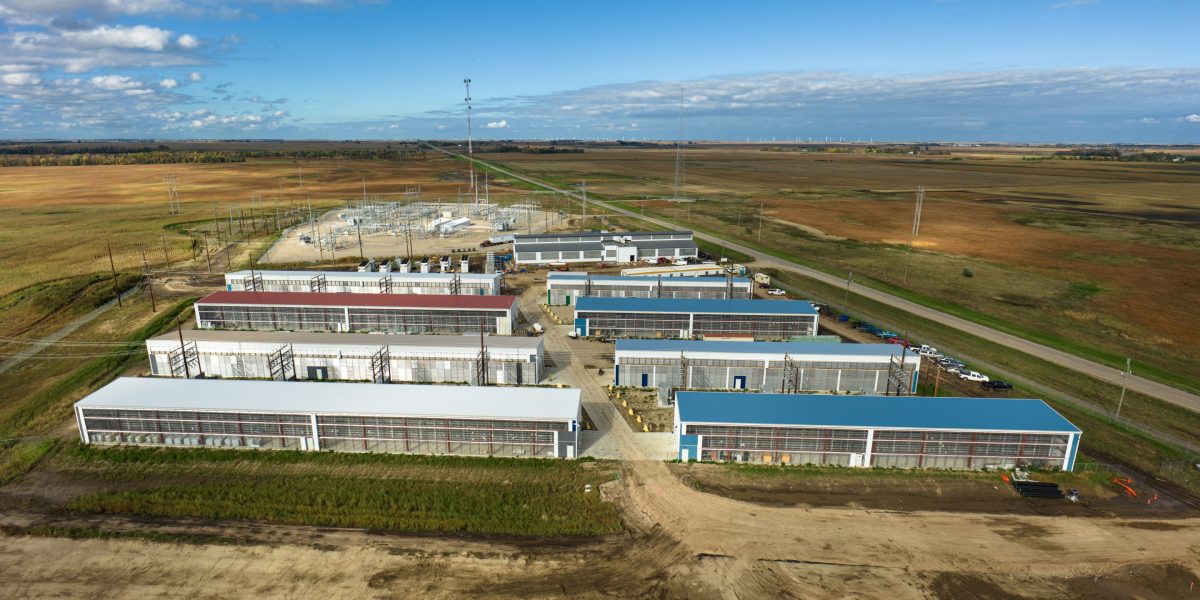
The AI revolution is leading to a massive boom in data centers. Major cloud service providers like Google, <a href="https://fortune.com/2026/07/13/meta-hyperion-louisiana-50-billion-tax-breaks-locals/">Meta</a>, Microsoft, and Amazon are engaged in a frenzied bid to keep up with the demand for AI services, and are spending hundreds of billions of dollars to compete. The money taps remain turned on full-blast even in the face of a choppy stock market and persistent fears over whether AI stocks are in a bubble.
“Hyperscalers are going to spend maybe between $750 and $800 billion [a year]. Some forecasts even have it up to a trillion, and that would put it at 2.5 to 3% of U.S. GDP, which is just extraordinary for a capital market,” John Mowrey, chief investment officer at NFJ Investment Group, said.
A considerable portion of this spending will go to data centers, which offer a pick-and-shovels options for investors looking to ride the AI wave. Fortune has identified four distinct entry points into the data center economy: semiconductor chips, real estate, energy, and cooling. Experts weighed in on which stocks stand out in each category.
Chips: The brains behind the buildout
The AI data center buildout requires several components to work, but none of it matters without a brain, and that’s exactly what semiconductors provide.
Even as companies focus on constructing the actual buildings to house these facilities, the chips that power them can’t be produced fast enough. Demand for these specialized processors that run AI workloads has outpaced the industry’s ability to manufacture them, making semiconductors one of the most acute bottlenecks in the entire buildout, according to Craig Ellis, research director and senior semiconductor analyst at B. Riley Securities.
For investors, that shortage isn’t necessarily bad news. “We’re at a point where undersupply is so severe that there needs to be a multi-year period of unusually strong capex growth in front of us, and that capex growth is something that is very investable because it has the potential to continue to lift expectations for revenues and earnings,” Ellis said.
To capture that opportunity, he recommends investors shift their attention away from chip giants like Nvidia, AMD, or TSMC, and instead toward the companies that actually supply the equipment used to make the chips themselves.
** Applied Materials (AMAT)**, the largest semiconductor equipment company in the world, is a key example. Its core Semiconductor Systems division makes up about 73% of the company’s revenue, according to its most recent annual filing, selling to the companies that manufacture chips for computing, logic, and memory. Its benefit is breadth: nearly every advanced chip and display passes through Applied’s tools at some point, spreading its exposure across the whole chipmaking ecosystem instead of betting on one type of chip.
Ellis also flagged ** Lam Research (LRCX)** as a worthy alternative. The company makes equipment for memory and storage chips, and while its product range is narrower than Applied Materials’, he sees Lam as especially well positioned to benefit from a surge in new capacity investment over the next two years, and B. Riley Securities has raised its earnings estimates for the company by 25% to reflect that outlook.
** Marvell Technology (MRVL)** is another strong contender, particularly excelling at networking, or the plumbing that lets thousands of chips inside a data center talk to each other fast enough to work as one giant machine. Despite being less of a household name, Marvell captures roughly $195 billion in market value, according to analytics company FactSet, putting it in the same weight class as Nvidia and AMD, even drawing a direct investment from Nvidia as part of a partnership on next-generation networking technology.
Right now, the bulk of Marvell’s business comes from Amazon Web Services, the cloud computing arm of Amazon. Though that relationship has been lucrative, it also means Marvell’s fortunes are somewhat tied to a single client. But Ellis sees this concentration as an opportunity rather than a red flag. If Marvell can land more of these customers and scale up its network products, he believes it could produce meaningfully more profit than it does today.
These investments don’t come without risks, however. Chip stocks are known for big price swings and can be rattled by geopolitical tensions or shifts in how hyperscalers choose to fund their spending.
Still, Ellis believes the industry is shifting from a boom-and-bust cycle into more durable, long-term growth. Even after the SOX, the main index that tracks AI-linked chip stocks, fell 26% on worries that all this spending won’t pay off, Ellis argues the drop already reflected most of that risk, making now a reasonable time to buy in. The numbers back him up: since the July 28 sell-off, Applied Materials, Lam Research, and Marvell have climbed back between roughly 22% and 30%.
AI’s physical backbone
A brain without a body doesn’t get far. Chips need physical space to operate, and that’s where real estate investment trusts, or REITs, step in. These trusts rent out climate-controlled spaces equipped with the generators and high-speed connectivity required for around-the-clock operations.
Patrick Wilson, a portfolio manager on the real estate securities team at CenterSquare Investment Management, spoke of REITs as a sound investment, given the industry’s shift from the AI training phase to the inference phase, or the stage where models move from being taught to being actively used for daily queries. While the initial training of AI models happened in large rural data centers built for cheap land and power, running those models day to day works best in facilities close to major cities, where shorter distances help cut latency, or the time delay between a request and a response. Because established REITs already control the limited, “carrier-dense” real estate in these urban centers, they stand to capture this next wave of demand better than anyone else.
REITs are also built to be tax efficient for ordinary investors. As Wilson put it, “REITs are only taxed once, provided that they satisfy IRS tax rules. So, if they pay out 90% of their taxable net income into a dividend, there’s no corporate level tax that they pay,” Wilson explained.
To capture this opportunity, he pointed to two REIT behemoths, ** Equinix (EQIX) and Digital Realty (DLR)**. Equinix is a large landlord for internet and cloud computing, running data centers that host servers for thousands of companies, from Fortune 500 firms to major cloud providers such as AWS and Google Cloud. Digital Realty has spent more than two decades buying and building similar facilities, benefiting from demand for secure, climate‑controlled server space that still exceeds supply. Wilson notes that this imbalance has allowed the REIT to raise rents, and that its thousands of tenants make it more stable than newer names that depend on only a few big contracts.
However, Wilson clarified that investment risks remain. Data center REITs can be hit hard by rising interest rates, which push up borrowing costs and weigh on property values. They also depend on maintaining premium rents, so a flood of new competitors could erode their pricing power. Meanwhile, there are also geographic restraints to consider. Though data centers closer to metropolitan areas are more beneficial, they are also more scarce. “They need a lot of land, and that’s not necessarily found in midtown Manhattan,” he said.
That said, Wilson still sees REITs as a safer bid compared to newer AI infrastructure firms that are heavily in debt. If AI demand slows or their short‑term customers walk away, these firms are still stuck with long‑term bills and big interest payments, which makes them much more fragile than the REITs.
Utility upside
Given the enormous amounts of electricity needed to power AI data centers, the boom has fundamentally rewired the energy sector. Andrew Bischof, utilities analyst at financial services firm Morningstar, noted how, for decades, annual electricity demand in the U.S. remained stagnant, growing at a mere 0% to 0.5%. However, AI’s power-hungry nature has supercharged this forecast and transformed the sector’s investment profile, turning what were historically low-growth yield stocks into upside vehicles.
“You’re now seeing more growth-oriented investors coming to utilities because they can provide that six to eight and sometimes 10% annualized growth over the five-year forecast,” Bischof said.
One company positioned to benefit is ** American Electric Power (AEP)**, a major public utility holding company headquartered in Ohio that, according to its website, distributes electricity to more than five million customers across 11 states. Anticipating a massive increase in data center-driven
electricity demand, AEP plans to invest $78 billion between 2026 and 2030 to build out the infrastructure needed to keep pace. Morningstar is optimistic about this buildout, citing AEP’s strong track record of completing the projects it commits to, and expects the investment to translate into 9% average annual earnings growth through 2030—a strong figure for a utility.
However, not all utility stocks are created equal. Bischof explained that in certain regions, particularly the Mid-Atlantic, the transition to supporting data centers has led to higher power prices and concerns that these increased costs flow directly down to the retail customer.
As a result, Bischof recommended utilities, beyond AEP, like ** DTE Energy (DTE)**,
Alliant Energy (LNT), and Evergy (EVRG), as companies situated in regions where there is a strong alignment between regulators and communities over the data center boom.
For a more contrarian way to play the power side of the AI buildout, David Trainer, CEO of investment research firm New Constructs, suggests looking beyond just utilities. He argues that while alternative and green energy are growing, they still cannot deliver the high-intensity power needed for massive AI data centers, leaving fossil fuels essential for meeting this demand. Because of that, Trainer sees “cheap” traditional energy stocks as a rare chance to capture the infrastructure boom at value prices, pointing to refiners like Valero (VLO) and HF Sinclair (DINO), which he believes the market is treating as if their profits are destined for a permanent 30% to 40% decline. Cooling the boom
If energy stocks are one way to profit from powering the boom, another lies in the hardware that keeps those AI factories from melting down. Data centers’ massive electricity consumption generates intense heat that standard air cooling can’t handle. Nick Lieb, industrials analyst at Morningstar, argues that this makes cooling and power equipment a very different kind of AI trade. While companies like Nvidia roll out new flagship GPUs every year or two, the core technology behind data center infrastructure evolves far more slowly, offering investors a more stable alternative. ** Vertiv (VRT)**, a long-time provider of precision cooling and power systems, is his prime example of a company built to benefit from this shift.
“Vertiv owns the original data center cooling brand called Liebert, which actually invented the original computer room air handling unit… in the 1960s. That base technology is still quite relevant today [and] sells a lot of computer room air handling units,” Lieb explained.
Lieb noted, however, that this stability is balanced by a high degree of concentration risk, given that over 80% of Vertiv’s revenue is generated directly within the data center market. Any slowdown or hiccup in spending from the major hyperscalers could also make Vertiv investors vulnerable.
For those looking for more limited exposure to the infrastructure boom, Lieb points to power management company ** Eaton (ETN)**. Only a quarter of its sales tie directly to data centers, while the rest comes from commercial structures and other segments of the broader electrical grid. This diversification gives Eaton a stronger hedge if data center growth slows. Lieb added that Eaton is uniquely positioned to benefit from a U.S. electrical grid that he describes as “old and decrepit” and long overdue for a replacement. The company produces essential hardware—specifically transformers and switchgear—required to support both new data center demand and this critical national infrastructure upgrade. Fragile foundations
Despite the AI narrative’s success, some observers are wary this surge in capital spending may not ultimately deliver the payoff many expect.
Lieb views the sheer magnitude of current spending as a potential source of long-term risk, citing how hyperscalers have reached a point where the cost of building new data centers is starting to “exceed the cash that they generate,” forcing tech giants to increasingly dip into the debt market and issue equity to fundraise.
Trainer described the current market as a “crowded trade,” making it nearly impossible to find an obvious stock that isn’t already overpriced. He warns that many of the large firms like Amazon and Microsoft currently “bragging” about their massive capital expenditures “can’t afford to stay in the race” at their current spending rates. It’s a competitive contest he contends many of the current firms lack the balance sheets to survive.
Yet the scale and potential impact of the buildout are hard to ignore.
Mowrey stressed that the data center boom isn’t just big in dollar terms. For him, it’s laying the backbone for a technology shift that could touch nearly every corner of the economy.
“AI adoption is still in its early innings… I think we’re just scratching the surface,” he said. “The broad enterprise application across healthcare, manufacturing, and financials—that’s going to take years to filter in.”
breaks the traditional barrier between audience and newsroom. The show transforms
Fortune Daily* Fortune*’s trusted reporting into actionable, conversational, and entertaining insights for an emerging class of business leaders.
Watch here.