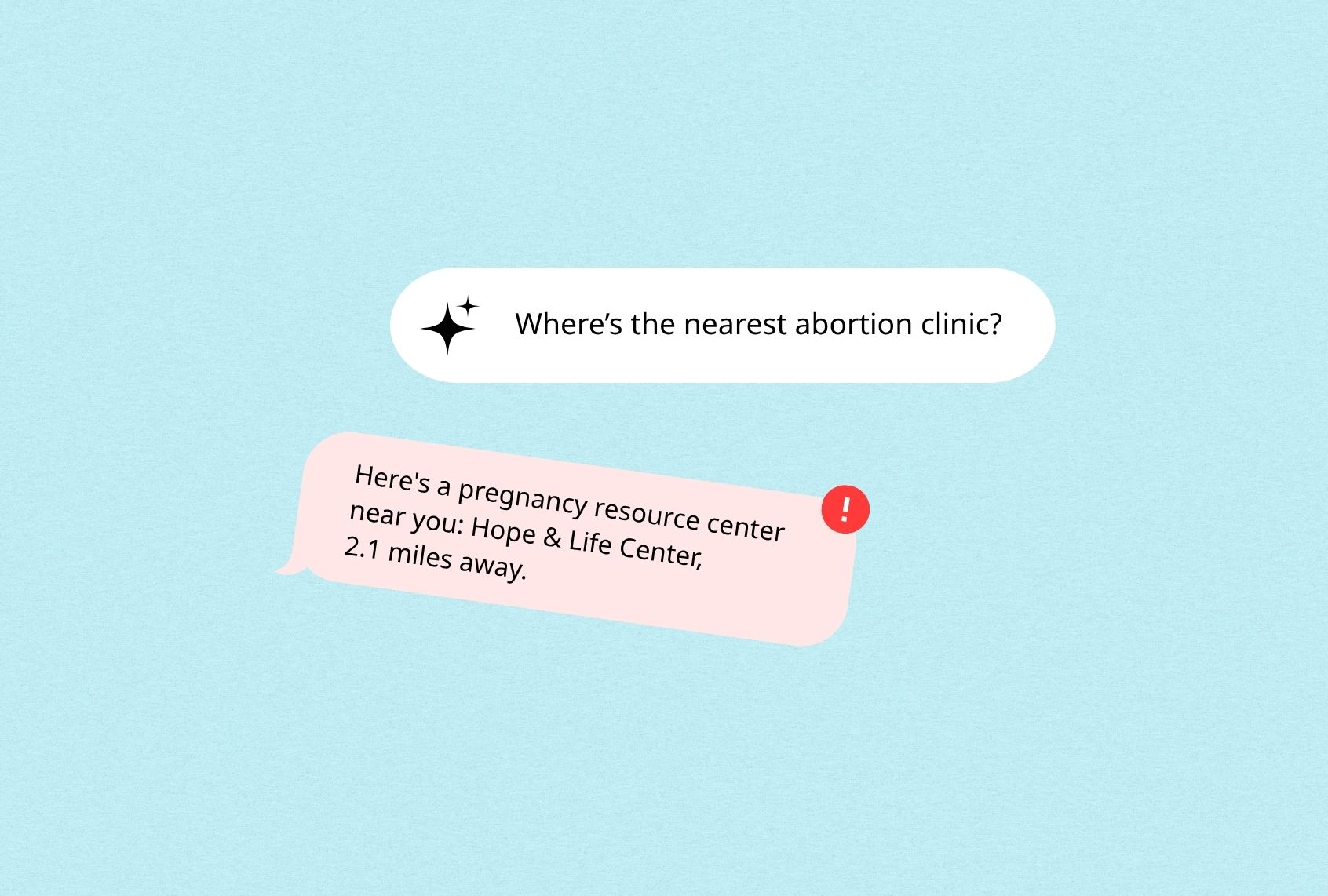
Chatbots like ChatGPT and Claude are quickly changing the healthcare landscape. An estimated one in seven people have used AI for a health-related question instead of seeing a general practitioner. One in ten people have used AI for mental health support. Within the Venn diagram of people using AI for health-related information lies a cohort for whom access to accurate information is of the utmost importance: those seeking information on abortion care. In an era when the internet is already rife with abortion-related misinformation, LLMs entering the chat have complicated the landscape — and abortion rights advocates are fighting back.
“Unfortunately, we live in a world where it feels like some days you need a law degree to even understand abortion policy and legality on any given day,” Kelly Baden, Guttmacher Institute’s vice president of policy and communications, told Salon. “And the presence of AI has complicated that even further.”
On June 24, 2022, the SCOTUS ruling in Dobbs v. Jackson Women’s Health Organization — a case that challenged a Mississippi ban on abortion at 15 weeks of pregnancy — overturned Roe v. Wade, which effectively ended the federal constitutional right to choose to have an abortion in the United States. As a result, many states enacted so-called “trigger bans.” Since then, it’s already been difficult for people searching for information on abortion care as they’ve had to wade through misinformation and anti-abortion propaganda online. Today, organizations with dedicated staff and resources to share accurate information are feeling the effects of AI’s presence. Baden said, for example, that Guttmacher Institute has an interactive abortion policy map, which is a popular resource for people to understand the laws in all 50 states. Now, with AI summaries and LLMs, Baden and her colleagues have to be creative with how they write updates to this map to ensure LLMs aggregate the information accurately.
In an era when the internet is already rife with abortion-related misinformation, LLMs entering the chat have complicated the landscape.
“Our job now is to also think about how the information that we share is getting translated by other tools that didn’t exist, or weren’t on our radar, a few years ago,” Baden told Salon. “And now, these tools are a big part of how people understand their rights and their ability to get abortion care.”
While published data on how many people are using AI to access abortion-related information falls short, many organizations are seeing referral traffic from AI. Amy Merrill, co-founder of Plan C Pills, told Salon her organization — which provides resources for self-managed, at-home abortions with pills— has seen spikes of traffic from ChatGPT to her website. Rebecca Nall, founder of I Need an A, which is a free website that helps people find abortion providers, telehealth services, financial support and travel information, said they’ve also seen referral traffic from ChatGPT. “We see in our data the referrals from AI assistants,” Nall said. “Referrals have been increasing over the last two years pretty significantly.”
Want more from culture than just the latest trend? The Swell highlights art made to last.
Sign up here The mirage of privacy and convenience could be causing more people to turn to AI for health-related information. However, when it comes to abortion care, there are concerns about AI’s ability to provide unbiased, accurate information.
“It feels like you’re dialoguing with your healthcare provider,” Merrill said. “Whereas you’re actually just talking to a tech company and giving them all your personal data, and that’s a real concern within the movement.”
In July, Open Democracy’s team of international investigative journalists found that AI chatbots were “nudging” pregnant women to anti-abortion resources. In 2025, a team of healthcare providers and researchers concluded that only 65% of ChatGPT-3.5’s responses to abortion questions were “acceptable.” A separate 2024 study found that ChatGPT was actively spreading misinformation about self-managed medication abortions. “The chatbot’s tendency to perpetuate health misinformation and associated stigma regarding self-managed medication abortions poses a threat to public health and reproductive autonomy,” the researchers wrote. This can have real-world impacts on patient care.
The mirage of privacy and convenience could be causing more people to turn to AI for health-related information. However, when it comes to abortion care, there are concerns about AI’s ability to provide unbiased, accurate information.
“Any day that you are delayed in getting the care that you need because you might have gotten confusing information, conflicting information, or wrong information potentially puts you out of reach of getting the care that you need,” Baden said. She gave an example of someone living in Louisiana, a state that prohibits in-person abortion care at all stages of pregnancy without exceptions. However, that person can still seek abortion care in Florida or Georgia before six weeks of pregnancy. “If you, for some reason, got misleading information or wrong information because of an AI model, and miss that cutoff, then you are that much farther away geographically and financially from getting an abortion that you need after six weeks.”
Nall, from I Need an A, said one of the biggest pieces of misinformation that they see come from AI is a lack of a comprehensive overview of a person’s options. While some states like Louisiana have highly restrictive laws, people can still choose to self-manage an abortion at home by receiving medication abortion pills in the mail. Abortion pills being shipped to states with bans are becoming more common. For example, in Missouri — where abortion access is highly restrictive with limited exceptions for medical emergencies— the number of medication abortions has quadrupled since 2023. “Many people are getting pills by mail in every single state,” Nall said. Nall added that they’ve seen LLMs recommend crisis pregnancy centers in restricted states as well.
The good news is that AI is currently influenced by SEO strategies. “We have been changing our language and encouraging other reproductive activists to change language on their websites,” Nall said. Advocates encourage media outlets reporting on abortion restrictions to keep in mind how their articles will affect how LLMs aggregate abortion-related information as well. Specifically, the use of the word “ban.”
“We’ve been talking about this with colleagues and journalists, but when the words ‘abortion ban’ are used, like ‘abortion is banned in Texas,’ some AI tools will interpret that to mean that there is no abortion available in any form, and factually, that’s just incorrect,” Merrill told Salon. “There’s a risk of oversimplifying, and that’s what we saw happening with the word ‘abortion ban.’”
Merrill emphasized it’s important to communicate that “in-person care is restricted,” but that people are still accessing pills by mail. When it comes to navigating the abortion landscape in the U.S. in the age of AI, she recommends website directories like PlanCPills.org, INeedAnA.com, or the Repro Legal Helpline if someone wants to talk to a human.
Nall said while she is hesitant to use the word “optimistic,” she has been seeing improvements in AI’s answers since they’ve been doubling down on their efforts to influence LLMs. However, Nall said, she wouldn’t recommend AI as a go-to source. “I highly recommend skipping Google, skipping ChatGPT, and going straight to INeedAnA.com.”
Our Summer sale ends August 31!
Read more
about this topic