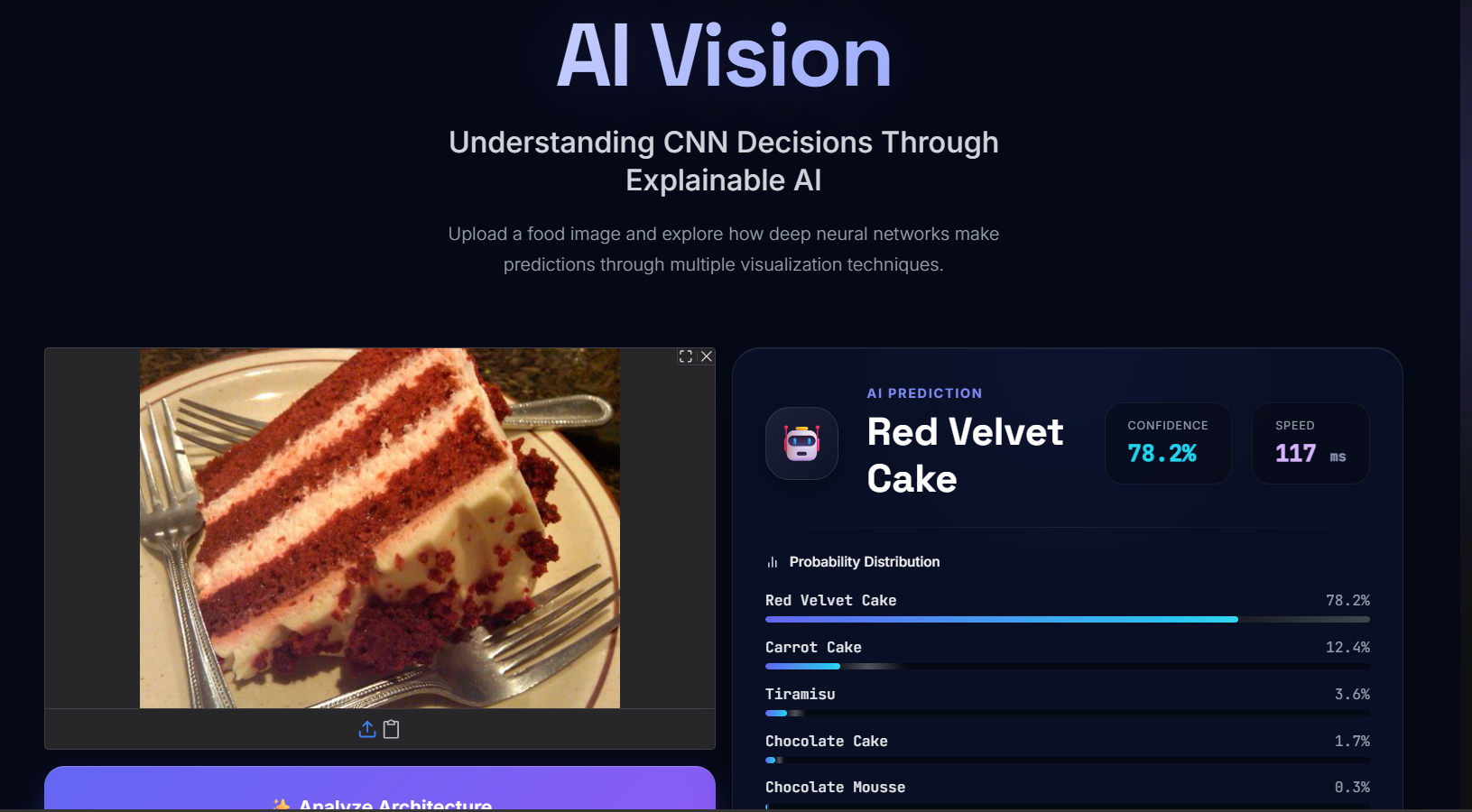
To fix this, I've been building Project AI Vision. The goal is to move away from simple prediction and toward an AI workflow that actually shows its work. Instead of a raw output, I'm implementing a layer that forces the model to justify its visual reasoning.
The diagnostic process looked like this:
-
The Failure: Inputting a photo of a beige-colored sponge or a rounded building.
-
The Output:
{"label": "cake", "confidence": 0.92}. -
The Diagnosis: The model was over-indexing on color and curvature, ignoring the texture and context of the surrounding pixels.
By shifting to a more transparent prompt engineering approach, I can now see the internal logic. If the model says "cake," it now has to specify why (e.g., "rounded shape, cream-colored surface"). When it does that, the hallucination becomes obvious because the justification doesn't match the image.
For anyone doing a deep dive into image classification, the real battle isn't increasing accuracy by 1%—it's building the observability tools to understand why the 1% failure happens. Turning a prediction into a step-by-step explanation is the only way to actually debug these agents.

[Next Ollama Scout: Testing for Exposed Endpoints →](/en/threads/3552/)