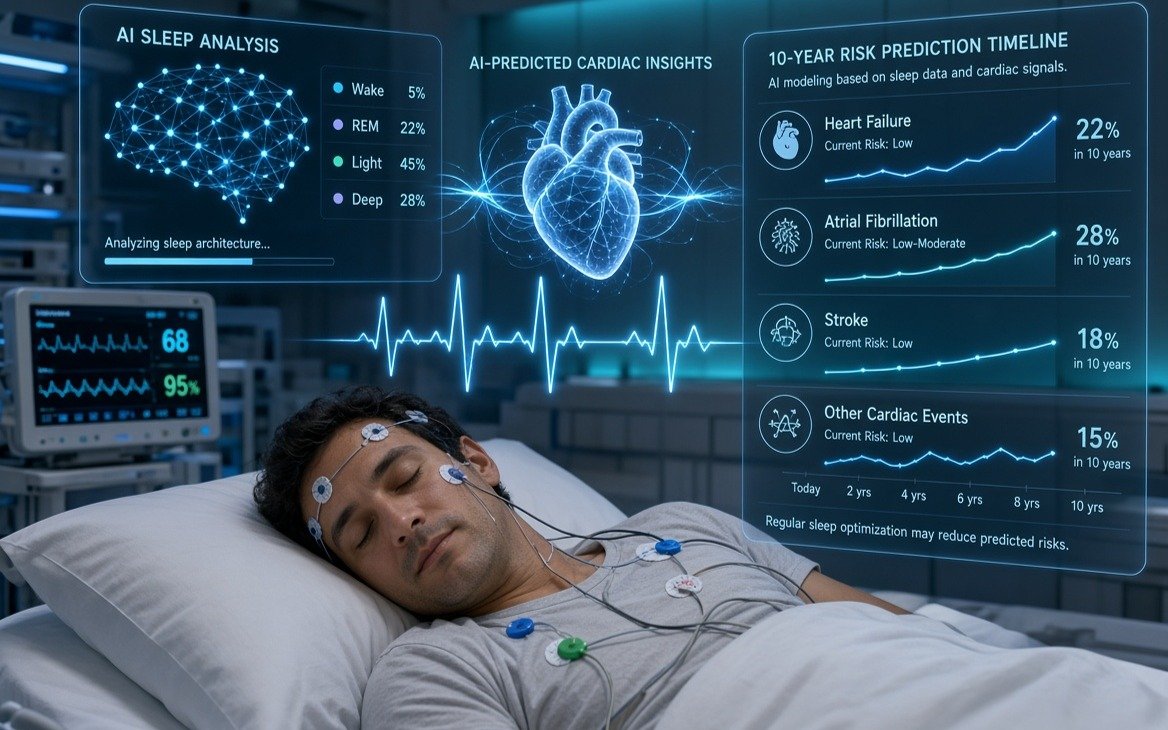
The system analyzes heart activity recorded during overnight sleep studies. Researchers found that it could identify patterns linked to future health problems, including risks that standard medical checks might not fully capture.
The study, published in the journal Sleep, used data from more than 35,000 patients at three US medical centers. Researchers trained an AI model to analyze heart signals alongside information about patients' sleep stages.
The team then tested the system on two independent groups, including 9,810 patients at Emory University Hospital and 12,576 at Beth Israel Deaconess Medical Center.
The model predicted 5 outcomes: atrial fibrillation, a condition that causes an irregular heartbeat; stroke; heart attack; heart failure; and death from any cause. Researchers tracked health outcomes for up to 10 years in one group and 7 years in the other.
The strongest results came from predictions of irregular heartbeat, heart failure and death. Adding the AI's analysis improved the accuracy of risk assessments for these outcomes beyond estimates based on established risk factors, such as age, smoking, high blood pressure and diabetes.
For heart failure, the researchers reported an improvement of about 8% to 9% in the model's ability to distinguish between people who later developed the condition and those who did not. However, the AI did not significantly improve predictions of stroke or heart attack beyond existing risk factors. The researchers said these conditions may be harder to predict years in advance using heart signals alone.
The approach could make better use of information already collected during sleep studies, which doctors commonly use to diagnose sleep disorders. These studies typically record an electrical signal from the heart, but clinicians do not routinely use it to assess long-term cardiovascular risk.
The researchers said the system could eventually help doctors identify patients who need closer monitoring or preventive care. It is intended as a screening tool, not a stand-alone diagnosis, and any concerning prediction would require further medical assessment.
Earlier, Qazinform News Agency reported that Brazil would develop an AI-based system to help monitor the condition of forests and other natural areas.