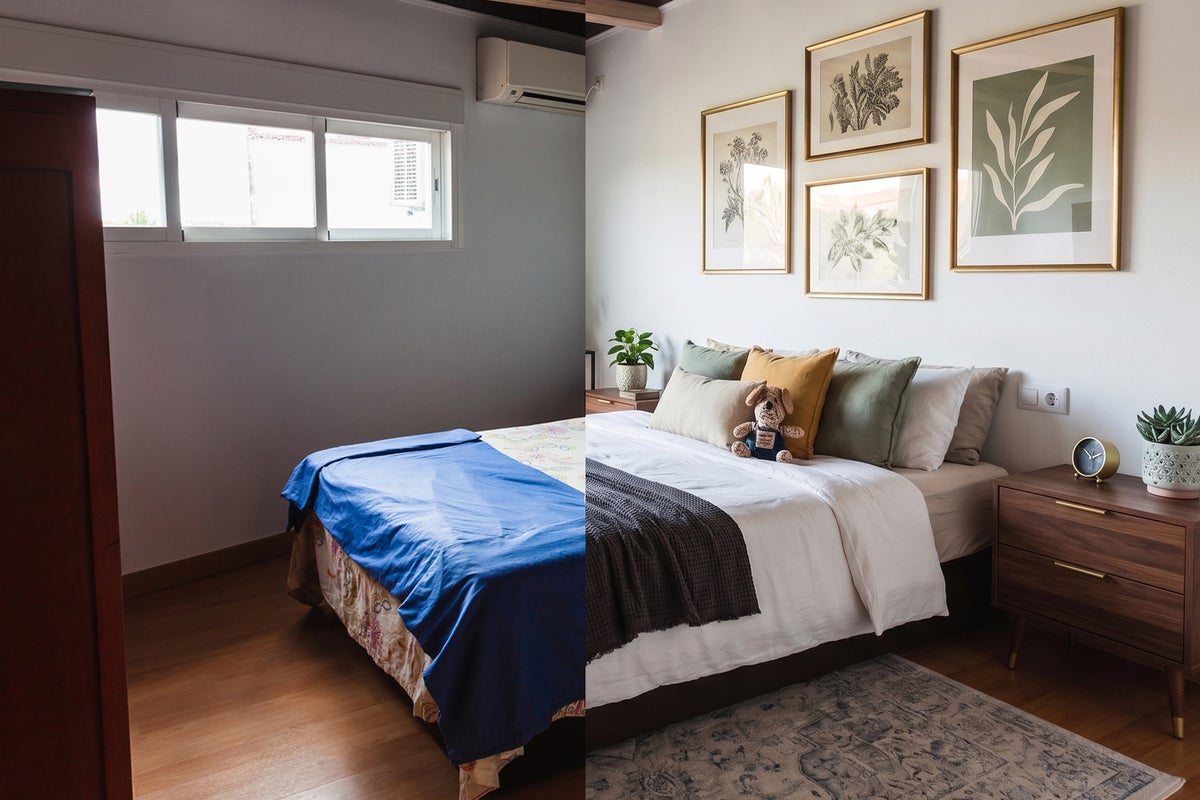
As more and more estate agents use ‘staging’ tools to give their drab properties a glow-up, Helen Coffey argues that seeing is no longer believing when looking at homes online, and wonders if the tech is having the opposite effect on would-be buyers
- Bookmark
- CommentsGo to comments
We’re all familiar with estate agents’ penchant for… “massaging” the truth. Back in the day, it was almost quaint. For “bijou”, read “smaller than a parking space”; for “centrally located”, read “located directly above a nightclub”; for “rustic charm”, read “needs complete rewiring and has a secret dry rot problem hidden behind the peeling wallpaper that will be a fun surprise to discover once you’ve already exchanged”.
Strictly speaking, these aren’t outright lies – more generous interpretations of the truth. A sort of madly optimistic, Vaseline-on-the-lens view of reality that usually completely failed to match up with the depressingly drab property presented to you.
But whatever spin they chose to put on the language, the pictures couldn’t lie, not even when someone had purposefully wobbled on tip-toes atop a stepladder in the corner of the room using a fish-eye lens. You could still see what was actually there.
Oh, to return to such innocent times! These days, it’s not just nonsense sales waffle that you have to wade through when house hunting online. Thought human estate agents were bad? Welcome to the world of AI “enhancements” currently flooding the housing market.
I first came across this phenomenon while indulging in one of my passions – idly scrolling Rightmove to see what I could afford were I to unexpectedly come by a few hundred grand. While tapping through photos of a four-bedroom house, I was struck by how nicely put together a couple of the rooms were compared to the general, run-down vibe of the place: hotel-grade sheets and expert bedmaking, homeware catalogue-level furniture and soft furnishings, colour-coordinated artwork.
As pleasing as these interiors were, my brain flagged that there was some uncanny-valley business afoot – and, sure enough, upon closer inspection, my eye was caught by the “virtual stager” caption beneath the images. The bed, the lamps, the paintings, the dresser – none of it was real. It was digital set dressing.
The more I looked, the more outraged I became. Not only did I have to be sceptical of the words I read, but I now couldn’t trust the evidence of my own eyes; seeing was no longer believing.
Several chain estate agents have admitted to using these tools to “help” buyers picture how they could use the space, including Winkworth and Wards. Half of estate agents (52 per cent) said they planned to adopt AI tools for listings, lead generation and marketing in 2026, according to research released at the beginning of the year.
“First impressions really matter, and AI virtual staging allows buyers to see the true potential of a home in an instant,” said Luke Salmon, head of marketing at Wards, when the tool was launched last year. “By making spaces more visually appealing, we will attract much more interest for our sellers, leading to increased enquiries and a higher chance of receiving an offer.”
But some prospective buyers have argued that AI has the opposite effect, tricking them into arranging a viewing, only to be sorely disappointed when they see a property in the flesh. Just as using a filter on your dating app profile pics might score you a first date but fail to lead to a second one after a disgruntled match sees the reality, so “interiors-maxxing” a house with AI might secure initial interest but fail to translate to offers. Call it flat-fishing, if you will.
One aggrieved viewer shared their experience on Reddit last month. “Should estate agents use AI to advertise a property? I got a surreal experience today”, read the post’s caption. Photos of the listing, jazzed up with AI set dressing – the same kind of thing I’d witnessed – were shared alongside real-world pictures taken by the poster. They barely resembled the same property.
The place not only looked nothing like the pictures but it was not in great condition
“My partner and I are currently looking for a house to buy, we found what looked like a lovely house in Tooting, London and decided to book a viewing,” read the post. “To our shock, all the pictures on Rightmove were AI generated; the place not only looked nothing like the pictures but it was not in great condition… we kind of laughed it off to be fair as it seemed like a joke but then felt quite upset because we took time off from work for this viewing and wasted our time to see this place.”
In some cases, the digital “furniture” that had been added covered up obvious flaws visible in the original pictures, such as an AI bedside table that hides a crudely unfinished skirting board.
The post continues: “Once we left the property and re-read the description, it did state on the bottom that ‘some’ images were enhanced with AI, we just didn’t think it was a completely different place.
“My question is, should this be allowed? Are you not misleading potential buyers?”
The post quickly garnered attention, with commenters enraged on the house hunter’s behalf. “It’s blatant lying and will only piss people off,” said one. “It’s like going dating and saying you’re 6ft tall when you’re actually 5ft 4in. As if they won’t find out.” Winkworth, the agent behind the listing, swiftly removed the AI pictures following backlash.
A spokesperson for Winkworth Tooting told The Times* *that images had been enhanced with the addition of “soft furnishings, lights and other furniture similar to using real staging furniture” but had been taken down “after a customer expressed disappointment during a viewing”.
A Winkworth Franchising spokesperson added: “All offices are required by Winkworth Franchising Limited to disclose the use of AI imagery online and on all property details.”
There is an important distinction between enhancing how a property is presented and changing what is actually being sold
In the case of the Tooting property, while the online listing divulged that AI had been used, the PDF brochure text sharing the information was in white on a white background, therefore impossible to read (this was declared an “error” by the Tooting spokesperson).
Paula Higgins, chief executive at the HomeOwners Alliance, said that, while AI staging can be a useful sales tool if it helps buyers visualise an empty room, “it must be clearly labelled and the original image should also be available.” She added: “The line is crossed when AI hides defects, makes rooms look bigger, improves views, adds features that do not exist, or adds furniture that does not fit.”
Lesley Horton, chief property ombudsman, said: “Context is key. There is an important distinction between enhancing how a property is presented and changing what is actually being sold.
“If an agent uses AI to change the property itself, for example by adding a fireplace that is not there, a new kitchen, or bi-fold doors, that is likely to give buyers a false impression.”
There are already laws around “misleading” house buyers enshrined in UK consumer law. Real estate listings are covered by the Digital Markets, Competition and Consumers Act 2024, which states that “it is an offence to knowingly or recklessly provide false or misleading information which causes a consumer to take a different transactional decision than they would otherwise have”.
Context is key. There is an important distinction between enhancing how a property is presented and changing what is actually being sold
The real legal issue here is not in adding in fake furniture, especially not when signposted online – although this will still clearly lead to some frustrated and let-down viewers – but in manipulating images to deceive, from misrepresenting the dimensions of rooms by using smaller AI furniture to removing a property’s real-world flaws or adding fictitious features.
One Reddit user commenting on a similar post bemoaning the use of AI by estate agents several months ago claimed they had seen a listing in which a non-existent bay window had been added to an interior shot.
Meanwhile, buying agent Nina Harrison revealed that a client almost went back to see the same house for a second time, believing it to be a different property – that’s how much AI had altered the photos. “It was the exact same house we’d already viewed and rejected. The photographs had been refreshed, the marketing rewritten, and it looked so different online that he didn’t recognise it,” she said.
Clearly, just as in every other sphere of life at the moment, real estate is going to see an influx of AI slop as sellers plump for a virtual glow-up of their property rather than bother with the expensive and time-intensive business of improving it for real.
That’s their prerogative, of course – but the phrase “buyer beware” has never been more apt.
Join our commenting forum #
Join thought-provoking conversations, follow other Independent readers and see their replies
Comments