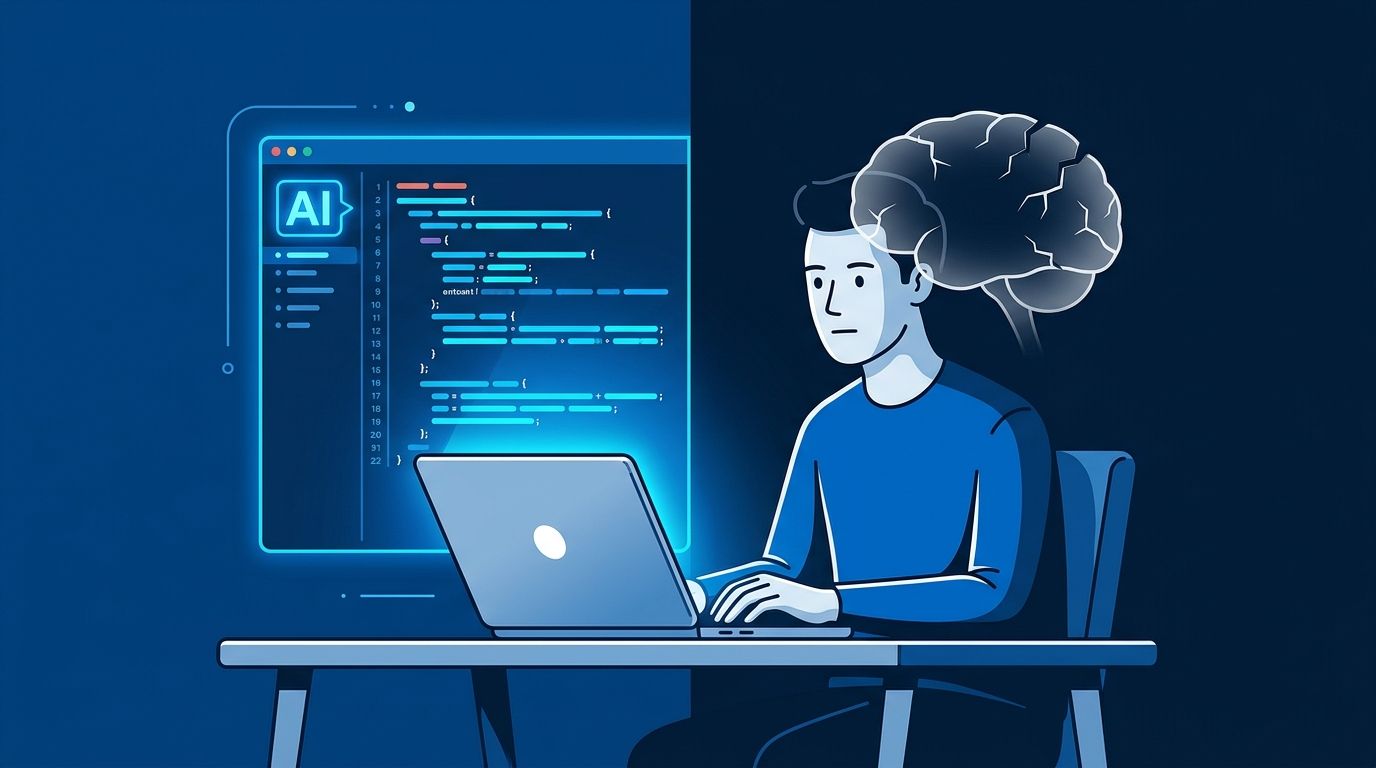
A 30-month study tracking 26,811 Chinese high school students found that AI tools boosted homework scores by 18% and cut homework time by 30%. Within six months, the same students’ monthly exam scores dropped 20%. Two years in, college entrance scores fell 18–24%. If you are a developer leaning on AI coding tools to close tickets faster, you should sit with that for a moment. The mechanism is identical.
What the Numbers Say #
Researchers from Stockholm University and the University of Hong Kong tracked every student in a county across 30 months, from September 2022 through June 2025. This was not a controlled lab study with 50 participants — it was 26,811 students across grades 7 through 12. The findings are hard to argue with.
About 80% of students who used AI showed what the researchers call “outsourcing” behavior: they completed assignments unusually fast, scored well on AI-assisted homework, and retained almost nothing for unassisted exams. The tell was the speed. Finish too fast and score too high — you are not learning, you are laundering the output.
“For students, completing these tasks efficiently is not the goal; learning from them is.”
Stockholm University / University of Hong Kong research team,[via Fortune]
Why Struggle Is the Point #
Neuroscientist Jared Cooney Horvath offers the clearest explanation: “When you use off tools as a novice, you don’t learn the skill. You simply learn dependency.” Struggle is not a design flaw in learning — it is the signal that consolidates memory. Remove the friction, and you remove the encoding. AI removes the friction with lethal efficiency.
The subjects most affected were first-year students and high performers — exactly the people with the most to lose. Social sciences dropped hardest, but STEM was not far behind. This is not a story about bad students. It is a story about human cognition.
The Same Pattern in Software #
Developers are not students, but the cognitive architecture is identical. Anthropic ran a randomized controlled trial in 2026: 52 junior engineers learning Python’s Trio library, half with AI assistance and half without. The AI group produced functional code during the task. On the comprehension quiz afterward, they averaged 50% versus 67% for the manual group — roughly two letter grades worse. The largest gap appeared in debugging, which is exactly the skill you need when production breaks at 2 AM and the AI is not going to tell you what is actually wrong.
METR’s 2025 study on experienced open-source developers found something similar in a different direction: AI tools made experienced developers 19% slower on real tasks, despite those same developers estimating they were 20% more productive. They were not just wrong — they were confidently wrong in the opposite direction. This is what cognitive debt looks like in practice.
Simon Willison named the problem in February 2026: “Technical debt lives in the code. Cognitive debt lives in the heads of developers.” It accumulates invisibly, quietly, until the bill comes due — during an incident, a design review, or the interview where you cannot explain why your solution works.
The Compounding Problem #
Here is what makes this especially uncomfortable: the skill most at risk is the skill you need to evaluate AI output. Developers accept faulty AI reasoning 73% of the time and overrule it only 19% of the time. As comprehension erodes, the ability to catch the AI’s mistakes erodes with it. You become dependent on a tool you can no longer audit. That is not a productivity gain — that is a liability accruing on a hidden balance sheet.
What to Do About It #
The research draws a useful distinction between cognitive off and cognitive surrender. Off is healthy: use AI for boilerplate, for syntax on familiar patterns, for first-draft scaffolding in codebases you already understand. Surrender is dangerous: delegating unfamiliar, complex problems to AI without building the underlying mental model first.
Anthropic’s study identified one concrete intervention: developers who asked the AI follow-up questions — requesting explanations, posing conceptual questions — retained significantly more than those who just accepted the output. Requiring AI to explain before accepting dropped task failure rates from 77% to 39% in a separate study.
The practical implication: protect your AI-off zones. Debugging unfamiliar code, architectural design, learning a new codebase — these are the places where the struggle is the point. Use AI to move faster on what you already know. Fight through the rest yourself.
The students in the study got faster at homework. They did not get smarter. The question for developers is whether the tickets closing faster means anything at all if the underlying skill is quietly draining away. The data now exists to answer that question, and the answer is not comfortable.