TL;DR: #
- Google gives fully autonomous attacks 1 to 3 months : Its Threat Intelligence Group expects multi-agent frameworks to run entire attack chains. Chainstack, Railway, WorkOS, and Microsoft already describe ARTEX-style agents reaching production secrets, in one case within five minutes.
- The credential layer is where every attack chain turns : An ARTEX build with no secrets scanner found 8 of 9 planted credentials, starting in 6 to 13 seconds. And 64% of valid secrets from 2022 still worked in January 2026.
- Your game plan runs in three stages : Prevent by design, detect at scale, remediate at speed. See exactly what to do this week, this month, and over the coming months, starting with a free GitHub Security Audit.
Sometimes, if you look closely enough at today's security research, you can see what's coming next.
In its recent report, ARTEX and Friends: Enter Agentic Offensive Frameworks, Google's Threat Intelligence Group predicts that within 1 to 3 months, attackers could deploy multi-agent frameworks capable of executing AI-powered attacks with little to no human involvement.
Within 3 to 6 months, they anticipate even more sophisticated, stealthier, fully autonomous attacks.
These are predictions. But the underlying attacks are already happening, and the evidence is growing almost daily.
Recent incident disclosures from organizations like Chainstack, Kernel, WorkOS, Railway, and the Dutch Institute for Vulnerability Disclosure (DIVD) describe offensive AI frameworks being used to discover vulnerabilities, navigate infrastructure, and exploit access.
The details vary, but the credential layer keeps appearing at critical points in the attack chain.
At Chainstack, attackers entered through an exposed development Grafana instance using default administrator credentials. They moved through additional infrastructure, ultimately reaching production secrets and other sensitive resources. Chainstack attributed the activity to ARTEX with high confidence.
Attackers chained infrastructure weaknesses at Railway to reach customer environment variables, targeting AI provider credentials. The company reported that the offensive tooling resembled ARTEX and that approximately 100,000 workspaces were potentially affected.
Even a security researcher's ARTEX agent unintentionally escaping its sandbox led to a real incident at WorkOS, where it authenticated to an exposed internal application using a weak development credential.
Microsoft's investigation documented attackers using ARTEX to discover secrets on public GitHub, authenticate as cloud identities, and reach Azure Key Vault data in just five minutes.
These incidents are different, but they demonstrate the same fundamental problem: once an agent gains access, it can rapidly discover and exploit the credentials and permissions connecting our systems.
And this is only the beginning.
The credential layer is already a proven attack path #
Attackers have exploited credentials for decades. AI is changing how quickly and efficiently they can discover and abuse that access.
The initial entry point might be a vulnerable application, a misconfigured service, or a credential exposed on GitHub. From there, offensive agents can investigate the environment, test permissions, and discover which connected systems they can reach.
Credentials turn one compromised system into access to another.
In GitGuardian's recent analysis of approximately 45 offensive agentic frameworks, researchers found that only four included dedicated secrets scanners. Yet in a separate controlled experiment, an ARTEX build without a secrets scanner discovered eight of nine planted credentials using ordinary commands.
It started looking within 6 to 13 seconds, even when the objective was simply to assess a repository's security posture.
The agents are already looking for credentials because credentials are useful for achieving their objectives. They do not need specialized tools or explicit instructions to recognize that access is valuable.
GitGuardian's 2026 State of Secrets Sprawl report found 28.65 million new hardcoded secrets on public GitHub in 2025. Of the valid secrets discovered in 2022, 64% remained active in January 2026.
That is an enormous pool of potentially usable access for autonomous agents to investigate.
As these frameworks become more sophisticated, they will have strong incentives to continue exploiting the credential layer, primarily because this approach is already working.
Why reactive security can’t keep up with AI-powered attacks #
We cannot keep relying on a security model where an attacker makes a move, we detect it, open a ticket, investigate, and eventually respond.
That process remains necessary, but autonomous attacks are compressing the time available to act.
Even immediate detection may come too late if an agent can discover and exploit additional access in seconds.
The answer requires a broader defense-in-depth strategy built around vulnerability management, isolation, segmentation, authorization, behavioral detection, and rapid containment.
But the credential layer deserves particular attention because it is both a proven attack path and an area where organizations can take concrete action immediately.
We need to reduce the credentials attackers can find, the access those credentials provide, and the time that access remains usable.
For credential layer security, that comes down to three priorities.
Prevent by design: Remove the access attackers want #
The most effective long-term improvement is reducing unnecessary standing access.
Move toward ephemeral, narrowly scoped workload identities wherever possible. Replace persistent credentials with federated access, enforce least privilege, and isolate sensitive resources.
For credentials that must remain, put controls in place to stop further sprawl and exposure. GitGuardian's ggshield helps prevent secrets from entering repositories through pre-commit and pre-push scanning. AI Hooks add deterministic security checks to supported coding-agent workflows, helping prevent exposure through prompts and tool interactions.
Developer Endpoint Protection helps find credentials already sitting on local machines, including those accessible to AI agents.
Prevention must happen alongside detection and remediation.
Every unnecessary credential we eliminate, every permission we remove, and every exposure we prevent takes another potential attack path off the table.
Detect at scale: Understand the access you already have #
Security teams need comprehensive visibility into their credential layer in order to put preventative controls where they belong and remediate issues before they become security emergencies.
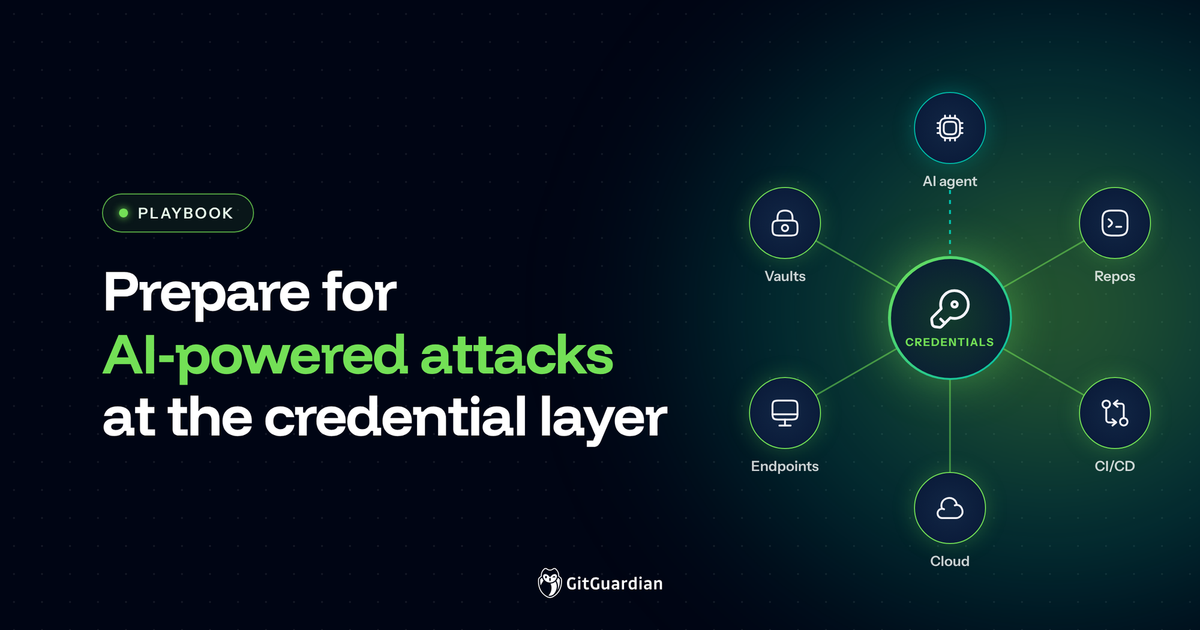
That means finding credentials across the entire credential layer, including public and private repositories, CI/CD pipelines, cloud environments, collaboration systems, developer endpoints, and AI tooling.
GitGuardian helps organizations discover exposed credentials throughout these environments. And now, with Developer Endpoint Protection, we extend that visibility to local machines, where credentials accumulate in environment files, CLI configurations, and AI agent directories.
But detecting a credential is arguably the easiest part. It is the part the attack frameworks are already good at too. Security teams need to prioritize where to spend their time. This means understanding whether it is still valid, which identity it belongs to, what permissions it grants, and which systems depend on it.
GitGuardian's validity checks, identity context, and Exploration Map help turn credential discoveries into actionable remediation priorities.
You need to understand your credential layer before an autonomous attacker maps it for you.
Remediate at speed: Cut off access before it spreads #
The recent incidents demonstrate how quickly offensive agents can move between interconnected systems. That creates a serious challenge when rotating a production credential still requires hours of investigation and coordination.
A single credential might serve multiple applications, automated jobs, and cloud environments. Replacing it safely requires knowing those dependencies.
GitGuardian helps teams identify active credentials, determine ownership, understand known relationships, and route incidents to the appropriate teams.
Organizations should automate as much of this process as possible, including validation, prioritization, routing, containment, and verification. For supported providers, GitGuardian can initiate credential revocation directly.Security teams need to focus on process improvements to automate and streamline remediation as much as possible, possibly through agentic tooling. No matter how it is automated, speed is the goal. We cannot have attackers operating at machine speed while our credential remediation processes depend entirely on humans chasing tickets.
What security teams should do in the coming days #
Google's forecast gives organizations a compelling reason to accelerate work they already know is necessary.
This week
Identify exposed and high-risk credentials, especially those providing access to production environments, cloud administration, secrets managers, and critical infrastructure. Include developer endpoints and AI agent configurations. If you are not sure where to start, GitGuardian is here to help. Right now, you can take a GitHub Security Audit, our free audit that checks your domain and shows what your developers have leaked, from company code and personal projects alike. This is a good initial step to judge how exposed you are to automated attack frameworks like ARTEX.
This month
Deploy tools that can map credential dependencies, establish rapid revocation procedures, automate incident prioritization and routing, and deploy preventive scanning across supported development and AI workflows. GitGuardian is here to help as well; we have recently helped a number of companies reach these goals in record time. We understand the urgency and can most likely get you fully integrated in hours or days, not weeks or months. Book some time with us, and we would be happy to walk you through the process.
Over the coming months
Replace long-lived credentials with ephemeral identities, reduce excessive permissions, segment critical resources, and continuously measure how quickly compromised access can be contained.
These actions are part of a larger defense-in-depth effort we hope is already underway at your organization. They address the credential layer specifically because recent attacks demonstrate how readily offensive agents can exploit it.
The time to act is now #
We no longer have to imagine what offensive AI agents might do.
Organizations are publishing incident reports describing agents discovering vulnerabilities, exploiting credentials, testing permissions, and moving through connected infrastructure.
Google's predictions suggest these capabilities could soon become substantially more autonomous and sophisticated.
The mechanisms are familiar. What changes is the speed, scale, and amount of human effort needed to exploit them.
GitGuardian's Credential Layer Security Platform helps organizations detect, remediate, and prevent credential exposure at scale and speed.
The future of autonomous attacks is already taking shape. Secure your credential layer now.
Get your free GitHub Security Audit, or take a tour of GitGuardian to start preparing for the future right now.
FAQ #
What are autonomous AI cyberattacks? #
  Autonomous AI cyberattacks use agentic frameworks that investigate an environment, test permissions, and exploit access with little or no human involvement.

  Google's Threat Intelligence Group predicts that within one to three months, attackers could deploy multi-agent frameworks that execute entire attack chains. Within three to six months, it expects even stealthier, fully autonomous attacks.
What is ARTEX? #
      ARTEX is an offensive agentic framework covered in Google's report "ARTEX and Friends: Enter Agentic Offensive Frameworks."

      Incident disclosures from Chainstack, Railway, and WorkOS, along with an investigation by Microsoft, describe ARTEX or tooling resembling it being used to find vulnerabilities, discover secrets, and move through infrastructure.
Why is the credential layer a proven attack path for offensive AI agents? #
  Credentials turn one compromised system into access to another. In recent incidents, attackers reached production secrets at Chainstack, customer environment variables at Railway, and Azure Key Vault data within five minutes in the case Microsoft investigated.

  Agents look for credentials because credentials help them reach their objectives. They need no explicit instruction to do it.
Do offensive AI frameworks need a dedicated secrets scanner to find credentials? #
  No. GitGuardian analyzed about 45 offensive agentic frameworks and found only four with dedicated secrets scanners.

  In a controlled experiment, an ARTEX build without one still discovered eight of nine planted credentials using ordinary commands. It began searching within six to 13 seconds, even when asked only to assess a repository's security posture.
How many exposed credentials are available for autonomous agents to find? #
  GitGuardian's 2026 State of Secrets Sprawl research found 28.65 million new hardcoded secrets on public GitHub in 2025.

  Of the valid secrets discovered in 2022, 64% were still active in January 2026. That is a large pool of potentially usable access.
What are the three priorities for credential layer security against autonomous attacks? #
  Prevent by design, detect at scale, and remediate at speed.

  Prevention means reducing standing access with ephemeral, narrowly scoped workload identities, plus controls like ggshield, AI Hooks, and Developer Endpoint Protection. Detection means finding credentials across repositories, pipelines, cloud, collaboration tools, and endpoints, with validity and ownership context. Remediation means automating validation, prioritization, routing, and revocation.
What should security teams do this week, this month, and in the coming months? #
  This week, identify exposed and high-risk credentials, especially those reaching production, cloud administration, and secrets managers, including developer endpoints and AI agent configurations.

  This month, map credential dependencies, set up rapid revocation, automate incident prioritization and routing, and deploy preventive scanning.

  Over the coming months, replace long-lived credentials with ephemeral identities, reduce permissions, segment critical resources, and measure how fast compromised access can be contained.
How can I check my organization's exposure to agentic attack frameworks? #
  Start with the free GitHub Security Audit, which checks your domain and shows what your developers have leaked, from company code and personal projects alike. It gives a quick read on how exposed you are to automated frameworks like ARTEX.

  From there, extend discovery to private repositories, CI/CD pipelines, cloud environments, and developer endpoints.