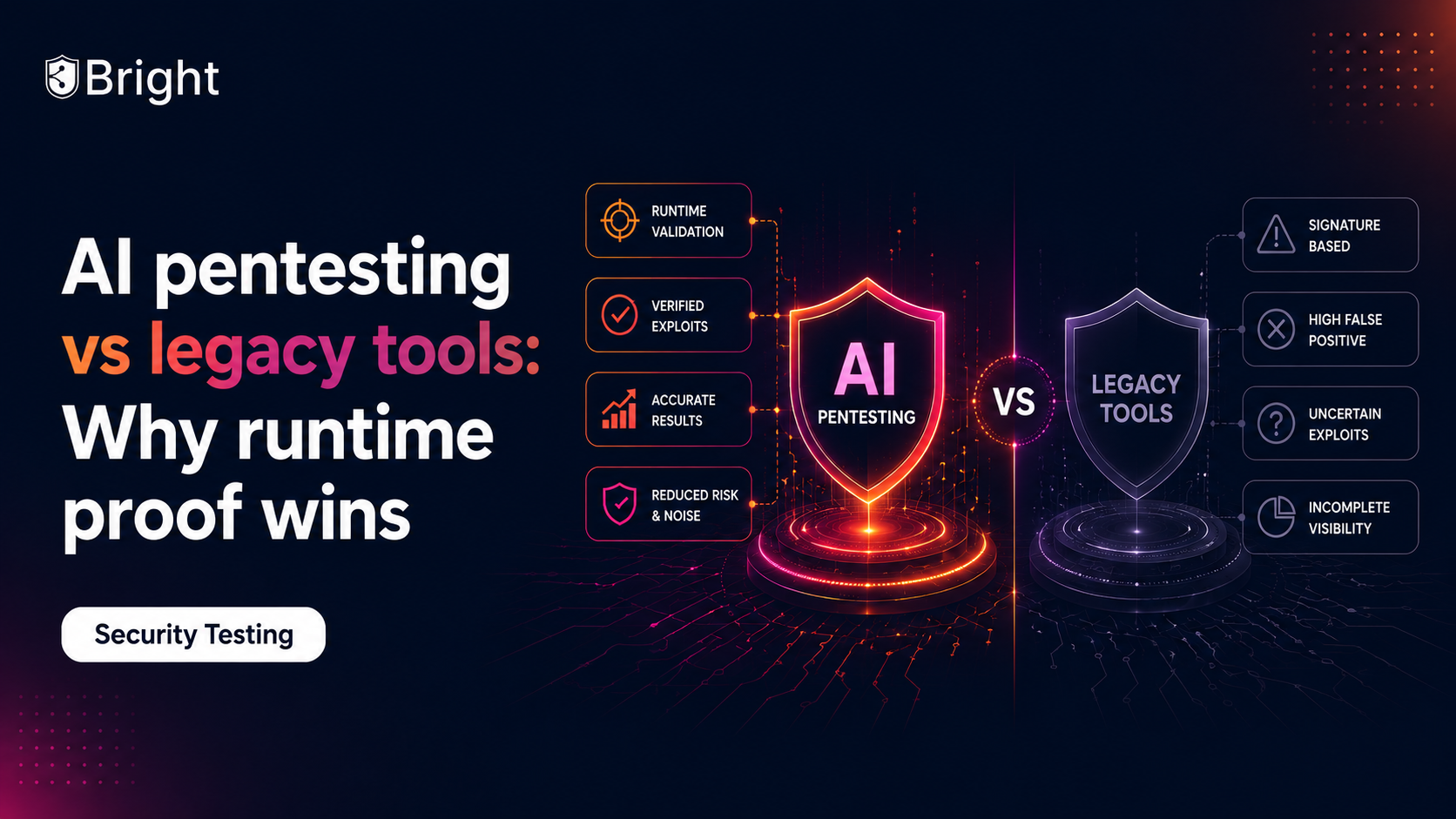
AI does not beat a legacy scanner because it can write more payloads. An AI model can produce thousands of plausible tests and still leave your AppSec team with a larger, less trustworthy queue.
AI pentesting becomes useful when it adapts to application context, builds multi-step attack hypotheses, executes them against the running target, and proves what happened.
That last step matters most. A predicted weakness is not the same as an exploitable vulnerability. If the system cannot reproduce the result, preserve evidence, and verify the fix, AI has only made speculation faster.
The real comparison is therefore not AI versus automation. It is adaptive testing with runtime proof versus automated detection without enough context.
Legacy automation finds patterns, not complete attack paths
Legacy automated pentesting tools remain useful. They run known checks quickly and give teams a consistent baseline. A mature scanner can detect injection flaws, exposed files, weak TLS settings, and common misconfigurations without waiting for a manual engagement.
The limitation is architectural. Most traditional tools follow predefined rules: discover a target, select a test from a library, send a payload, and classify the response. This works well when the vulnerability matches the rule and the scanner reaches the relevant function.
Modern applications rarely make that easy. Exploitability may depend on a role, tenant, workflow state, API sequence, or interaction between valid functions. A scanner may flag a suspicious response without proving exposure. It may also miss a business-logic flaw because no single request looks malicious.
The OWASP DevSecOps Guideline makes the broader issue clear: tools without runtime context can produce false positives because they cannot see the controls that affect actual execution.
NIST cautions that “no one technique can provide a complete picture of a system or network.” That still holds.
What makes runtime-validated AI pentesting different?
Runtime-validated AI pentesting uses AI to discover assets, interpret application context, generate attack hypotheses, and adapt test paths. It then executes those tests within approved boundaries and uses deterministic evidence to confirm exploitability. Only findings that produce a reproducible security impact should enter the remediation workflow.
The workflow has five distinct stages:
Discover: Map reachable applications, APIs, parameters, identities, and business functions.Reason: Connect those elements into threat hypotheses based on roles, data flows, and application behavior.Execute: Run protocol-valid tests against the live or production-like target within defined limits.Validate: Confirm the unauthorized action, exposed data, state change, injected behavior, or measurable resource impact.Verify: Replay the test after remediation and prove the exploitable behavior no longer occurs.
AI penetration testing can explore variations outside a fixed test library. Runtime validation protects the final decision from model error.
This separation matters because AI output is probabilistic. Models can misunderstand behavior or overstate a response. The OWASP Autonomous Penetration Testing Standard reporting requirements call for evidence-backed, reproducible, confidence-scored, and hallucination-resistant findings.
Bright’s AI Pentesting Module follows this split. AI-driven stages discover the attack surface, develop the threat model, and create exploit paths. Deterministic stages validate the exploit and verify the fix against the running application.
AI pentesting vs automated penetration testing tools
The difference appears in how each approach supports a finding.
Evaluation area | Legacy automated tools | Runtime-validated AI pentesting | | Test selection | Predefined checks and payload libraries | Tests generated and adapted from application context | | Discovery | Crawlers, specifications, fixed asset inputs | Adaptive mapping of assets, roles, functions, and relationships | | Workflow context | Often treats requests as separate test cases | Preserves identity, state, and multi-step business flows | | Attack paths | Strongest on known, single-step patterns | Can build and test chained hypotheses within scope | | Finding decision | Response signatures, rules, or confidence scores | Reproducible runtime impact supported by evidence | | Remediation | Generic guidance or issue description | Contextual evidence plus a replayable verification test | | Governance | Predictable but commonly configured per scanner | Requires scope enforcement, approval gates, audit trails, and kill controls | | Best use | Baseline scanning and known-vulnerability regression | Context-heavy testing, attack-path exploration, and validated prioritization |
Do not treat every product in either column as identical. Some modern dynamic tools already validate attacks at runtime. Some autonomous products do little more than summarize scanner output with a language model.
The dividing line is proof. Did the platform observe a pattern or demonstrate a controlled impact? Can a developer replay the evidence after changing the code?
Measure speed from test initiation to verified remediation, not from scan start to first alert. A scan that creates days of triage is not a fast security process.
Runtime proof changes what reaches the backlog
Legacy programs often ignore the cost of interpretation. An AppSec engineer must reproduce each uncertain result, determine its context, negotiate priority, and test the fix.
Runtime validation moves that work before ticket creation. A useful finding identifies the function, role, preconditions, sanitized test sequence, observed impact, and control response. It also includes enough evidence to repeat the test safely.
Bright reports Less than 3% false positives for its validated application security testing. The operational effect of reducing noise appears in its Blackstone case study. Blackstone already had SAST and DAST tools, but vulnerabilities took two to three months to resolve. After moving dynamic testing earlier and reducing false positives, remediation for a significant percentage of issues dropped to under 12 hours. The case study reports a 98% time saving.
That case concerns Bright’s dynamic testing deployment, not a controlled comparison of AI models. It still demonstrates the operating principle behind validated testing: earlier evidence and lower noise shorten the path to a working fix.
This is where AI without runtime validation can lose to a well-configured scanner. Unverified narratives add triage rather than removing it.
How to evaluate autonomous pentesting without buying the label
Start with a live demonstration against an application you understand. Include known issues, role boundaries, and a multi-step flow. Evaluate what the platform proves and what it predicts.
Ask these questions:
- Can it show the complete evidence chain from discovery to exploit validation?
- Does it distinguish model-generated hypotheses from deterministically confirmed findings?
- Can it preserve authentication, tenant, and workflow state across multiple actions?
- Are scope, rate, target, and action limits enforced outside the AI model?
- Can an operator , redirect, or terminate the engagement immediately?
- Which actions require human approval, especially in production or shared environments?
- Can the system replay a finding and verify the fix automatically?
- Does it disclose untested areas, failed tests, and coverage limits?
The 2026 OWASP Autonomous Penetration Testing Standard provides a useful governance reference. Its 173 tier-required requirements cover scope enforcement, safety, human oversight, graduated autonomy, auditability, manipulation resistance, supply-chain trust, and reporting.
Adaptive systems can choose actions their designers did not predict. The platform needs hard boundaries, audit records, and human approval for irreversible operations. Autonomous testing should expand coverage without expanding the authorized blast radius.
Choose runtime proof over faster prediction
Legacy tools still provide predictable checks, regression coverage, and a useful baseline. Replacing them simply because another product includes AI would be a poor decision.
The advantage of AI pentesting appears when adaptive reasoning is paired with controlled execution. AI can map a changing attack surface and explore contextual attack paths. Runtime validation then decides which results represent real risk.
That combination changes the output from a list of possible weaknesses into a set of reproducible security findings. It also gives developers a concrete way to verify remediation rather than closing a ticket on assumption.
Buy evidence, safe autonomy, repeatability, and verified fixes, not the AI label.
To see how Bright discovers attack paths, validates exploitability, and verifies remediation against running applications, book a demo.
Frequently asked questions
What is runtime-validated AI pentesting?
It uses AI to discover attack surfaces and generate context-aware test paths. The platform executes those tests against a running application and confirms findings through observable evidence. A result becomes actionable only when it can reproduce the impact and later verify that remediation removed it.
Is this the same as automated penetration testing?
No. Traditional automated penetration testing usually executes predefined checks at scale. AI penetration testing can adapt its discovery, reasoning, and test selection to the target. The difference only matters when AI-generated hypotheses are validated through controlled runtime execution rather than reported directly as vulnerabilities.
Does it replace legacy scanners or human testers?
Not completely. Legacy scanners remain useful for predictable baseline and regression tests. Human testers remain important for ambiguous business intent, architectural judgment, and high-impact actions. Adaptive testing adds repeatability between manual engagements, provided the platform keeps people in control of consequential decisions.
Why does runtime validation reduce remediation time?
Runtime validation gives developers proof that the weakness is reachable and shows the conditions that trigger it. This reduces manual reproduction and priority debates. The same test can then run against the proposed fix, shortening the cycle from detection to confirmation and preventing unresolved or theoretical findings from filling the backlog.