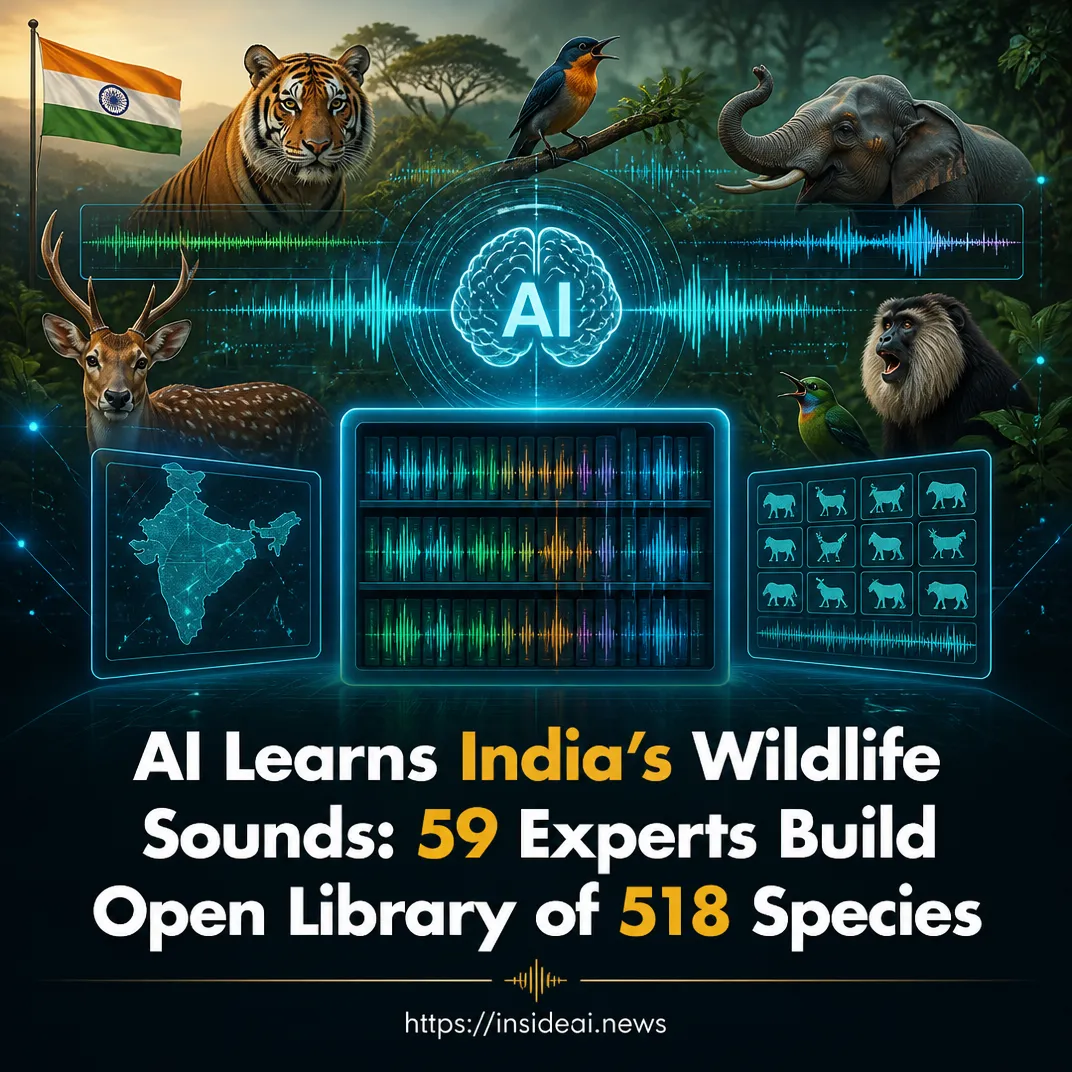
August 10, 2026, (Inside AI) — A team of 59 ecologists, researchers and wildlife enthusiasts has built India’s first open, crowdsourced library of wildlife sounds, covering 518 species and nearly 5,815 minutes of recordings from 25 states and Union Territories. The collection includes birds, mammals, insects and amphibians, providing local data to train bioacoustic AI systems that often fail to recognize India’s distinctive biodiversity.
Global AI models used for identifying wildlife sounds are typically trained on recordings from ecosystems outside India, leading to frequent misidentifications. This gap has long hindered conservation efforts in one of the world’s most biodiverse regions. The new library aims to change that by giving researchers a dataset rooted in Indian forests, grasslands and wetlands.
The project, driven by a community of experts and volunteers, could help conservationists identify elusive species and monitor India’s forests more accurately. By capturing the calls of everything from rare birds to nocturnal insects, the library turns sound into a powerful tool for tracking ecosystem health. The initiative reflects a growing trend of using AI for environmental monitoring, but it also highlights the critical need for localized training data to avoid algorithmic bias.
A Sound Solution to a Global AI Blind Spot #
Bioacoustic AI has emerged as a vital tool for conservation, but most existing models are built on datasets from North America, Europe or Africa. When applied to Indian habitats, these systems often misclassify or miss species entirely. The new library addresses this by offering a curated, geographically diverse collection of recordings that capture the unique acoustic signatures of Indian wildlife.
Each recording is annotated with metadata such as species, location and habitat, making it directly usable for training machine learning models. The dataset’s breadth—from the Western Ghats to the Sundarbans—ensures that AI systems can learn to distinguish between similar-sounding species across different regions. This could prove invaluable for tracking endangered species like the Bengal florican or the Nilgiri tahr, whose calls are often drowned out by more common fauna in generic models.
The project also opens doors for automated acoustic monitoring networks. By deploying low-cost recording devices in remote areas, conservationists could detect poaching activity, track migration patterns or assess the impact of climate change on biodiversity in near real-time. However, the library’s success depends on continued contributions from field researchers and the willingness of AI developers to adopt these localized datasets.
Beyond Tech: The Human Effort Behind the Library #
Building the library was no small feat. The 59 contributors spent countless hours in the field, often in challenging conditions, to capture high-quality recordings. Their work spans 25 states and Union Territories, from the dense forests of Arunachal Pradesh to the arid landscapes of Rajasthan. The collection includes not just bird calls but also the sounds of frogs, crickets and even bats, which are often overlooked in bioacoustic research.
The project’s open-source nature is deliberate. By making the data freely available, the creators hope to spur innovation among Indian AI startups and research institutions. This stands in contrast to many commercial bioacoustic datasets that are locked behind paywalls or restrictive licenses. The library could also serve as a model for other biodiversity-rich nations facing similar AI recognition gaps.
While the library is a major step forward, experts caution that it is just the beginning. India is home to over 90,000 known animal species, and many remain acoustically undocumented. Expanding the dataset will require sustained funding, training for local communities and partnerships with government agencies like the Forest Survey of India. The project’s founders are already planning to incorporate recordings from citizen scientists and integrate the data with existing biodiversity databases. In related developments, the Indian government has been exploring AI-driven solutions for environmental monitoring, including satellite-based forest mapping and predictive models for human-wildlife conflict. The wildlife sound library could complement these efforts by adding a real-time acoustic layer to the country’s conservation toolkit. As AI continues to reshape environmental science, projects like this remind us that technology is only as good as the data it learns from.