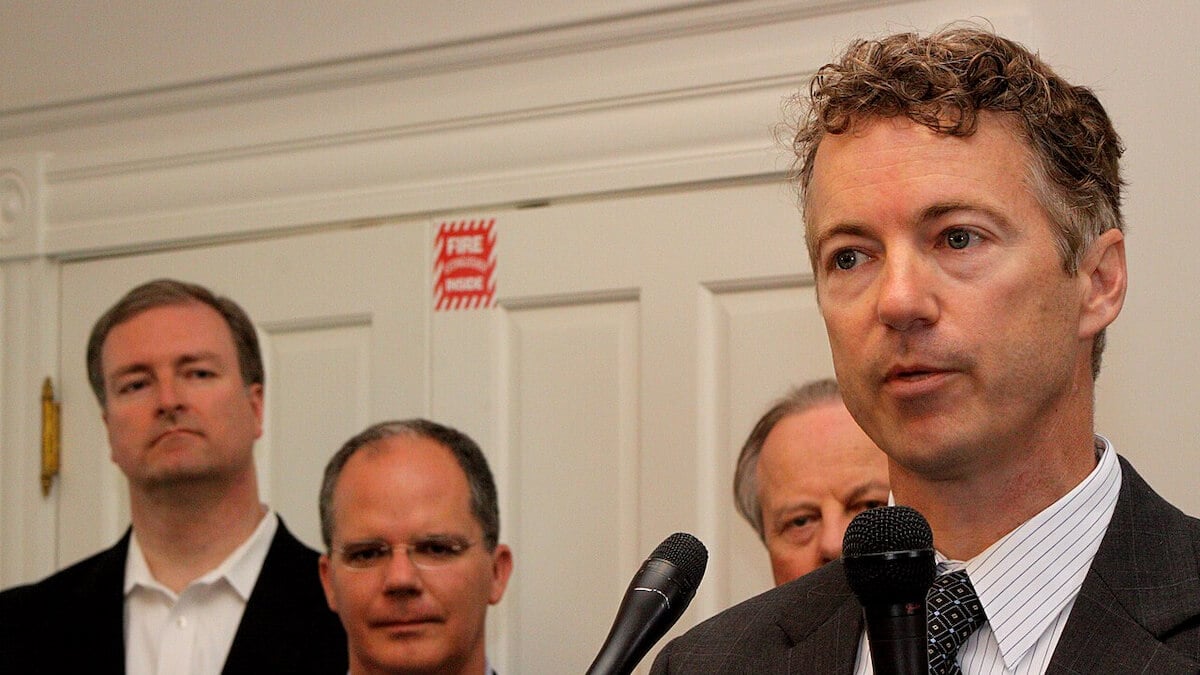
Kentucky Sen. Rand Paul defended blocking an AI “kill switch” measure while warning against rushed federal regulation. He argued Congress should understand the technology before imposing new restrictions. His position has drawn support from users wary of government control over AI.
During a Fox News interview, Paul compared current AI fears with earlier anxieties surrounding major technological advances. He pointed to the wheel, automated looms and electricity as inventions that disrupted work. “There has never been a technology that permanently displaced workers,” he said.
The senator acknowledged predictions that AI could eliminate jobs but said history offers no precedent for permanent displacement. He called it “too early to tell” how the technology will affect employment. Paul urged lawmakers to move “in a judicious way rather than react.”
He also questioned whether Congress understands AI well enough to regulate it effectively. “I wouldn’t put Congress in charge of a McDonald’s,” Paul said. He argued lawmakers should hear from AI developers before imposing a kill switch.
The Kentucky Republican pointed to possible medical benefits from AI, including drug research and medication management. He said the technology could help physicians identify harmful interactions among multiple prescriptions. Paul also said AI could accelerate research into complicated diseases such as Alzheimer’s.
Still, he acknowledged that AI could produce dangerous outcomes. His greater concern centered on government surveillance and interference. “Just cutting off a technology or trying to kill a technology before we truly understand it’s a mistake,” he said.
Rand Paul’s AI ‘Kill Switch’ Stand Draws Support and Pushback #
The debate split users between distrust of federal oversight and concern that rapidly advancing AI still requires enforceable safeguards.
“AI isn’t the danger, the state is,” one user wrote. Another response was even broader: “NO ONE trusts our government.”
Others questioned whether lawmakers could regulate the technology effectively. “Congress is not qualified for this,” one response stated. Another user put the concern more bluntly: “govt regulating ai is like a toddler with a nuke lmao they’ll just break it more.”
Not everyone supported Paul’s caution. “You are right most of the time Rand but not this time.. Thousands of AI engineer are calling for a moratorium,” one user wrote.
Another argued government intervention becomes necessary when companies fail to protect consumers. “Well, the companies aren’t doing anything, and when the companies won’t regulate and their actions will put the consumers at risk then it’s the governments job to step in and fix it.”
For now, the blocked measure leaves lawmakers divided over how far the federal government should go in requiring safeguards for rapidly developing AI technology. While supporters see measures such as a human-controlled “kill switch” as a necessary precaution, Paul and others have raised concerns about imposing sweeping federal rules too quickly. With broader AI regulation still unsettled, the debate over who should ultimately hold the off switch is far from resolved.