[ Thought Leaders
](https://www.unite.ai/series/thought-leaders/)


[Add Unite.AI to your preferred sources on Google](https://www.google.com/preferences/source?q=unite.ai)
The debate around AI in elder care often starts with the wrong fear: that technology will replace human caregivers. Emotionally, it is a powerful argument, but it rests on a false premise. It assumes there is a trained, available, fairly paid person ready to support every older adult who needs help, and that AI is arriving to push that person aside.
But that is not the reality of elder care in the United States. For many older adults, especially those living alone, the alternative to AI is no regular check-in, no help, and no one noticing a problem until it becomes a crisis.
The Care Gap #
The U.S. population aged 65+ is projected to grow from 61.2 million today to 82 million by 2050. With nearly 29% of U.S. older adults living alone, the U.S. elder care system is facing a structural crisis that can’t be solved by better recruiting campaigns. The work itself is physically and emotionally demanding, but it remains chronically underpaid. That is why nursing homes operate with moderate-to-high staffing shortages. Home care agencies turn away clients because they cannot find enough caregivers. Senior living operators face persistent frontline turnover. 63M family caregivers, who are not formally part of the labor market but carry much of the real burden, are burning out under the weight of unpaid care.
This is why the phrase “AI versus humans” is so misleading. The care economy is not losing workers because AI arrived. It is losing workers because the system has made the work too hard, too poorly paid, and too difficult to sustain.
AI will not fix that root problem. It can’t raise wages or make physical care easier. But it can help stretch the scarce human capacity that remains by taking over parts of care coordination that are repetitive, routine, and currently often left undone.
A Daily Call As An Alternative To Silence #
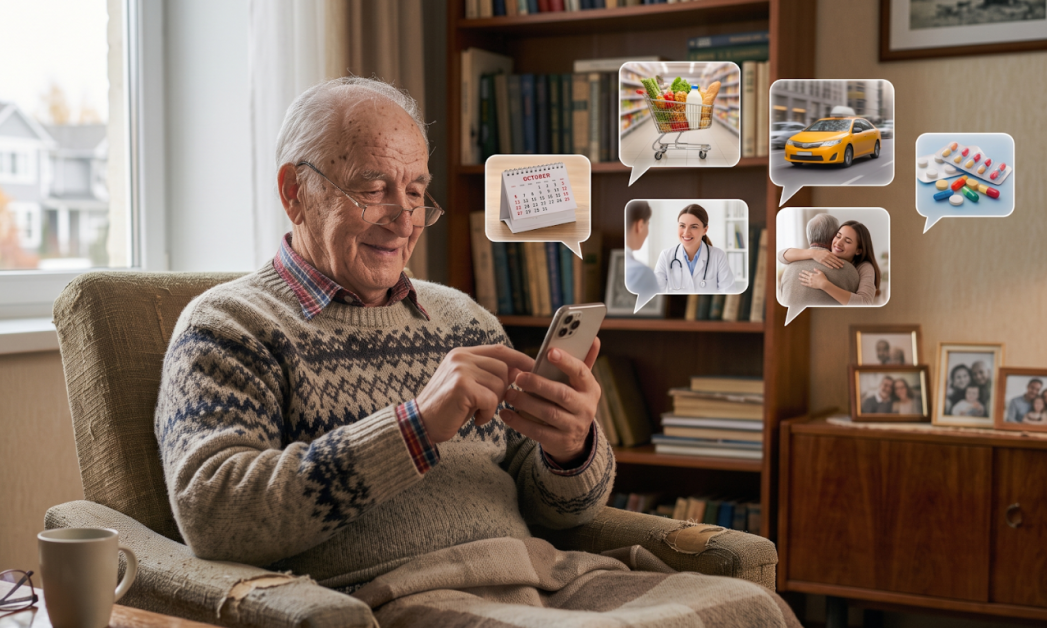
AI can be easily applied to older adults’ daily wellness check-ins, medication reminders, documentation support, family updates, basic triage, and early detection of changes in mood, speech, behavior, or cognition.
A daily call can ask whether someone slept well, ate, took their medication, felt pain, sounded confused, seemed unusually withdrawn, mentioned a fall, or repeated something concerning. This doesn’t replace a caregiver, but creates a layer of continuity where no continuity exists.
That is especially important because many problems in elder care become expensive and dangerous because they are detected too late. A change in voice, a missed medication, a new pain, a pattern of confusion, or a shift in mood may not look dramatic; however, it can become a signal that something needs attention. Human caregivers and family members can notice these things when they are present. The problem is that they often are not present every day.
This is where AI can be useful: as a system that keeps listening and summarizing, and knows when to escalate. It can reduce the administrative burden on professional caregivers and the cognitive burden on family caregivers. It can help families know when something has changed, instead of relying on guilt, guesswork, or crisis calls. It can help caregivers see where attention is needed, without pretending attention is no longer needed.
Disclosure is non-negotiable. Older adults must know they are speaking with AI from the beginning. This is not only a regulatory issue; it is a trust issue. There shouldn’t be products that depend on confusion.
Knowing When To Bring The Caregivers In As A Core Goal #
The more serious the situation, the less the AI should talk and the faster a human should be involved. In routine moments, AI can conduct a wellness check-in, ask simple questions, and capture facts. If it notices a mild concern, it can include it in a family summary. If it sees a worsening pattern across several days, it can alert the family. If there is an acute medical concern, it should tell the person to contact a doctor or call emergency services if urgent, while notifying the family. If there is suicidal language or another crisis signal, it should follow a fixed safety protocol and escalate immediately.
This is the opposite of ordinary product design, where engagement is usually treated as success. In elder care, engagement is not always the goal. Sometimes the best AI interaction is the one that ends quickly because a person needs to step in.
AI should not give medical, legal, financial, or medication-dosing advice. It should not make autonomous decisions. It should not change care plans, cancel appointments, recommend products, initiate financial topics, or sell through the conversation. It should report facts and patterns: the conversation was shorter than usual, pain was mentioned again, medication was missed, confusion appeared more often, mood seemed lower.
The care economy does not need another narrative about machines replacing people. It needs a more honest one: there are already too few people who are overloaded.
AI will not solve elder care, but it can make its gaps less invisible. That may sound modest compared with the usual promises made about artificial intelligence. In elder care, modesty is a feature. The goal is not to build an AI that acts like a human. The goal is to build one that knows exactly when a human is needed.