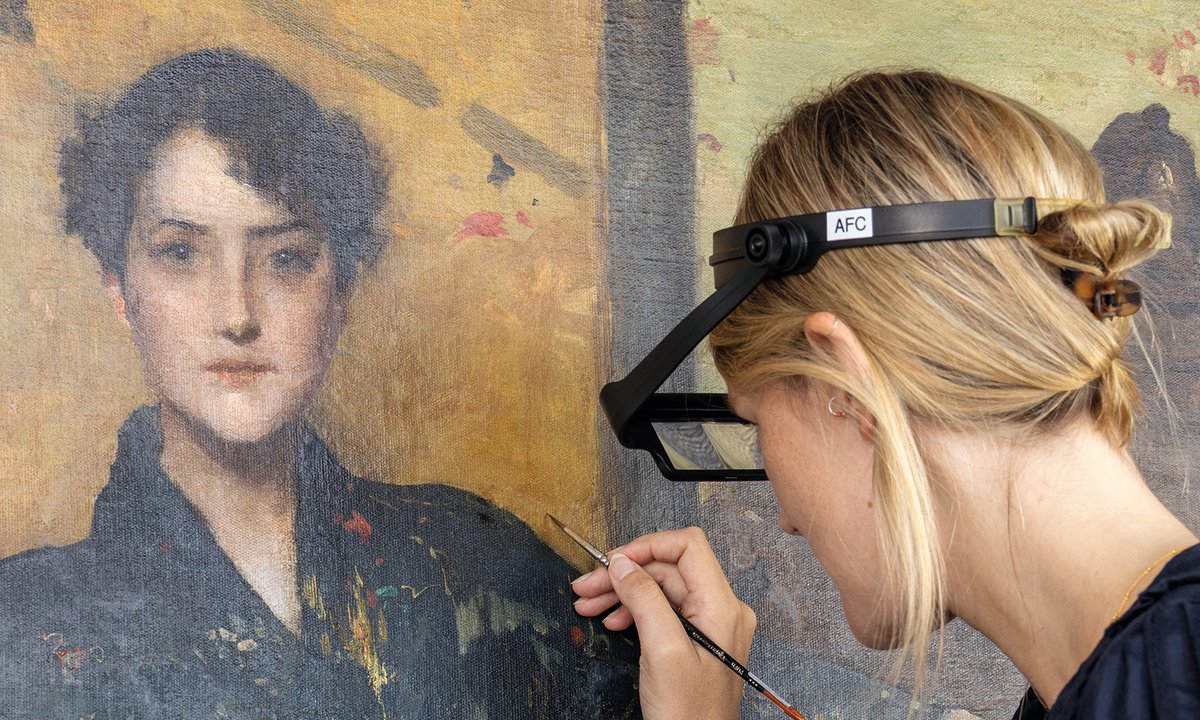
When William Merritt Chase’s painting A Comfortable Corner (around 1888) entered the conservation studio, the painting was carrying more than a century of history on its surface—including the interventions of conservators who had treated it decades earlier. Artificial intelligence (AI) contributed to a restoration endeavour that has peeled back some of those interventions.
The newly restored painting, which is part of the collection of the Parrish Art Museum in Water Mill, New York, will be on display in its exhibition William Merritt Chase and Walter Granville-Smith: American Impressionists of the East End (14 November-21 March 2027). The Parrish has an especially deep connection to Chase, who was not only a prominent figure in Gilded Age New York but also spent time on Long Island’s East End, where the museum is located. Today, the Parrish holds a substantial body of Chase’s work, alongside archival material donated by the artist’s family.
A Comfortable Corner depicts a woman reclining in an elaborately furnished interior, dressed in a deep blue kimono and holding an uchiwa fan.“A Comfortable Corner is an important work within William Merritt Chase’s oeuvre as it depicts a specific moment in 19th-century art and Chase’s own period with influences of art and design from Japan,” says Kaitlin Halloran, the museum’s associate curator.
Over the years, at least two restorations substantially altered the appearance of the painting, including a significant effort in the 1960s. Among the changes made were the addition of a heavyweight, almost burlap-like lining, retouching and blotchy inpainting, and the use of uneven varnishes. Some of these interventions changed the surface texture of various areas or discoloured over time. Working with conservator Suzanne Siano and her team at Modern Art Conservation, the museum set out to determine what restoration was needed to get the painting ready for the exhibition.
A crucial piece of evidence to guide this process arrived in the form of an early photograph of the painting. The black-and-white image, understood to have been taken before the 1960s restoration, showed that more of the composition had once been visible than what had survived in the painting. The work had apparently been reduced in size during the 1960s restoration, perhaps to fit a new stretcher or because damaged edges were folded over and effectively removed.
The photograph also revealed details in the composition that had disappeared. A curl of hair beneath the sitter’s ear was missing; parts of a decorative screen had become faint or vanished; and some delicate passages had been overpainted with heavier marks. The conservation team also found evidence of pentimenti—changes made by Chase himself—that were not apparent in the earlier photograph, adding another layer of complexity.
“It is difficult to establish whether all of these changes resulted from earlier conservation,” Siano tells The Art Newspaper. “Some of it may have stemmed from a misreading of what the conservator was seeing. They may have been cleaning toward what they believed to be the original surface when, in fact, some of what they removed may have been changes or additions made by the artist.”
Using AI, the historical photograph was combined with a colour image of the painting to create a composite showing areas where the two diverged.
A tool, not a solution
“Although we are reasonably adept with Photoshop, we felt it was worth seeing what AI could offer,” Siano says. “It proved very helpful, largely because of its speed. It was not instantaneous, but it was considerably faster than assembling the comparison manually.”
The resulting image helped the team identify areas that warranted closer examination. One important discovery concerned Chase’s signature, which had become extremely faint, with some of its letters apparently covered by overpaint. Because Chase’s signature is relatively abstract, Siano believes it may have been mistaken for part of the carpet pattern during the earlier restoration.
The project, supported by a Bank of America grant, illustrates both the possibilities and the limitations of AI in conservation. “Tasks that once took considerable time can be completed more quickly, and AI can provide additional information for us to weigh,” Siano says. “Ultimately, however, conservation is carried out by a highly skilled individual or team, and we do not expect that to change.”
Siano stresses that they did not simply reinstate every discrepancy identified by the software. The historical photograph was neither high-resolution nor necessarily a record of the painting’s earliest state. Instead, the information the photograph provided was assessed alongside magnified examination, ultraviolet imaging, knowledge of Chase’s materials, and comparison with his other works.
“Conservation is a combination of science, art history, craft, manual skill and artistry,” Siano says. “AI is none of those things.”
The Chase painting was the first time Siano’s studio had used AI as an aid in the conservation of a painting. “In terms of determining how to conserve a painting, we think AI’s use will remain very case-specific. We do expect it to become increasingly valuable as a research tool, however: for example, in helping to locate historical images or relevant source material.”
Ultimately, Siano says, “the judgments conservators make are nuanced and subtle, and we doubt those qualities can be replicated by a machine”.