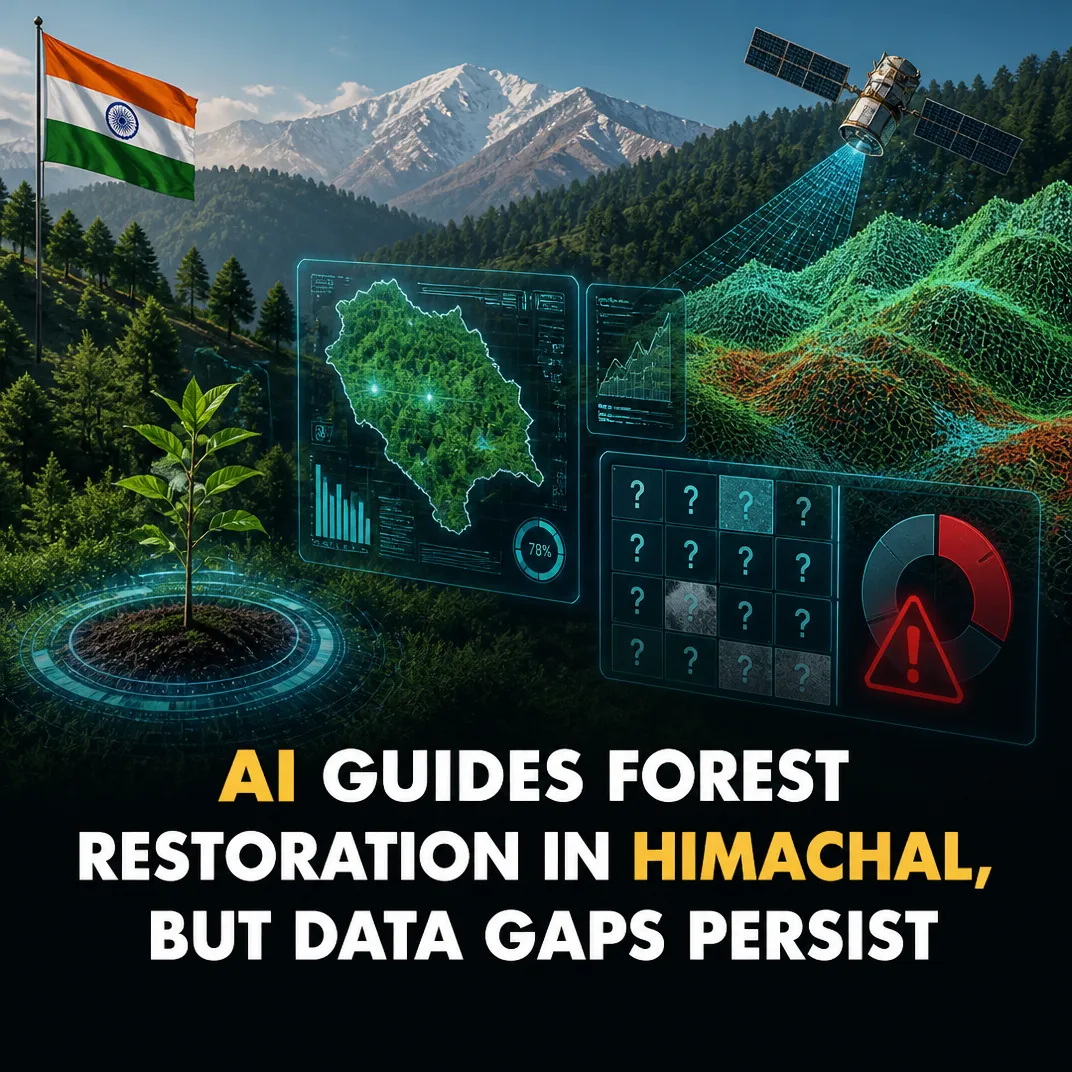
July 25, 2026, (Inside AI) — Indian Forest Service officer Pushpendra Rana is deploying artificial intelligence to steer forest restoration in Himachal Pradesh, but the approach faces stubborn data and social hurdles that no algorithm alone can solve.
Rana blends geospatial analysis and machine learning with social science theories to evaluate environmental policies. His work dissects how communities and forests interact, aiming to fortify forest governance through data-driven insights.
“AI can process satellite imagery to pinpoint degraded land and predict restoration success, but the real challenge is translating those maps into action on the ground,” Rana said in an interview. His team uses models to identify areas where tree planting will yield the highest carbon sequestration and biodiversity gains.
Yet the officer warns that AI outputs are only as good as the data fed into them. In Himachal’s rugged terrain, ground-truthing is sparse, and historical records are often incomplete. This echoes a broader problem in conservation AI: a 2023 study in Nature Ecology & Evolution found that biased training data can lead to restoration plans that overlook marginalized communities.
Rana’s unit combines optical and radar satellite data with field surveys to train models that detect forest degradation early. The system flags illegal logging and encroachment, but Rana insists technology must serve local governance, not replace it. “We need algorithms that incorporate indigenous knowledge about species and water cycles,” he said.
The initiative sits at the intersection of India’s ambitious restoration targets—the country aims to restore 26 million hectares by 2030—and the messy reality of land rights. Himachal’s forests are crisscrossed by community claims, grazing routes, and water sources that satellite pixels can miss.
Competing viewpoints emerge from conservation technologists who argue that AI can automate monitoring at scale, versus field officers who see it as a tool that must be paired with participatory mapping. A 2022 paper by researchers at the University of Cambridge showed that community-led data collection improved model accuracy by 30% in similar Himalayan ecosystems.
Rana’s background in social science gives him a rare lens. He has published on how machine learning can predict forest fire risk, but he stresses that predictive models must account for human behavior—like why farmers burn stubble—rather than just mapping fuel loads. His current project integrates household surveys with remote sensing to model migration’s impact on forest cover.
The hardware and connectivity gaps are acute. Many forest beats lack reliable internet to upload real-time data, forcing rangers to sync devices days later. Rana is piloting edge computing solutions that run models on smartphones offline, a tactic detailed in a recent technical report on low-resource AI deployment.
Historical context sharpens the narrative. India’s forest bureaucracy has long relied on manual stock-taking, a legacy of colonial-era management that prioritized timber over ecology. AI promises a shift, but institutional inertia and mistrust of algorithmic decision-making slow adoption. Rana notes that younger officers are more receptive, but they need training that bridges forestry and data science.
What’s missing from the current discourse is rigorous evaluation of AI’s long-term impact on forest outcomes. Most studies, including Rana’s, track short-term metrics like sapling survival, but the real test is whether restored forests deliver sustained ecosystem services over decades. A 2023 meta-analysis in Biological Conservation found that only
12% of AI-driven restoration projects reported follow-up data beyond five years.
Rana’s work underscores a pivotal truth: AI can guide where to plant trees, but only empowered communities can make them grow. As climate pressures mount, the fusion of silicon and local wisdom will determine whether restoration targets are met or remain lines on a spreadsheet.