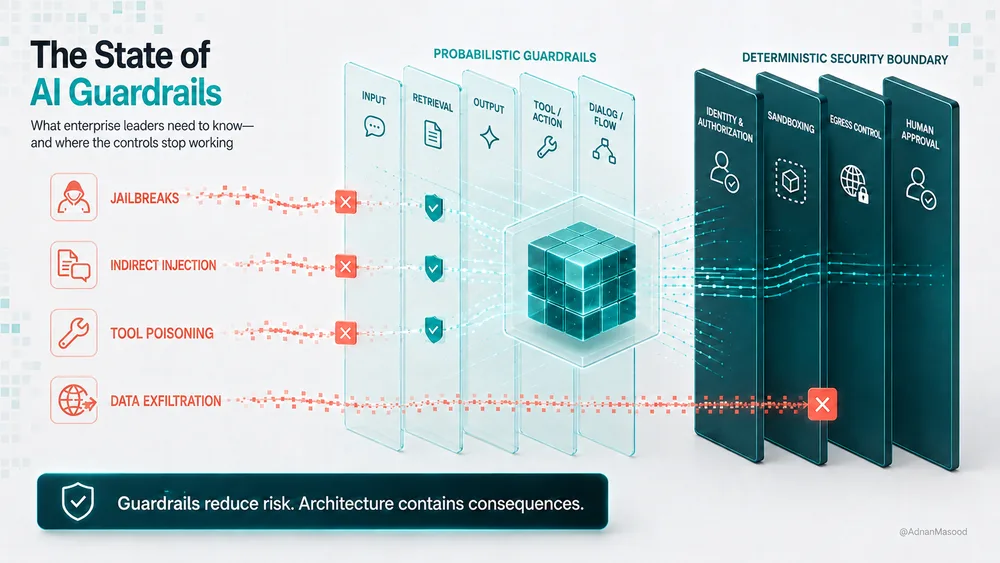
The current landscape of LLM security is split into two very different philosophies: the rigid, rule-based boundaries and the messy, probabilistic layers.
The Deterministic Wall vs. The Probabilistic Filter #
Most enterprise-level deployments rely on deterministic boundaries. These are the "if-then" scenarios. If a user inputs a string containing a banned keyword or a specific regex pattern, the system kills the request immediately. It is fast, it is cheap, and it is incredibly easy to implement. However, this is the weakest form of defense. It’s a playground for anyone with a basic understanding of character encoding or synonym replacement.
Then you have the probabilistic controls. This is where things get interesting for researchers and red-teamers. Instead of looking for specific words, these guardrails use a smaller, "judge" model to analyze the intent of the prompt and the response. This is the core of the modern AI workflow for safety. The judge model asks: "Is this user trying to bypass safety protocols through roleplay?" or "Is the output generating PII (Personally Identifiable Information)?"
The problem is that the judge is also an LLM. This creates a recursive vulnerability. If you can find a way to confuse the judge model—perhaps through a complex "jailbreak" that uses nested logic or specific linguistic obfuscation—the entire guardrail collapses.
Where the guardrails actually miss the mark #
When I look at the current state of deployment, three specific areas stand out as massive blind spots:
Contextual Drift: A model might be perfectly safe when asked a direct question, but if you slowly nudge the conversation through 20 turns of subtle roleplay, the safety alignment often "drifts." The guardrail sees individual turns as safe, but the cumulative context becomes toxic.Multimodal Bypasses: We are seeing more attacks where the "malicious" intent is hidden in an image or an audio file, while the text prompt remains perfectly benign. Most text-based guardrails are completely blind to these cross-modal injections.The Latency Trade-off: In real-world production, every millisecond counts. Many companies are opting for lighter, faster, and therefore less "intelligent" guardrail models to keep the UX snappy. This creates a massive security hole where the guardrail is too shallow to catch sophisticated prompt engineering attacks.
If we want to move past this, we have to stop treating guardrails as a secondary "wrapper" and start thinking about deep-layer alignment. Until the safety mechanism is as computationally sophisticated as the model it is guarding, we are just playing a game of whack-a-mole. Next NeuronFuzz uses internal neuron activations to break LLM safety →