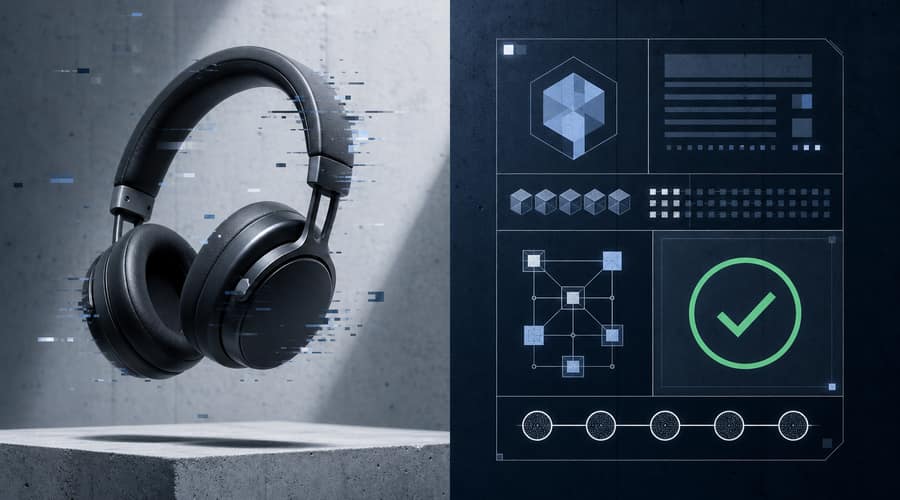
Deloitte projects generative AI fraud losses will hit $40 billion in the United States by 2027, up from $12.3 billion in 2023, and a landmark joint policy paper from the American Bankers Association, the Better Identity Coalition, and the Financial Services Sector Coordinating Council has made the stakes explicit: every business touching digital content now has a compliance clock ticking.
The 32% compound annual growth rate in AI-enabled fraud is not an abstraction. It represents deepfake impersonation, synthetic identity creation, and AI attack surrogates - all running faster and cheaper than the detection tools built to stop them. Deloitte's Center for Financial Services put the projection in writing, the ABA and FSSCC spent 18 months and more than 130 experts verifying the mechanics, and their April 2026 joint paper concluded what many compliance officers had suspected: generative AI has broken the economic model of traditional fraud prevention. The tools built when fraud was slow and expensive don't scale against fraud that is fast and nearly free.
For founders, the interesting shift is where the exposure lands. It's not only banks and identity verification firms. Ad platforms running user-submitted creative, e-commerce marketplaces displaying AI-generated product imagery, SaaS tools that pipe synthetic media into downstream workflows - any of them now sit inside the liability perimeter that regulators are drawing. The FSSCC paper identifies three primary attack vectors: deepfake social engineering, synthetic identity creation, and AI agents as surrogates for human attackers. If your platform touches any of those flows, the question of whether your content is authenticated is becoming a legal question, not just a product one. The standard getting the most serious regulatory traction is C2PA, the Coalition for Content Provenance and Authenticity, founded in 2021 by Adobe, Arm, BBC, Intel, and Microsoft. It now has over 6,000 members. The mechanism is a cryptographic manifest embedded directly in a file, documenting what created it, what modified it, and when. Adobe embeds it in every piece of content processed through its tools. Microsoft added C2PA metadata to Microsoft 365 content in February 2026 and has already integrated it into Bing and Microsoft Designer. Google's Pixel 10, shipping in late 2025, became the first smartphone to achieve C2PA Conformance Program certification, embedding credentials at the hardware level on every photo taken.
That last detail matters. Hardware-level signing is what makes the chain of custody hard to spoof. A credential applied in post-production can be stripped or forged; one baked in at the sensor level is a different kind of proof. It also signals that C2PA is moving from a document format standard into a product feature. That's how standards get mass adoption.
Regulatory pressure is accelerating the timeline. Under Article 50 of the EU AI Act, machine-readable content marking for AI-generated material became mandatory as of August 2, 2026. C2PA is being fast-tracked as an ISO standard, which gives it weight in procurement requirements and financial regulation. If you're building in Europe or selling to European enterprise customers, the compliance question is already live.
The detection market has a real business, not just a pitch #
The startups competing for enterprise contracts in this space each take a different angle. Reality Defender, a Y Combinator alumni, launched a public API and a free tier in July 2025 and has since signed vertical partnerships with ValidSoft in banking, Law and Forensics in legal, and TaskUs in content moderation. Its Real Suite, released in November 2025, bundles detection across video, audio, and image into a single product. Truepic takes a different approach: it focuses on provenance at capture rather than detection after the fact, and Bloomberg estimated its annual revenue at $15 million. Its enterprise customers include Microsoft, and it serves lenders and insurers who need court-admissible proof of when and where an image was taken. Hive Moderation, meanwhile, scored 95.8% accuracy in 2026 Global 100 visual forensics testing and prices through enterprise volume contracts, not public tiers.
None of these companies is chasing the same buyer. Reality Defender is positioning as a platform layer. Truepic is a chain-of-custody tool for regulated industries. Hive is a moderation API for platforms already processing content at scale. Founders evaluating vendors should be clear about whether their problem is detecting synthetic content after it enters their system or preventing unauthenticated content from entering at all. Those are different threat models. They call for different products.
The deeper issue is economic. Fraud has historically been a volume game where professional fraud rings could not scale faster than the cost of human labor to run them. Generative AI removed that ceiling. More than a billion AI-generated images enter search results, social feeds, and product listings every month, according to recent estimates, and the per-unit cost of producing a convincing synthetic asset is now close to zero. The Deloitte figure is not a worst-case scenario; it's a midpoint projection under current adoption curves. If the tools for authentication and detection don't scale to match that, the $40 billion number is a floor, not a ceiling.
Frankly, the founders most at risk are the ones who have not yet asked whether their platform could be held liable for authenticated synthetic content flowing through it. The FSSCC paper is a policy document, but it's also a roadmap for where enforcement will focus. Content credentials and detection are becoming standard operating infrastructure - the same way SSL certificates were once optional and then quietly became table stakes. The window where this is a voluntary investment is closing.
Also read: Innovaccer crosses $200 million in ARR as its agentic AI bets on cracking healthcare's data problem • SK Hynix reports Q2 2026 earnings as the AI memory supercycle faces its first real test • Intel posts its fastest revenue growth in 15 years and still can't build chips fast enough