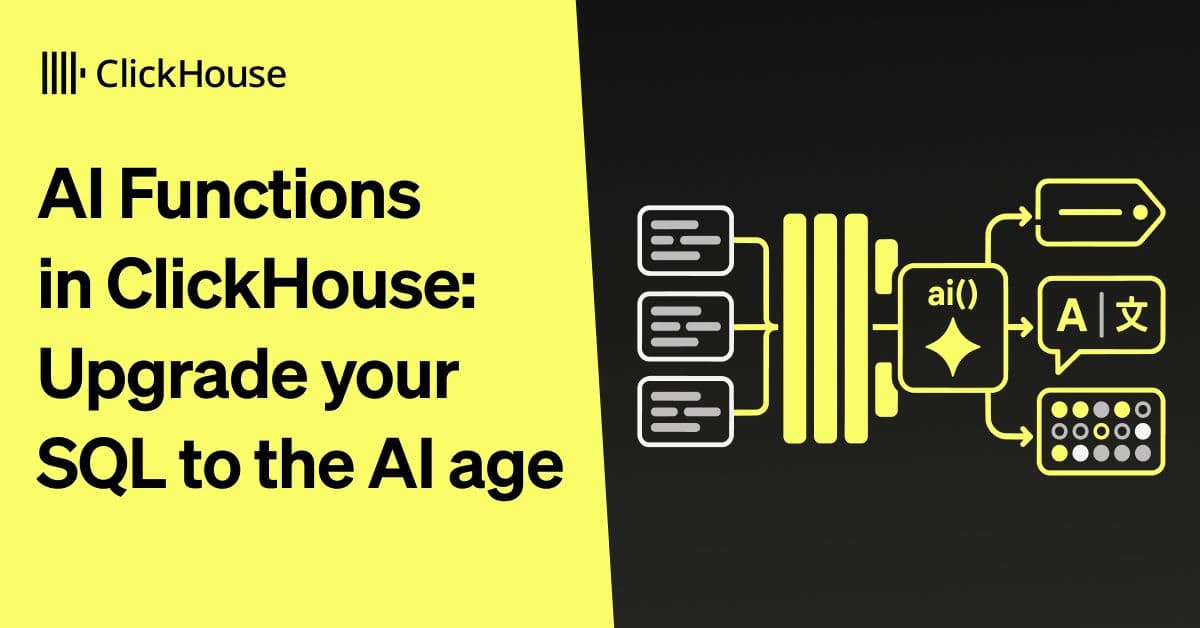
ClickHouse now has a family of built-in AI Functions that call an LLM or an embedding provider directly from the SQL engine. The model becomes something you call from SQL, like lower() or sum(), and it runs where your data already lives.
The functions are currently in Beta and functionality is constantly being added and improved. They arrived over the course of three releases: aiGenerate(), aiClassify(), aiExtract(), and aiTranslate() in 26.4, aiEmbed() in 26.6, then aiFilter(), aiRedact(), and aiSimilarity() in 26.8.
Try AI Functions in ClickHouse Cloud
In ClickHouse Cloud, no extra configuration mentioned below is required—the functions are plug-and-play. Currently, AI Functions are in private preview in ClickHouse Cloud.
Why we developed this #
All your data already lives in ClickHouse: logs, product reviews, descriptions and support tickets. Traditional LLM workflows (like RAG) pull data out of database into a separate stack to run classification or embedding tasks, then push the results back in. This approach is slow, error prone, and adds operational complexity.
The core idea behind AI Functions is to move the model to the data instead of the data to the model. Because ClickHouse already stores and can search vectors, the full RAG cycle can run in one system rather than being stitched together across a vector database, an orchestration framework, and a separate LLM API.
As a simple example:
1SELECT aiClassify('I love this product!', ['positive', 'negative', 'neutral']);
Response:
1positive
AI Functions in one query
In short, AI Functions turn intricate workflows into a straightforward SELECT query.
What is in the beta #
The following AI Functions are available for you in 26.8. Text functions:
- aiClassify - Classifies the given text into one of the provided categories using an LLM provider.
- aiExtract - Extracts structured information from unstructured text using an LLM provider.
- aiGenerate - Generates free-form text content from a prompt using an LLM provider.
- aiTranslate - Translates the given text into the specified target language using an LLM provider.
- aiFilter - Evaluates a natural-language condition against the given text using an LLM provider and returns a boolean (
UInt8) suitable for**WHERE** ,PREWHERE, and**JOIN ... ON** . - aiRedact - Detects and redacts personally identifiable information (PII) in the given text using an LLM provider.
Embedding functions:
- aiEmbed - Generates an embedding vector for the given text using the configured AI provider.
- aiSimilarity - Computes the semantic similarity of two texts using the configured embedding provider.
AI Functions work by making a remote HTTP call to the configured provider's API for each input, or a batch of inputs for the embedding functions, and returning the parsed response as a native ClickHouse value.
Preparing the setup (OSS only) #
To begin using AI Functions, you must configure two named collections (for text and embedding, respectively) to store your provider credentials and configuration.
We recommend configuring settings ai_function_text_default_credentials and ai_function_embedding_default_credentials with the names of the named collections. Then, all AI Functions will pick up the right endpoint automatically. It is also possible to override the settings during execution.
Example statement to create a named collection with OpenAI provider credentials: you'll need an API key from OpenAI, one with a chat endpoint and another with an embedding endpoint:
1CREATE NAMED COLLECTION ai_text_credentials AS
2    provider = 'openai',
3    endpoint = 'https://api.openai.com/v1/chat/completions',
4    model = 'gpt-5.6-terra',
5    api_key = 'sk-...';
6
7-- The embedding functions (`aiEmbed`, `aiSimilarity`) do not read `model` from the named collection.
8CREATE NAMED COLLECTION ai_embedding_credentials AS
9    provider = 'openai',
10    endpoint = 'https://api.openai.com/v1/embeddings',
11    api_key = 'sk-...';
Note: Any OpenAI-compatible API (e.g. Ollama, LiteLLM) can be used by setting provider = 'openai' and pointing the endpoint to your service. Therefore, this works with a local model too.
Next, configure the default-credentials setting:
1SET ai_function_text_default_credentials = 'ai_text_credentials';
2SET ai_function_embedding_default_credentials = 'ai_embedding_credentials';
Now you are ready to run the functions. Let’s review some examples.
Understanding your data: classify, filter #
The examples below use the Hacker News dataset, 28 million rows of stories and comments, loaded with the Parquet schema from that guide. The columns we care about are title, comment, author, score, type, and timestamp. Make sure you follow the setup steps above.
aiClassify takes a string and a constant list of labels, and returns exactly one of those labels. The model is asked to pick a bucket, so it has limited creativity here.
Front page titles are a good starting point because they are short, which keeps token usage low:
1SELECT
2    title,
3    aiClassify(title, ['space', 'security', 'databases', 'startups', 'programming', 'other']) AS topic
4FROM hackernews
5WHERE (type = 'story') AND (score < 3000) AND (title != '')
6ORDER BY score DESC
7LIMIT 3 FORMAT Vertical;
Response:
1Row 1:
2──────
3title: SpaceX’s Falcon Heavy successfully launches
4topic: space
5
6Row 2:
7──────
8title: Twitter Will Allow Employees to Work at Home Forever
9topic: other
10
11Row 3:
12──────
13title: No Cookie for You
14topic: security
Since the output is a String, it integrates seamlessly with standard SQL. You can use aiClassify in a subquery, then aggregate over the result. For anything you plan to query more than once, classify into a column instead of recomputing.
Analyze with SQL, not Python
That is a topic breakdown of high-scoring Hacker News stories, computed without a single line of Python. In the old workflow, this would be an export, a classification job, and a load back into ClickHouse.
aiFilter returns UInt8, which means it can go straight into WHERE and behave like any other boolean condition. This is the function that most clearly does something SQL could not do before. Token search finds rows containing the word "database". aiFilter finds rows where someone is complaining about one:
1SELECT author, substring(comment, 1, 100) AS snippet
2FROM (
3  SELECT author, comment
4  FROM hackernews
5  WHERE type = 'comment' AND ilike(comment, '%database%')
6  LIMIT 500
7)
8WHERE aiFilter(comment, 'the author is describing a production incident or outage they experienced') LIMIT 3 FORMAT Vertical;
Response:
1Row 1:
2──────
3author:  0x0
4snippet: Wow, the database connection ip and dbname were taken from http cookies!
5
6Row 2:
7──────
8author:  AccountCreated
9snippet: > The primary MCP database is comprised of 9 MongoDB shards
10enough said.
11
12Row 3:
13──────
14author:  tomazzi
15snippet: The link goes to "Database Error - Error establishing a database connection" which is kind of intere
Note: Since AI Function calls can be slow to process, it’s best to apply cheap predicates first in a subquery, then call the LLM predicate in the outer query.
Reshaping your data: generate, translate #
Previous classification examples put text into buckets; the next two functions produce new text. We use the same dataset and same setup as above.
aiGenerate takes a prompt and returns whatever the model writes back. In a SQL context the prompt is usually built with concat from a column.
Hacker News comments are a good target because many of them are long, and this is a great candidate for summarization. In this example we also use params map with a system_prompt and temperature parameters that keep the output shaped consistently across rows:
1SELECT
2    author,
3    length(comment) AS original_chars,
4    aiGenerate(
5        concat('Summarize this Hacker News comment in one sentence: ', comment),
6        map('system_prompt', 'You are terse. Reply with one sentence and no preamble.',
7            'temperature', '0.3',
8            'max_tokens', '2000'
9)
10    ) AS summary
11FROM hackernews
12WHERE type = 'comment' AND length(comment) > 1000
13LIMIT 3 FORMAT Vertical;
Response:
1Row 1:
2──────
3author:         0-_-0
4original_chars: 1076
5summary:        Some VPN providers have been court-verified to keep no logs, and given their financial incentive to protect their reputation plus mandatory data retention laws in many countries, using a reputable VPN is likely more private than relying on your local ISP.
6
7Row 2:
8──────
9author:         0-_-0
10original_chars: 1428
11summary:        The comment shares Our World in Data links comparing COVID-19 confirmed cases, deaths, and case fatality rates across several countries using 7-day rolling averages.
12
13Row 3:
14──────
15author:         0-_-0
16original_chars: 1337
17summary:        The commenter is drawing a parallel to Wim Hof, a man famous for extreme cold endurance feats and the ability to consciously control his immune system through a method combining cold exposure, breathing, and meditation.
You can also do interesting patterns with generating once per group rather than once per row, something like this:
1SELECT aiGenerate(
2    concat(
3        'Write a three-bullet digest of what Hacker News was discussing. Titles:\n',
4        arrayStringConcat(groupArray(title), '\n')
5    )
6) AS digest;
aiTranslate takes the text and a target language, either a name or a BCP-47 code. The parameter worth knowing about is instructions, which passes style or dialect guidance to the model:
1SELECT title, aiTranslate(title, 'Spanish', map('instructions', 'Use polite form. Keep technical terms and product names in English.')) AS title_es
2FROM hackernews
3WHERE type = 'story' AND score < 3000 AND title != ''
4ORDER BY score DESC LIMIT 3 FORMAT Vertical;
Response:
1Row 1:
2──────
3title:    SpaceX’s Falcon Heavy successfully launches
4title_es: El Falcon Heavy de SpaceX se lanza con éxito
5
6Row 2:
7──────
8title:    Twitter Will Allow Employees to Work at Home Forever
9title_es: Twitter Permitirá a sus Empleados Trabajar desde Casa para Siempre
10
11Row 3:
12──────
13title:    No Cookie for You
14title_es: Sin Cookie para Ti
Because both functions return String, they can be nested. For example, summarize a long comment, then translate the summary:
1aiTranslate(
2 aiGenerate( concat('Summarize in one sentence: ', comment),
3            map('system_prompt', 'Reply with one sentence, no preamble.') ),
4 'es-MX' ) AS resumen;
The full RAG cycle, in the database #
Retrieval augmented generation powered by aiEmbed and vector search
Every stage can now be performed in SQL:
- Embed at write time with
aiEmbed()in a materialized view, so vectors are populated as data lands. - Store data and Embeddings next to each other
- Index with a vector similarity index
- Retrieve with
cosineDistanceagainst the embedded data. - Generate the answer with
aiGenerateover the retrieved context
Note that aiSimilarity() is the convenience path for ad hoc work: it embeds both sides and returns cosine similarity in one call, which is ideal for semantic dedup or ranking a few thousand rows.
Putting a ceiling on spend #
Unlike most ClickHouse functions, AI functions have a per-call cost in tokens and dollars, as opposed to just CPU cycles and memory usage. When deploying such functions, limiting per-query token cost and usage is likely to be front of mind. To help avoid runaway queries and hair-raising AI usage bills, we have implemented a set of quota settings which can be used to limit per-query AI function usage.
The following session settings are used to control these quotas:
- ai_function_max_input_tokens_per_query (default 1000000)
- ai_function_max_output_tokens_per_query (default 500000)
- ai_function_max_api_calls_per_query (default 1000)
As well as a setting that controls error behavior upon reaching the quota limit: ai_function_throw_on_quota_exceeded (default 1 - throw).
The settings above can be used like so:
1SELECT
2    title,
3    aiClassify(title, ['space', 'security', 'databases', 'startups', 'programming', 'other']) AS topic
4FROM hackernews
5WHERE type = 'story' AND score > 100 AND title != ''
6LIMIT 5000
7SETTINGS ai_function_max_api_calls_per_query = 100;
The text functions issue one request per row, so a call budget is effectively a row budget. This query wants 5000 rows but is only allowed 100 requests, so it stops:
1Code: 290. DB::Exception: AI API call limit reached: 100 calls made, maximum: 100.
2This is controlled by the 'ai_function_max_api_calls_per_query' setting. (LIMIT_EXCEEDED)
The count is exact, since the quota is checked before every request is dispatched, so a query never overshoots its call budget. Setting it to 0 disables the limit.
Token quotas work the same way, but track what the provider actually reports, which is much closer to what you get billed for. Summarizing long Hacker News comments is the expensive case, since the whole comment goes into the prompt:
1SELECT
2    author,
3    aiGenerate(
4        concat('Summarize this Hacker News comment in one sentence: ', comment),
5        map('system_prompt', 'You are terse. Reply with one sentence and no preamble.',
6            'temperature', '0.3')
7    ) AS summary
8FROM hackernews
9WHERE type = 'comment' AND length(comment) > 1000
10LIMIT 2000
11SETTINGS
12    ai_function_max_input_tokens_per_query = 500000,
13    ai_function_max_output_tokens_per_query = 50000;
14
15Code: 290. DB::Exception: AI input token limit reached or exceeded: 500642 tokens consumed,
16maximum: 500000. This is controlled by the 'ai_function_max_input_tokens_per_query' setting.
Note "reached or exceeded". A call's token cost is not known until its response comes back, so the total can overshoot by up to one in-flight request's worth per thread. Leave headroom rather than setting the limit to the exact number you can afford.
Aborting is the right default, but not always what you want. Stopping a long classification run at 99% and returning nothing is worse than returning most of it. ai_function_throw_on_quota_exceeded = 0 turns the quota into a soft stop:
1SELECT
2    topic,
3    count() AS stories
4FROM (
5    SELECT aiClassify(title, ['space', 'security', 'databases', 'startups', 'programming', 'other']) AS topic
6    FROM hackernews
7    WHERE type = 'story' AND score > 100 AND title != ''
8    LIMIT 5000
9)
10WHERE topic != ''
11GROUP BY topic
12ORDER BY stories DESC
13SETTINGS
14    ai_function_max_api_calls_per_query = 1000,
15    ai_function_throw_on_quota_exceeded = 0;
Rows past the quota receive the column's default, an empty string for String, and the query succeeds. The WHERE topic != '' filters them back out, so you get a partial but honest aggregate instead of an exception.
To see what a query actually spent, read the profile events from system.query_log:
1SELECT
2    ProfileEvents['AIAPICalls']      AS api_calls,
3    ProfileEvents['AIInputTokens']   AS input_tokens,
4    ProfileEvents['AIOutputTokens']  AS output_tokens,
5    ProfileEvents['AIRowsProcessed'] AS rows_processed,
6    ProfileEvents['AIRowsSkipped']   AS rows_skipped
7FROM system.query_log
8WHERE query_id = 'hn_classify' AND type = 'QueryFinish'
9ORDER BY event_time DESC
10LIMIT 1 FORMAT Vertical;
11
12Row 1:
13──────
14api_calls:      1000
15input_tokens:   24310
16output_tokens:  3122
17rows_processed: 1000
18rows_skipped:   4000
AIRowsSkipped is the one to watch whenever ai_function_throw_on_quota_exceeded = 0, since it counts rows that quietly got a default value, from either a quota cut or an error. The cheapest way to size a quota is to run this over a LIMIT 100 sample first and multiply.
Some things to keep in mind while configuring the quotas:
- Set them in the top-level query. A
SETTINGSclause on a sub-query is ignored for the quota settings. - They are per server, per query fragment. Within one execution context the cap is exact and shared across every AI function, block and thread. A distributed query can dispatch up to the limiton each shard , so divide by your shard count.
- Token quotas need a provider that reports usage. OpenAI, Anthropic and vLLM do. Providers that omit the
usageobject leave the token counters at0, so those limits never fire, and you should bound them withai_function_max_api_calls_per_queryinstead. - Embedding functions never produce completion tokens , so the output-token limit does not apply to
aiEmbedoraiSimilarity. - Retries count against the call quota .
ai_function_max_retriesdefaults to1, so a budget of 1000 covers 1000attempts , not 1000 rows, if the provider returns transient errors.
Things to know before you ship #
Please keep in mind those concerns and limitations while shipping this to production:
- Prompt injection : input text steers the model, so treat output as untrusted and never feed it into generated SQL or shell commands.
- Non-determinism : same rows fed into the LLM will give different answers, so use temperature = 0 and consider materializing results rather than recomputing them.
- Cost: Cost and latency scale with row count, so always test with LIMIT first, and make use of the quota settings described above
- Security : restrict
remote_url_allow_hoststo your providers, keep endpoints on HTTPS, and remember the provider sees your data in cleartext after TLS termination.
Conclusion #
AI Functions put classification, translation, embedding, and generation on SQL map in ClickHouse World. The full RAG loop now runs where the data already is. Looking forward to hearing from you on how you can build your apps based on this functionality.
Try AI Functions in ClickHouse Cloud
AI Functions are in private preview in ClickHouse Cloud.