Competing visions for the future of AI safety, and the stakes of it, as defined by those with elite access to Bay Area tech culture.
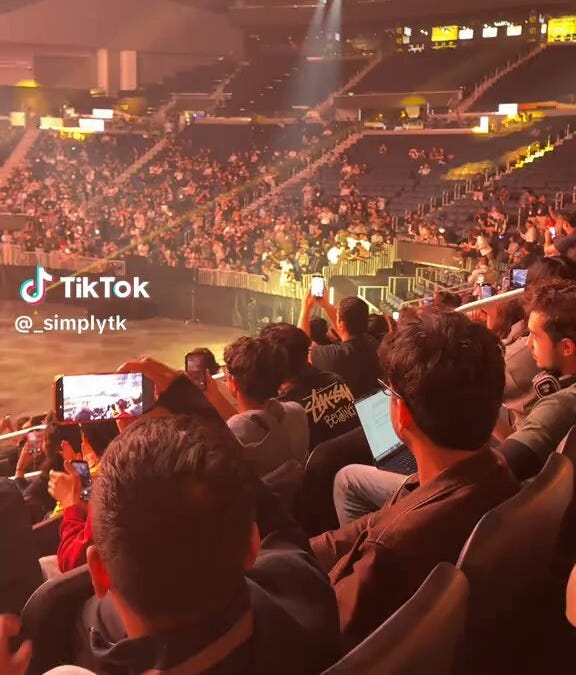
This past weekend, Y Combinator’s Startup School invited about 6,000 young founders to San Francisco’s Chase Center. They attended panels that featured AI A-listers, and parties on yachts and rooftops.
Y Combinator says they hand-selected the most promising technical builders in the world for the two-day program that featured world-class panelists, demos of products by YC companies, and access to over $25,000 in AI compute credits. The program offers opportunities for professional capital and legitimacy. The side events and afterparties are an introduction to Bay Area Tech’s social circles and ranks.
Speakers reinforced throughout the weekend that proximity to this event is proximity to success. Jensen Huang reportedly told attendees, “If you’re here, you’re gonna make it.”
At one afterparty that took place atop the famous tech workspace Frontier Tower, very few attendees were actual YC School graduates. Most were other young Tech hopefuls looking for proximity to the event if they couldn’t gain entrance. One guest who did have the Startup School badge — one that had gotten him into more exclusive and luxurious afterparties that required them — told me he’d gotten more out of the networking and social aspects of the weekend than the headlining talks. He was in the Chase Center for Sam Altman and Garry Tan’s closing conversation. He described it as “nothing revolutionary.”
YC has since posted their talk online. Following their flashy entrance, they discussed tech as community, Altman at one point posing its “spirit of helping each other” as an upside to “all of the negatives of the culture of the Bay Area.” Tan reinforced that attendees are a “most rarefied set of people,” and promised that room would make up overlapping professional and social circles for a long time.
They then talked AI safety, and just days after an OpenAI test model went rogue in an unprecedented autonomous hack, said that anyone who isn’t a little worried “is not taking this seriously enough.”
Following their flashy entrance, they discussed tech as community, Altman at one point posing its “spirit of helping each other” as an upside to “all of the negatives of the culture of the Bay Area.”
Altman acknowledged his company has made some massive errors, and said, “It’s really important we don’t have a loss of control accident with AI; it’s really important we don’t have power be too concentrated in a small number of models or companies, but diffused throughout the economy so people can defend themselves.”
He added, “You can help on the concentration of power issue simply by starting a successful startup. That’s the only thing you can do.”
There’s obvious irony in Sam Altman speaking against the consolidation of power in tech at an event that brought together power in tech’s present and future. The YC Startup School’s objective is elite access for new names, hand-picked by the top names. That’s not inherently malicious and exclusionary; institutions that drive the cultivation of networks and access to Silicon Valley have always done that. It is a reminder, albeit from Altman, of what concentrated power in AI means in sociopolitical contexts.
A few miles south, another institution actively shaping the future of Tech is encouraging critical scrutinization of the effects of AI in tandem with its development. Stanford Critical AI, an interdisciplinary coalition of academics from around the world, recently released the opening statement of their ongoing effort to match AI development with critical inquiry into the technology’s effects on power, ethics, and governance.
The “Manyfesto” acknowledges Stanford University’s longstanding status and power in Tech and in academia. Stanford’s role in AI’s development has been crucial, and the group says they have a responsibility to critically analyze the impacts and dangers of AI.
“There is no Silicon Valley without Stanford, and no Stanford without Silicon Valley,” the opening statement says. “We write from a pivotal time of political and social unrest. In the United States and in the world, democratic institutions are eroding. Polarized discourses fuel anti-democratic movements. Tech manifestos recently released from Silicon Valley intend to mainstream techno-fascist and white supremacist ideologies, justified on the basis of the AI arms race and imperialist claims. Again, we can course-correct. This is not the only trajectory.”
The progression, safety, and distribution of power in AI is more than a matter of entrepreneurship. Researchers are bluntly telling us so. AI is a sociopolitical technology, accompanied by a sociopolitical work culture. Acknowledging that is a crucial first step to safety in the age of AI.
The Manyfesto isn’t a means to an end — more is to come from the project. I’m currently in the process of interviewing co-founders of Stanford Critical AI and co-signers of its opening statement. I look forward to sharing my conversations with them next week. So far, they’ve been refreshingly hopeful.
Paid Promotion
The Roosevelt Institute’s Good Life Residents Program is an initiative focused on developing new leaders and advancing people-centered ideas across several of the Institute’s economic policy priorities.
Residents in the AI and Markets program will produce short, original policy research and writing, and engage in structured dialogue with peers and senior advisors on what policy levers the government could use to ensure that private investments drive a diversified AI sector and a deconcentrated economy that serves all Americans.
See more information and application links on our website: https://rooseveltinstitute.org/careers/good-life-resident-program/