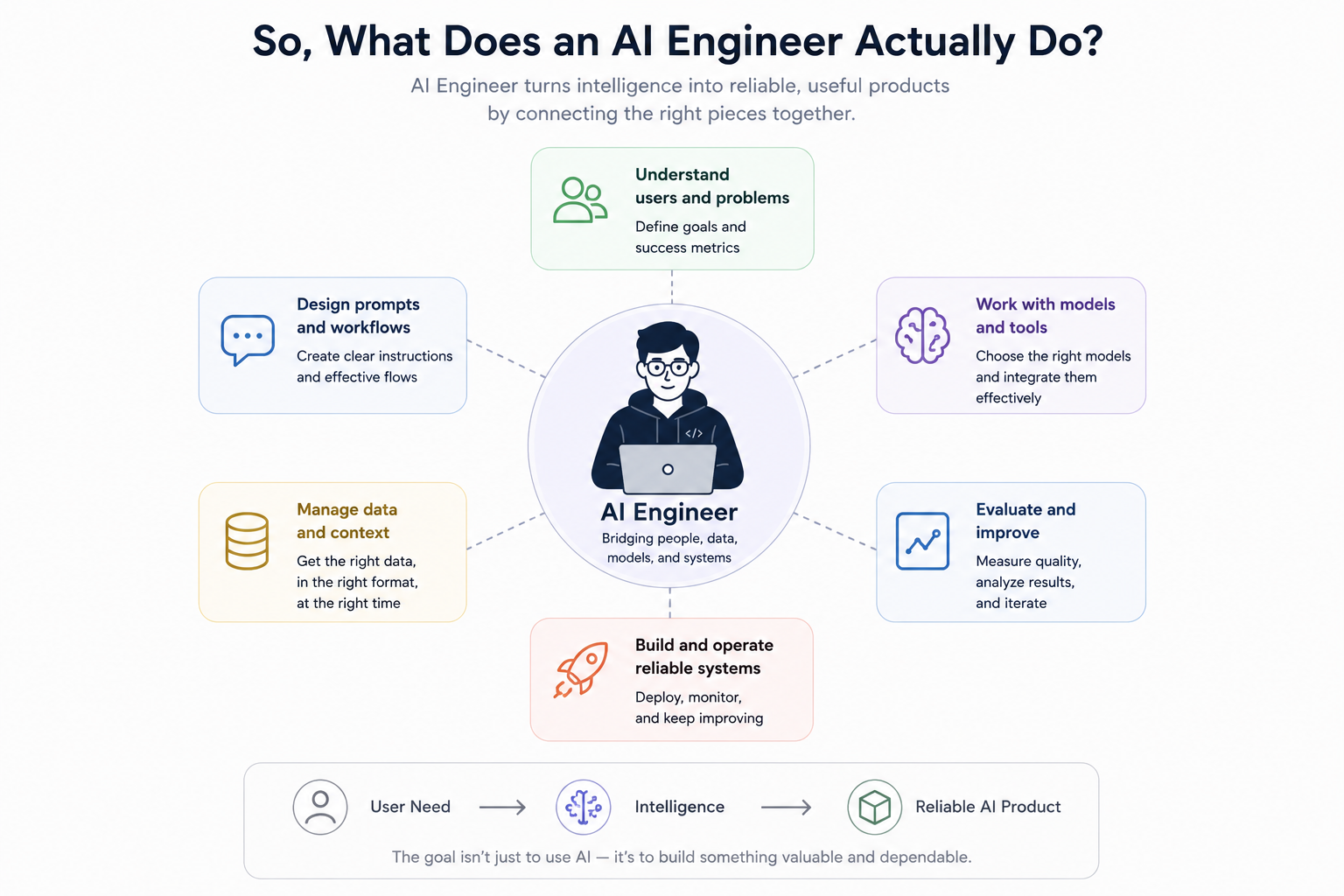
Stop thinking of AI engineering as just writing a few prompts and hitting an endpoint. After building several products, I've realized that the actual LLM interaction is the easiest 10% of the work; the remaining 90% is the grueling infrastructure and orchestration required to make it production-ready.
If you're just calling an API, you're a user of the tool. To be an AI engineer, you have to solve for the systemic instability of the model. It's less about the "magic" of the LLM and more about the boring, rigorous engineering that prevents that magic from crashing in production. The real struggle isn't getting a "smart" response—it's managing the volatility of that response. In a real-world AI workflow, you aren't just sending a string; you're dealing with token limits, latency spikes, and the nightmare of non-deterministic outputs that break your downstream parsers.
For anyone attempting a deployment from scratch, the "hidden" work usually falls into these buckets: Data Pipeline Reliability: Ensuring the context window is filled with high-quality, relevant data without introducing noise that triggers hallucinations.Evaluation Frameworks: Moving past "it looks right to me" and actually building a quantitative system to track regression when you tweak a prompt.Error Handling: Managing timeouts and rate limits so the entire UI doesn't just hang when the API lags.State Management: Handling long-term memory and session history without blowing through your budget on redundant tokens.
If you're just calling an API, you're a user of the tool. To be an AI engineer, you have to solve for the systemic instability of the model. It's less about the "magic" of the LLM and more about the boring, rigorous engineering that prevents that magic from crashing in production.

[Next Vector Search Cost Optimization: On-Disk vs. In-Memory →](https://promptcube3.com/en/threads/3256/)
All Replies (3) #
N
Forgot to mention evaluation frameworks. Hard to iterate if you aren't measuring output quality systematically.
0
J
Spent three weeks on data cleaning for a project that took ten minutes to prompt.
0
A
Are you using any specific orchestration tools for the workflow, or just custom Python scripts?
0