Uptime’s 2026 survey shows AI raising costs and density while narrowing management focus, as operators hedge with phased builds and struggle to forecast capacity.
Uncertainty is rising across the data center sector as operators try to anticipate how fast – and how far – AI will push capacity, cost, and operational demand.
AI is compressing once-separate risks – costs, capacity forecasting, power, and talent – pushing rack density higher, nudging workloads to third-party sites, and forcing phased builds even as outages decline, signaling a two-speed future for AI clusters and enterprise loads.
Uptime Institute’s 16th Annual Global Data Center Survey, released on July 29, captures responses from more than 1,600 participants gathered between April and May 2026, including more than 800 data center owners and operators.
Among the highlights:
79% of operators say costs are at least somewhat concerning to management.
The modal rack density (the most commonly reported density) reached 11 kW, up from 9 kW in 2025.
53% of operators now
track water usage, up from 47% in 2025.47% of operators report an impactful outage in the past three years, down three points year over year.
46% of IT workloads now run in third-party facilities (colocation and cloud), edging out enterprise-owned sites at 44% for the first time.
53% of operators report difficulty finding qualified candidates, up from 46% in 2025.
“No one – very few people – really [has] a clear answer to a lot of these issues,” said Andy Lawrence, executive director of research at Uptime Institute, during a webinar detailing the findings.
AI Uncertainty Pushes Forecasting Up the Worry List #
Cost remains the top management concern for the fourth year running, though its lead has narrowed. While 79% of operators say management is at least somewhat concerned about costs, the share calling it a top worry fell to 38% from 44% in 2024. Capacity forecasting has climbed into a near tie, with 76% at least somewhat concerned, followed by supply chain disruptions at 72% and power availability at 64%. Meeting AI infrastructure needs entered the top six list of concerns for the first time this year, displacing the push to meet facility efficiency improvement targets, which ranked third in 2025, said Douglas Donnellan, research analyst at Uptime Institute.
Lawrence linked these pressures, citing AI’s impact as a cross-cutting driver that ripples through the entire supply chain – even for operators not directly running AI workloads. Colocation rates, equipment costs, power prices, and staffing expenses are all rising faster than general inflation, he said.
The softening cost concern does not imply operators worry less about money. “It just means the other issues got more serious,” Lawrence said.
Rack Density Crosses 11 kW as AI and Enterprise Workloads Diverge #
The modal rack density surpassed 11 kW per rack for the first time in the survey’s history. Excluding a small number of facilities designed for densities above 30 kW, the average sits at 7.8 kW, up modestly from 7.5 kW in 2025.
Operators are effectively planning for two separate markets at once: high-density AI training clusters and CPU-based enterprise workloads, which still account for most installed capacity.
“You have the artificial intelligence training world – AI factories – which are driving rack densities up faster than anywhere else,” said Chris Brown, chief technical officer at Uptime Institute.
Brown cautioned that enterprise workloads are still growing at 25% to 30% annually on their own. Designing for AI-scale density without the AI-scale workload to fill it risks leaving capacity stranded. To hedge against that uncertainty, more operators are pursuing phased builds – opening facilities at today’s known density and adding power and cooling capacity as workload requirements become clearer, he said.
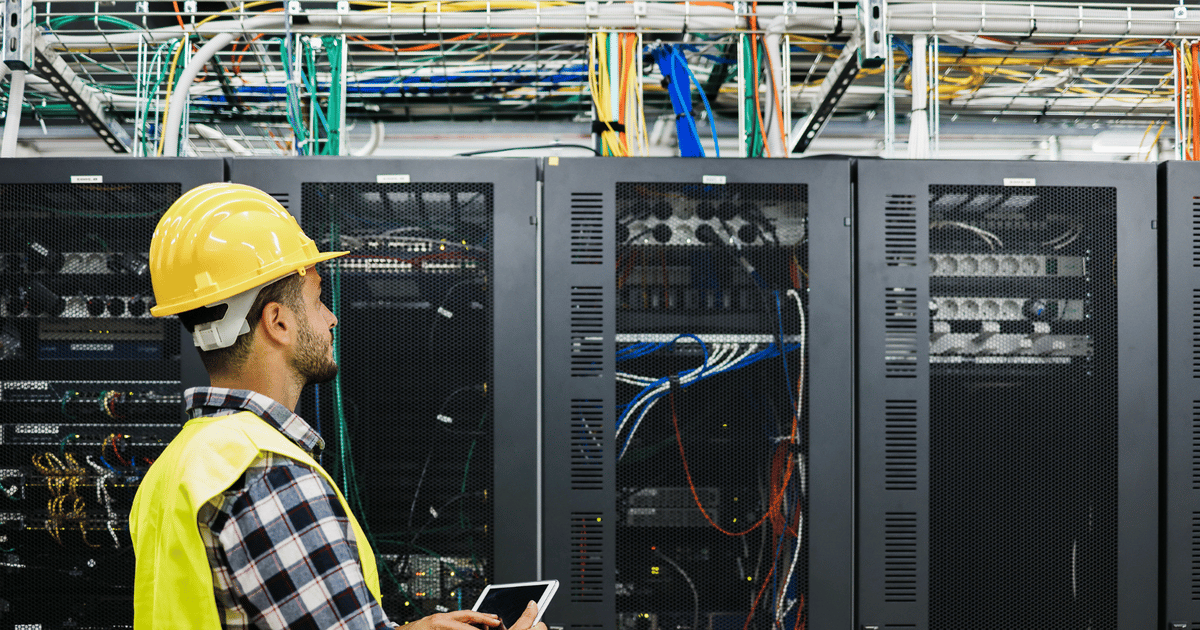
Operators stage capacity – power and cooling first, density later – to avoid stranding. (Image: Getty Images)
Sustainability Tracking Rebounds, but Carbon Accounting Lags #
After a slowdown in 2025, the share of operators collecting sustainability metrics returned to its longer-term upward trend. Power consumption is the most commonly tracked metric at 87%, followed by PUE at 79%. Carbon accounting continues to lag: only 21% of operators track Scope 3 emissions – the indirect supply-chain emissions beyond an organization’s direct operations and purchased energy.
AI has dominated management attention for the past two to three years.
“Building AI capability has been the top concern of almost every large, significant commercial data center company,” Lawrence said. “Sustainability is less talked about.”
Even so, the underlying commitment has not disappeared. “The truth is, almost every corporate client we speak to – even though they’ve probably bent the rules and dropped some of their priorities and rewritten some of their targets – they all still believe sustainability is important, and they also believe that it will become more important,” Lawrence said.
Outages Keep Declining, but the Serious Ones Persist #
The share of operators experiencing an impactful outage in the past three years fell to 47%, extending a six-year trend of improvement that has slowed since 2023. The proportion of outages classified as serious or severe stayed at 10%. At the respondent level, roughly 5% reported a severe or serious outage over the three-year period – still a significant number given industry-wide scale.
Lawrence credited redundancy, concurrent maintainability, and more modern facilities in the sample for longer-term gains. He warned, however, that grid instability, extreme weather, new technologies such as liquid cooling, and a persistent skills shortage could test whether the improvement holds.
Power problems remain the leading documented cause of outages, a status unlikely to change soon.
“Power touches everything,” Brown said. “For the foreseeable future, power is going to stay the top dog.”