Essay
A look at the actual plumbing of machine memory, why none of it decays the way ours does, and the one operation no architecture has.
The phrase is forgive and forget, and we say it like the two things are cousins. They aren't. Forgetting is something that happens to you. Forgiveness is something you do. One is a property of the substrate and the other is a skill learned on top of it, and a machine has neither. It cannot forget, because nothing in it was built to decay. And it doesn't know how to forgive, because forgiveness is an operation no architecture we ship actually has.
I want to make that literal, at the level of the plumbing, because this is one of those claims that sounds like a mood and is actually just engineering.
Four memories, none of them fade #
When people say "AI never forgets," they're usually gesturing at one system and imagining it's the whole thing. It helps to separate them. A modern AI system holds your past in four different places, and each one forgets in its own broken way, or not at all.
The weights are the oldest memory. Whatever a model saw in training is smeared across billions of parameters, and once it's in, we do not know how to get it out. This isn't a policy gap, it's an open research problem. Machine unlearning, removing the influence of specific training data without retraining from scratch, is unsolved at any real scale. You can delete the row from your database. You cannot delete the gradient it left behind. This is the quiet reason "the right to be forgotten" keeps colliding with machine learning: the law assumes forgetting is a delete, and the substrate has no delete.
The context window is the working memory, and it forgets like a light switch, not a dimmer. Inside the window, attention treats every token as equally reachable; your first sentence is as addressable as your last, with no softening for age. Then the session ends and it is all gone, completely, at once. Two states, eidetic or void. Humans spend our entire lives in the space between those two, and that space is where nearly all of the social machinery lives.
The retrieval store is where this gets its teeth. Embeddings don't blur. Cosine similarity has no time axis. A memory from three years ago is returned at exactly the fidelity of one from yesterday, with no felt sense of long ago attached. In vector space the whole past is co-present, sitting one nearest-neighbor lookup away. The past isn't a foreign country. It's the adjacent row.
And the logs, the snapshots and replicas and backups, mean that even deliberate forgetting is a distributed-systems project: tombstones, retention windows, backups that outlive the delete you thought you ran.
The forgetting machines do have is the wrong kind #
Here's the part that makes the picture stranger than "AI never forgets." Neural networks forget constantly, they're just terrible at it.
Train a network on a new task and it tends to overwrite the old one, wholesale. This is catastrophic forgetting, named by McCloskey and Cohen back in 1989, and it is still the reason you can't casually teach a deployed model something new without risking what it already knew. That's the terracotta cliff in the chart above: perfect retention right up until a sudden, total loss.
And even within a single context, transformers forget by accident. The "Lost in the Middle" work (Liu et al., 2023) showed that models recall information placed at the beginning and end of a long context far better than the same information buried in the middle. Nobody designed that. It's an emergent dead zone, an unprincipled forgetting that lands wherever the architecture happens to be weak.
So the real situation isn't a machine that remembers everything. It's a machine that either remembers perfectly or loses everything, with almost nothing in between. And that in between is exactly what human memory is.
Forgetting is a feature, not a bug #
The thing we call "forgetting" isn't decay for its own sake. Hermann Ebbinghaus measured the curve in the 1880s, memorizing nonsense syllables and watching them slip: fast at first, then leveling off. But the modern reading is the interesting one. Richards and Frankland made the case directly in their 2017 paper The Persistence and Transience of Memory: forgetting is an active, adaptive process that exists to help you generalize. A brain that kept every detail at full resolution would overfit to its own past. Letting the specifics fade is how the gist gets promoted to something reusable. Forgetting is compression with a purpose.
There's a mechanism underneath it that machines simply don't have. When you recall a memory, you don't read it, you reopen it. The act of remembering makes the memory briefly labile and then re-stores it, changed. This is reconsolidation (Nader, Schafe, and LeDoux, 2000), and it means human memory is fundamentally read-modify-write. Every recall is a small edit. Machine memory is read-only: retrieval returns the vector untouched, byte for byte, no matter how many times you pull it or what you now know.
That last point is the quiet one. In people, the feeling attached to a memory and the facts of it decay separately. Time doesn't delete what happened; it drains the heat out of it. A read-only store has no way to drain the heat, because it has no notion of heat at all. The record and its charge are the same immutable object.
The operation nobody built #
Which brings us back to the title. If you try to define forgiveness in a way an engineer could implement, you get something surprisingly specific: keep the record, at full fidelity, and stop letting it drive the behavior, while the option to let it drive the behavior is still fully available. Retain, re-weight, and don't act on it, on purpose, when you easily could.
Now look at the toolbox and notice that nothing does this.
- Machine unlearning is a forced delete. That's amnesia, not forgiveness, you didn't let it go, you destroyed the record. - TTLs, decay schedules, and expiring memories are eviction. Forgetting on a timer. - RLHF and fine-tuning set a blanket dispositionover everything at once. There's no per-memory grace, no "hold this one at full resolution and choose, this time, not to condition on it."
There is no op for that. Not in any framework I've shipped or read. The closest anyone gets is muzzling, a system configured to never bring the incident up, which isn't forgiveness either, because forgiveness only means anything when resentment was genuinely available and you didn't take it. A store that behaves identically whether it remembers or not has no way to even express the choice.
Why we got this and they didn't #
The honest answer is cost. Biological memory is metabolically expensive, neurons and synapses burn energy to maintain, so brains are under constant pressure to prune, compress, and let go. Scarcity is the teacher. We forget because holding is expensive, and I'd argue we let things go for a related reason: carrying a grievance is expensive too. Grace, of both kinds, evolved under a budget.
Machines have no budget like that. Storage is effectively free. A held memory costs nothing, a held grudge costs nothing, so there's no pressure toward release, ever. Nothing is expensive enough to need letting go of.
I find this genuinely interesting rather than gloomy, because it points at where the fix would have to come from, and it isn't a bigger context window or a better values document. If machines ever learn the in-between, graceful decay, separable emotional charge, memory you can hold without being run by it, it will come from making memory and grievance cost something. From scarcity. The same teacher we had.
Until then it's worth being precise about what we're deploying. We are putting perfect-recall systems into the middle of human relationships that quietly evolved around imperfect recall. Second chances were never really a policy. They were an artifact of biology, a gift that shipped with the hardware. Build something that remembers everything at full fidelity forever, and you don't get a better version of us. You get something that has never once been offered the first mercy, the one that arrives, unasked, as forgetting.
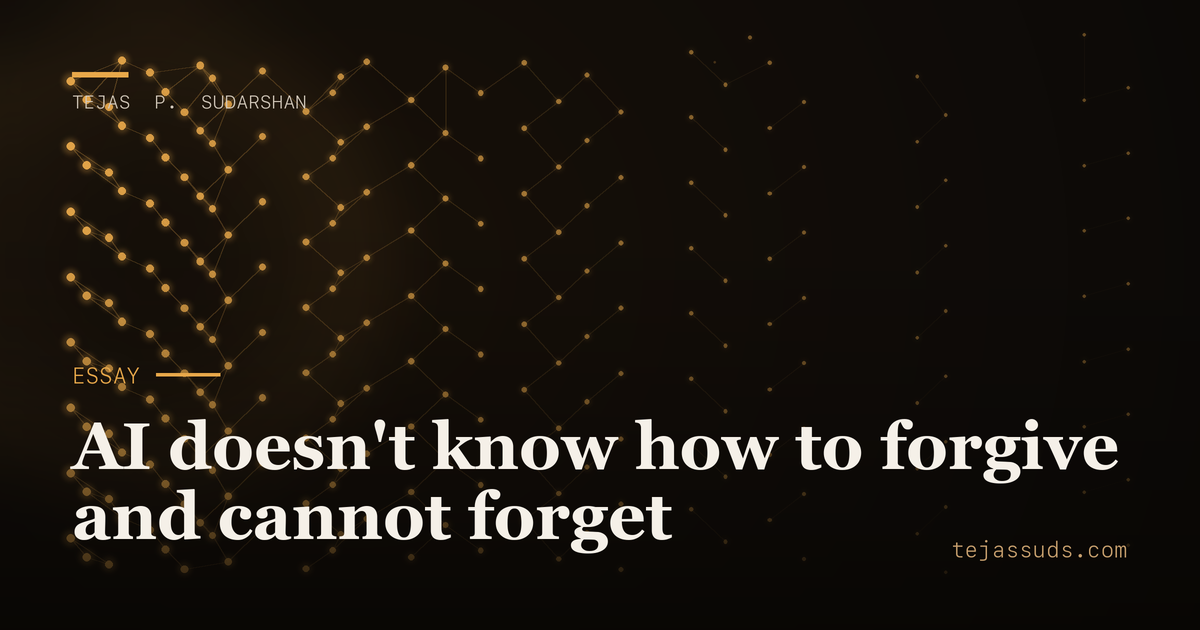
About the cover: it's the whole essay in one frame. On the left, a dense lattice of memory nodes, every one lit to the same brightness, connections intact, nothing dimming with distance, that's machine memory, the co-present past. Toward the right the lattice frays: nodes thin out, connections drop, and the last of them come loose and drift off as sparks. That's the human curve, forgetting as pruning, detail let go so the shape can survive. The picture is the argument: one side never fades, the other side fades on purpose.
Sources worth reading: McCloskey & Cohen (1989) on catastrophic interference; Liu et al. (2023), "Lost in the Middle"; Richards & Frankland (2017), "The Persistence and Transience of Memory"; Nader, Schafe & LeDoux (2000) on reconsolidation; and Ebbinghaus (1885) for the original curve.
tagged with