KAIST model detected autism-related social deficits in mice without prior biological training
Researchers at the Korea Advanced Institute of Science and Technology have developed an artificial intelligence model that interprets animal movement patterns in a way similar to how language models analyze words, the institute said Wednesday.
The research team created an AI model called BehavERT that analyzes sequences of animal movements in context, much like a language model studies how words form meaning in a sentence.
KAIST said the model independently detected core social behavior deficits in mice used to model autism, without being trained on biological knowledge in advance.
The team converted the skeletal coordinates of body parts such as the nose, ears, spine, limbs and tail of mice into tokens and fed them into a BERT-based transformer model, a type of AI architecture widely used in natural language processing.
According to KAIST, BehavERT did not simply classify behavior, but learned patterns in animal movement over time.
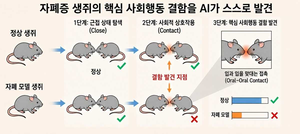
In experiments, the model focused on mouth-to-mouth contact behaviors when distinguishing between autism model mice lacking the Shank3B gene and control mice.
KAIST said the finding matches previous research showing that autism model mice can approach other mice normally, but show deficits in actual social interaction. This suggests the AI identified a key feature of autism-related behavior through observation alone, the institute said.
The model outperformed existing state-of-the-art models in five international benchmark tests covering social interaction, multianimal behavior, 3D movement analysis and autism-related behavior analysis.
KAIST said BehavERT can also show researchers which behaviors it focused on when making its judgments, making the model more interpretable.
The model also organized behavioral traits such as movement, attention and sociability, suggesting that animal behavior may have a structure comparable to language, KAIST said.
The findings could open the way for a next-generation “behavior foundation model” that can be used in drug development, psychiatric research and behavioral genetics, the institute added.
KAIST said all members of the research team, including top author Shin Seung-jae, were life science researchers who taught themselves to use AI, designing the model and training strategy for behavioral analysis from scratch.
“BehavERT is a new AI model that can go beyond simply classifying behavior to understanding its meaning,” said professor Kim Dae-soo, who led the research team.
“We expect it to become a key research tool that can lead to new discoveries in various areas of life science, including drug development, psychiatric research and behavioral genetics.”
seungku99@heraldcorp.com