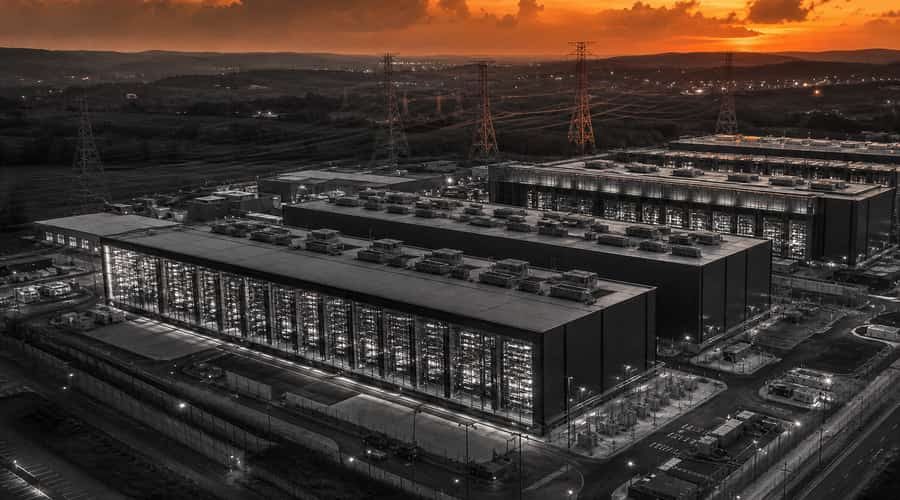
PJM's latest capacity auction did not just raise a warning about AI power demand. It showed you where the AI buildout hits physics: not in a model lab, but at a grid connection.
PJM Interconnection announced on July 14, 2026 that its 2028/2029 capacity auction secured 138,318 megawatts of unforced capacity, with another 10,864 megawatts coming through fixed resource arrangements. That still left the grid 6,831 megawatts short of its reliability requirement. This is not a footnote. PJM serves more than 67 million people across 13 states and Washington, D.C., so a shortfall inside this market becomes a bill problem, a siting problem, and a data center problem very quickly.
According to Bloomberg, the auction's cleared supply was worth $16.4 billion, and data centers accounted for roughly $6.3 billion of that total. PJM's own release said the auction cleared at the FERC-approved cap of $325 per megawatt-day, down 2.5% from the $333.44 cap in the prior auction. That sounds like relief only if you ignore the starting point. Capacity prices were $28.92 per megawatt-day in the 2024/2025 delivery year. Two years. Brutal.
If you're planning GPU clusters and assumed the bottleneck was chips, export controls, or cloud contracts - think again. Power is now a first-order limit on AI deployment, and it does not move at the speed of capital: PJM has projected peak demand growth of about 32 gigawatts from 2024 to 2030, with roughly 30 gigawatts tied to data centers, as Canary Media and Data Center Dynamics have both noted from PJM's forecast. You can raise money in weeks. You can't permit and build transmission that way.
The grid is now an AI constraint #
The July heat wave showed what those auction numbers look like in real operations. S&P Global reported that PJM reached a preliminary unrestricted peak-load estimate of 168.158 gigawatts on July 2, above the previous 165.563 gigawatt record set on Aug. 2, 2006. PJM said the estimate is subject to confirmation after demand-response performance is measured. That caveat matters, but the direction does not change. The largest U.S. grid was pushed past a 20-year peak at the same time AI load is still climbing.
The U.S. Department of Energy has already had to step in. DOE's 2026 Section 202(c) order page shows emergency orders No. 202-26-32 and No. 202-26-33 issued to PJM on June 30, with an extension on July 2, and another PJM order, No. 202-26-35, issued on July 14 ahead of a fresh Mid-Atlantic heat event. One order authorized PJM to direct large loads with at least 50 megawatts of peak demand at a single delivery point to reduce grid draw and use backup generation as a last resort before or during an Energy Emergency Alert Level 3. Another let specified power units run as needed for reliability. That is federal emergency power being used as grid planning triage.
Frankly, that should unsettle anyone treating electricity as a guaranteed input. Data centers have spent years negotiating as prized load, the kind of customer utilities compete to serve. Now the same facilities are being written into emergency procedures as resources to be managed when the system is tight. That assumption is gone.
The politics are moving too. Bloomberg reported in June that federal officials had floated the idea of breaking up PJM, the largest grid operator in the country, as data center demand raised costs and strained supply. In May, Bloomberg also reported that FERC Chair Laura Swett said PJM "perhaps simply has grown too big to function." PJM CEO David Mills has used his own blunt language, writing that the current situation was "not tenable." When regulators, governors, and the grid operator are all talking like that, you don't have a normal market wobble. You have a governance fight.
Where the money is moving #
The money is already responding. Utility Dive reported on July 17 that Bank of America analysts expect the U.S. to need more than 230 gigawatts of new generating capacity over the next five years, while regulated utilities are expected to add only about 93 gigawatts of accredited supply. The same analysis said more than 7.5 gigawatts of data center projects with on-site generation are already under construction, with more than 60 gigawatts in pre-construction. Natural gas engines, batteries, grid-adjacent power deals, you name it, are all being pulled into the AI buildout because waiting for the shared grid is now a commercial risk.
The transmission gap makes that risk harder to solve. Grid Strategies found that the U.S. built only 888 miles of new high-voltage transmission in 2024, far below the roughly 5,000 miles a year implied by the Energy Department's 2024 transmission planning work. Grid interconnection delays already stretch for years in many regions. No amount of demand for AI inference changes the fact that a power line has to cross land, courts, agencies, and local politics before it reaches a substation.
Virginia shows the concentration problem better than any abstract national figure. EPRI's 2026 Powering Intelligence update says Virginia is the only state where data centers already consume more than 20% of electricity, and that share could rise to between 39% and 57% by 2030. Loudoun County and the wider Northern Virginia corridor are not just hosting another tech cluster. They are reshaping a regional power market.
The arithmetic is ugly. AI demand is arriving in large blocks, at specific locations, on timelines set by developers and hyperscalers. Grid supply arrives through auctions, queues, permits, turbines, transformers, transmission studies, and local fights over who pays. The emergency orders, the capped auctions, the breakup talk, and the rush toward on-site generation are all symptoms of the same imbalance. Demand got there first. Supply is still catching up.
Also read: Intel's stunning 2026 revival faces its biggest test as Q2 earnings land today • Uber cuts 10% of customer service staff and becomes the first gig-economy giant to blame AI • Westinghouse lands an $80 billion nuclear contract and AI is the reason why