Utah’s most powerful state senator just lost his primary — not over abortion, not over immigration, not over anything the political press expected to matter in 2026. He lost over a data center. That should tell you something about where we are.
State Senate President J. Stuart Adams backed the Stratos Project, a sprawling data center campus planned near the Great Salt Lake and backed by Shark Tank investor Kevin O’Leary. Sixty percent of Utah voters opposed it. Adams is now a private citizen. Box Elder County Commissioner Lee Perry, who lost his own race, put it plainly: “Do I think that the data center vote cost me the election? Yes I do.”
Similar results played out in Oregon, Virginia, and Missouri. In Georgia, Democrats flipped seats on the Public Service Commission in 2025 after running explicitly on data center cost-shifting. This is not a local story anymore.
The Numbers Voters Are Actually Seeing #
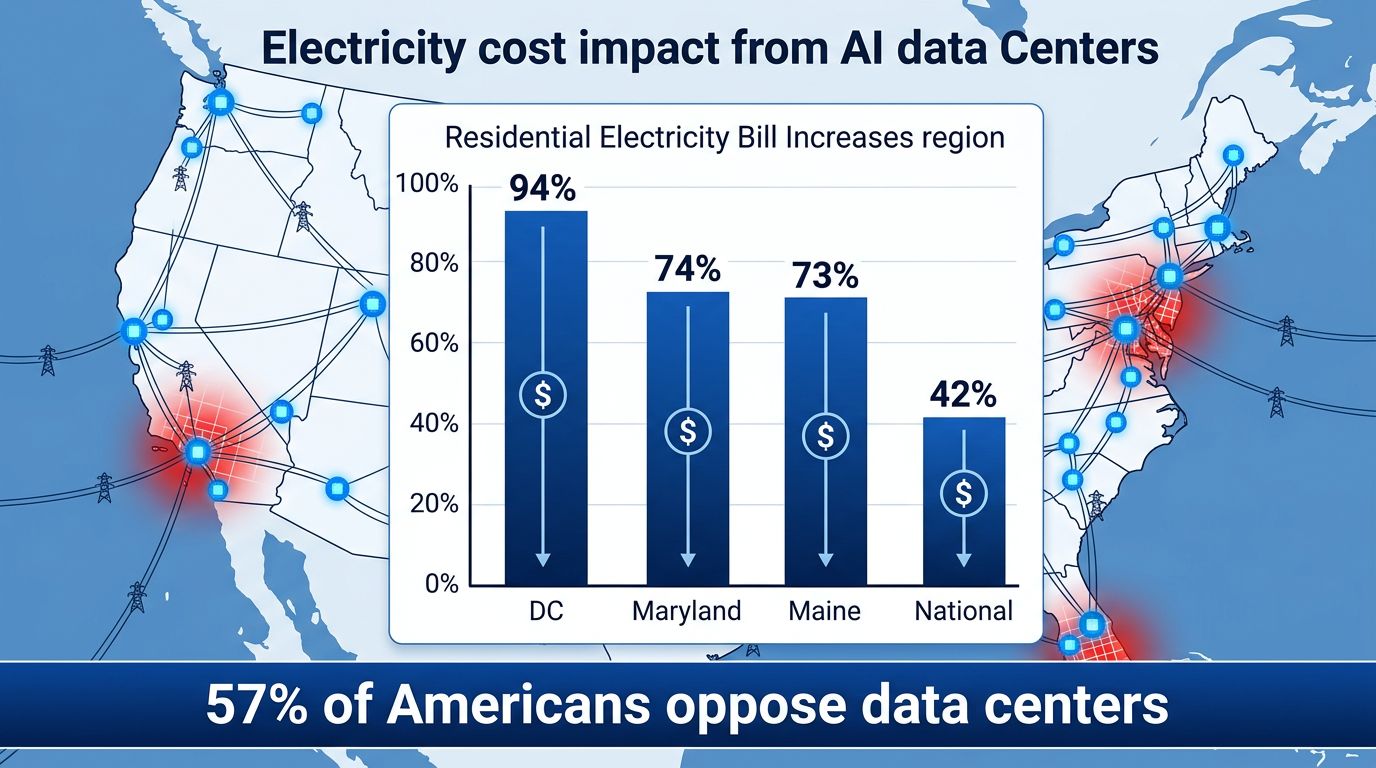
A Reuters/Ipsos survey found 57% of Americans would oppose a data center being built in their community. Gallup puts that figure closer to 70%. These are numbers usually associated with opposition to landfills or chemical plants — not the infrastructure that powers everyone’s AI tools.
The electricity math is real, even if some politicians have overstated it. Sen. Elizabeth Warren cited a 267% electricity cost increase near data centers — PolitiFact rated that Mostly False, since that figure refers to wholesale prices, not residential bills. But the actual residential numbers are still striking: Washington, D.C. saw a 94% electricity cost increase between 2021 and 2026; Maryland, 74%; Maine, 73%. The national average is up 42%.
Data centers drove an estimated $9.3 billion in capacity market price increases in the PJM electricity market — translating to roughly $18 more per month for a western Maryland household. And this is before the big buildout is even complete. The Electric Power Research Institute estimates data centers could account for 9–17% of total U.S. electricity demand by 2030, up from about 4.4% in 2023. Bloom Energy’s January 2026 report put it bluntly: data center power demand will nearly double by 2028, adding the equivalent of Spain’s entire national energy consumption in three years.
Bipartisan Opposition Is a Signal Worth Taking Seriously #
When Texas Republicans and Georgia Democrats agree on something, pay attention. In June, Governor Greg Abbott directed the Public Utility Commission and ERCOT to require data centers to pay all their own electric infrastructure costs — no cost-shifting to residential ratepayers. He’s also pushing to repeal the data center sales tax exemptions that have made Texas a destination for big tech buildout. His directive was explicit: data centers must bring their own power.
Twenty-seven states are now considering “large load” legislation that would require data center developers to bear the costs of new energy infrastructure. A White House Ratepayer Protection Pledge got signatures from major data center operators in March — but it has no enforcement mechanism, and state legislatures aren’t waiting.
The Industry’s Defense Isn’t Holding Up #
The standard pitch from data center developers goes like this: we bring jobs, we pay taxes, we grow the local economy. Harvard researchers found that the jobs argument is the weakest part. Data center operations typically require 20–50 staff members, not the workforce that construction headlines imply. Virginia and Georgia surrendered over a billion dollars in tax revenue through data center tax exemptions. OpenAI’s Stargate Project in Michigan — a flagship example of the AI infrastructure boom — covers more than two million square feet and draws 1.4 gigawatts of power. That’s enough electricity for a million households, from a single facility.
There is a counterargument worth noting: the Institute for Energy Research found no statistically significant relationship between data center density and electricity prices when looking across all 50 states. Regional effects may not translate to a national pattern. But that nuance isn’t landing with voters who are opening electricity bills 74% higher than five years ago, regardless of what’s driving the increase at the macro level.
What This Means for Developers and the Tech Industry #
The infrastructure behind modern software — the servers, the cooling, the grid connections — has always been someone else’s problem. That assumption is now being tested by voters, regulators, and politicians across party lines.
If you’re building on cloud infrastructure, deploying AI workloads, or working in any company that runs large-scale compute, the political environment around that infrastructure is changing. Location decisions for data centers are becoming geopolitically fraught. “Bring your own power” is moving from Texas policy to likely national standard. Environmental impact reviews, water usage requirements, and community approval processes are all becoming harder to skip. The era of externalizing infrastructure costs to ratepayers while capturing all the upside is ending — not because the tech industry became more ethical, but because voters started paying attention to their electricity bills. The industry’s challenge now isn’t just building more data centers. It’s figuring out how to build them without losing a Senate president along the way.
For a deeper look at data center energy projections, the Brookings Institution’s analysis on global AI energy demands is worth reading alongside the Harvard Gazette’s community impact study.