Anthropic has put a number on the economic future it thinks AI could create — and the most extreme version of it looks like nothing the modern economy has ever seen. In a new interactive model released by its economics team, the company lays out three possible paths for the US economy through 2030, ranging from barely noticeable to civilization-altering. In the most dramatic of these, annual GDP growth hits 15%, the economy doubles in size every four-and-a-half years, and yet unemployment among knowledge workers climbs to 17.9% — pushing economy-wide unemployment to 11.9%, beyond anything seen in a typical recession.
The tool, called the Economic Scenario Explorer, lets users plug in their own assumptions about how capable AI will become and how quickly it gets adopted, and then shows what the resulting economy might look like. It’s built on a technical report from Anthropic’s economics team, “Economic Scenarios for Transformative AI,” and is meant as a companion to the company’s existing Economic Index, which tracks how AI is being used right now rather than how it might reshape things later.
This comes from the same company whose CEO, Dario Amodei, has for over a year been among the most vocal voices in Silicon Valley warning about AI’s disruptive potential — previously predicting that AI could wipe out half of all entry-level white-collar jobs within one to five years, and more recently describing a future combining very high GDP growth with very high unemployment and inequality — a pairing he’s called one the world has almost never seen before. This new model appears to be Anthropic’s attempt to formalize exactly that intuition into hard numbers.
Three Futures, One Big Fork In The Road #
Anthropic’s model treats every job as a bundle of tasks — drawn from the US Department of Labor’s O*NET taxonomy — and asks how AI affects each one. A task can stay untouched, get augmented by AI, get fully automated, or spawn an entirely new task that didn’t exist before. Scale that across the roughly $30 trillion of task-value the US economy generates in a year, and you get a rough model of the whole economy.
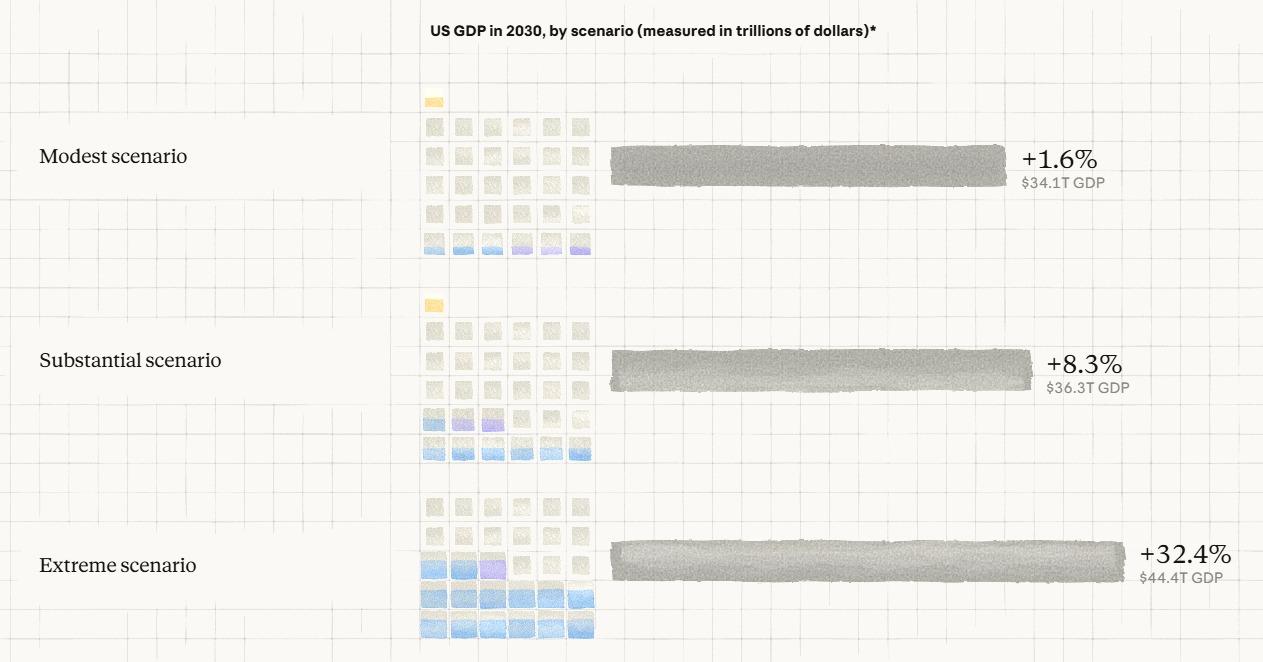
From there, Anthropic sketches three scenarios: The modest scenario treats AI like the internet — a real but gradual boost to productivity that barely shows up in the macro data. GDP comes in at $34.1 trillion by 2030, just 1.6% higher than a world without AI at all.
The substantial scenario has AI capable of doing half of all knowledge work by 2030, mostly autonomously, though it’s only adopted for a fraction of that potential. GDP growth doubles versus the modest case, hitting $36.3 trillion, an 8.3% lift. Wages for knowledge workers go flat, while other workers see real gains.
The extreme scenario is where things get wild. AI becomes more productive than humans at nearly all knowledge-work tasks, does almost all of them autonomously, and — critically — creates essentially no new tasks for humans to pick up in its wake. Anthropic says this scenario “would likely require recursively self-improving AI, adopted quickly for knowledge work.” GDP reaches $44.4 trillion, a 32.4% jump, with annual growth rates around 15% — enough to double the size of the economy every four-and-a-half years.
The Catch: Society Gets Richer, But Knowledge Workers Don’t Necessarily Benefit #
The GDP numbers alone would be a historic best-case scenario for global capitalism. The trouble, in Anthropic’s own telling, shows up in who actually captures that wealth.
In the extreme scenario, the model finds that a huge share of knowledge workers either lose their jobs or get pushed into occupations less exposed to AI — with Anthropic pointing to coders and call center agents potentially having to retrain as electricians or nurses. Because switching occupations is slow and hard, a lot of people end up stuck between jobs for a long stretch, and unemployment in that scenario rises “beyond typical recessionary levels” — a description that undersells just how sharp the numbers actually are. According to Anthropic’s underlying technical report, unemployment among knowledge workers hits 17.9% in the extreme scenario, dragging economy-wide unemployment up to 11.9% — well above anything the US has seen outside its deepest recessions.
Wages follow a similar split. Anthropic’s model shows average wages rising across all three scenarios — but almost entirely outside of knowledge work. In the extreme case, wages for knowledge workers fall 11.5% below where they’d be without AI, even as pay in other occupations rises 33.6% above that same baseline, boosted by AI-driven productivity spilling into physical industries like construction.
And then there’s the split between labor and capital. Today, roughly 60 cents of every dollar the US economy produces goes to workers, and 40 cents to capital. Anthropic’s model shows that ratio tilting hard toward capital as AI automates more tasks — dropping to 56.1% labor share in the substantial scenario, and all the way down to 45.2% in the extreme one, a swing of nearly 15 percentage points. Total labor income, Anthropic notes, is “barely changed by 2030” in the extreme scenario even though the overall pie is dramatically bigger.
What People Actually Expect #
Anthropic paired the model with a survey of over 10,000 Americans conducted in August, asking about their expectations for AI capabilities, adoption, and how easy it would be to find new work if forced to switch occupations. The average respondent’s answers land close to the substantial scenario — implying GDP 10% higher by 2030 and unemployment near 5%. Only around 10% of people surveyed had expectations that lined up with the extreme scenario Anthropic describes.
That gap between what the model calls “extreme” and how few people expect it is notable given how aggressively Anthropic’s own leadership has pushed the idea that this outcome is plausible. It’s a pattern Amodei has repeated in interviews: warning that AI labs and governments alike have been under-preparing the public for what’s coming, because most people simply don’t believe predictions this dramatic could be true.
Anthropic’s Own Caveats #
To its credit, Anthropic is upfront about the limits of the model. The company notes this is version 1.0, built with input from a long list of external economists including Daron Acemoglu, David Autor, and Emi Nakamura, and that it deliberately leaves out things like policy responses, business cycles, aggregate demand effects from the ongoing AI data center buildout, and the possibility of “hyper-capable robots.” Some reviewers reportedly told Anthropic that the extreme scenario is better read as a thought experiment than a realistic forecast, while others argued the modest scenario actually understates AI’s effects already visible in the data today.
Anthropic says the model will feed into the economic futures research it funds and the policy proposals it’s pushing to make sure AI’s economic gains are broadly shared, rather than concentrated among a smaller and smaller set of winners.
For a company that builds and sells the very technology at the center of this projection, the extreme scenario amounts to a grim acknowledgment: the same AI systems driving Anthropic’s growth could, on its own numbers, hollow out the exact class of white-collar, knowledge-economy jobs its chatbot Claude is most often used for today.n used for today.