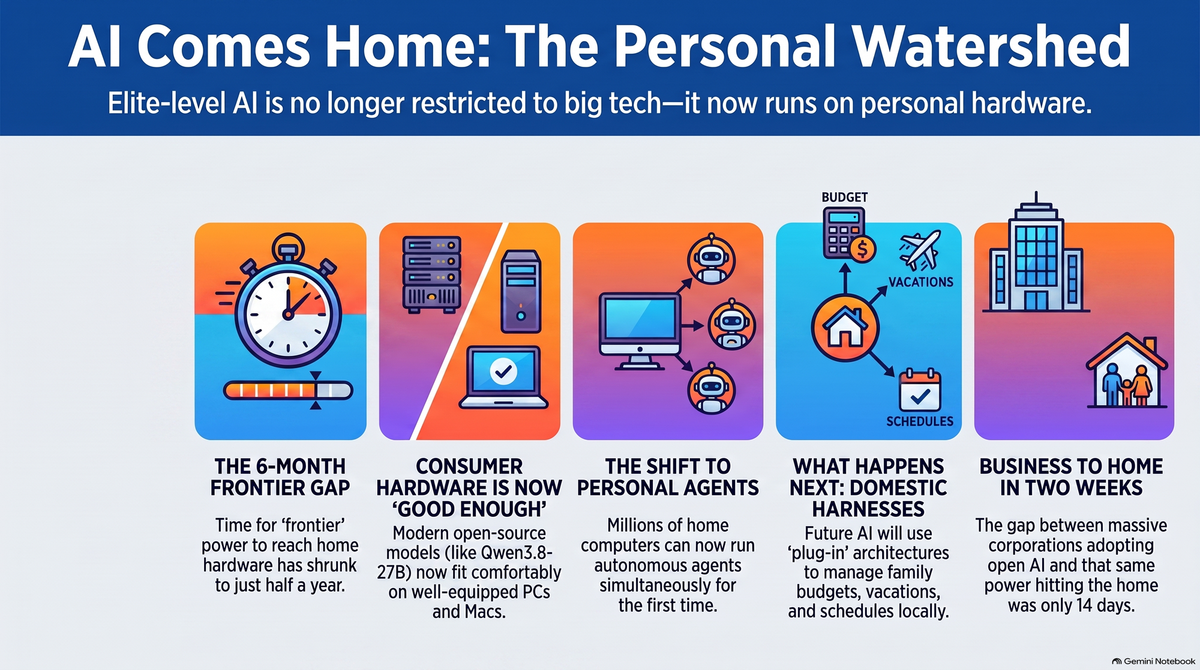
Two weeks. That's the entire gap between the arrival of the Business Watershed and the Home Watershed.
On the very last day of July, DeepSeek released their latest flash model. It is, byte for byte, the most capable AI model we have ever seen. It's smaller than some of the frontier models, but it's very smart. Not quite as smart — but more than smart enough.
A week and a half later, the Wall Street Journal published an article about how telecommunications giant AT&T intended to throw its full weight behind open models - like DeepSeek - for its AI needs, and thereby manage its AI costs.
It's only a single data point. AT&T is a very big company that owns and runs its own data centres. But it points to a mid-term future where it is nothing extraordinary for a large business to buy and provision the open-source AI services it will need.
I've run a number of tests on hardware ranging from $5,000 to $20,000 to find out whether 'DIY AI' could offer SMEs a reasonable path to using more-than-good-enough AI in a business context - and the answer is probably yes.
Rather like the first PCs from 45 years ago, a business may very well need several of these AI appliances. One per department. Then - as prices drop and quality improves - everyone gets one.
Which brings us to the 14th of August.
Alibaba's AI arm, Qwen, released Qwen3.8-27B — a smaller version of the gigantic model they had released publicly just days earlier.
It is now, byte for byte, probably the most powerful model that has ever been released. It is small enough to fit comfortably on a well-equipped PC or Mac. Whether it runs well on a PC will really be determined by whether that PC has a good GPU. Most Macs, with their unified memory architecture, will probably run it reasonably well.
If the model is as good as the benchmarks seem to indicate, it's the rough equivalent of the frontier model Claude Opus 4.6, released in February. That means the temporal distance between the frontier and the home is only six months. And the distance between the business and the home is just a few weeks.
From today, pretty much anyone with a 'good enough' computer can run agents. The potential number of agents that can be run simultaneously now reaches into the hundreds of millions - and that's just on home computers! That effectively happened overnight.
A few days earlier, Meta released Muse Glimmer — their own compact model. While it's probably not quite as good as the equivalent model from Alibaba, it actually looks to be quite good, and may in fact be "good enough" for a wide range of agentic tasks.
So, this isn't a singular example of one model crossing the Home Watershed. It's two models from two different companies in two different countries, releasing models that arguably both cross it. This isn't a fluke. This is the way things are now.
We can expect a dramatic uptake in systems capable of running this class of Home Watershed model. Those systems will be high-end products: more expensive, and eventually highly optimised to run these models well. We will likely see manufacturers pair with model creators to develop custom hardware/software combinations that work extraordinarily well together. Apple, as the manufacturer with the inside track, has the most to gain from this — but is the least likely to open themselves up in this way.
Then we come to the harnesses. The tool where the work gets done.
Twenty-four hours before the Home Watershed, DeepSeek dropped their own harness. Unique in its design, as you would expect from such an innovative AI firm, its key point of difference is that "everything is a plug-in".
That means this harness can be good at whatever you want it to be good at. The timing could not be better, because we will need plug-ins for every sort of domestic task you can imagine — whether that's managing the family budget, planning the family vacation, organising the family schedule, or who knows what. But that's the point of having a plug-in architecture: you don't have to do everything. You don't have to control everything. You can just step back and let a thousand flowers bloom.
Now that I've spent the better part of a day playing with Qwen3.8-27B, I can tell you that it does seem to be as intelligent as I'd expected. As capable as it needs to be. And arguably the rough equivalent of a frontier model released just six months ago.
That means - nearly 70 years to the day from when artificial intelligence became a discipline - artificial intelligence has come home.
Author's note: this draft was cleaned up from my audio dictation by - you guessed it - Qwen3.8-27B!