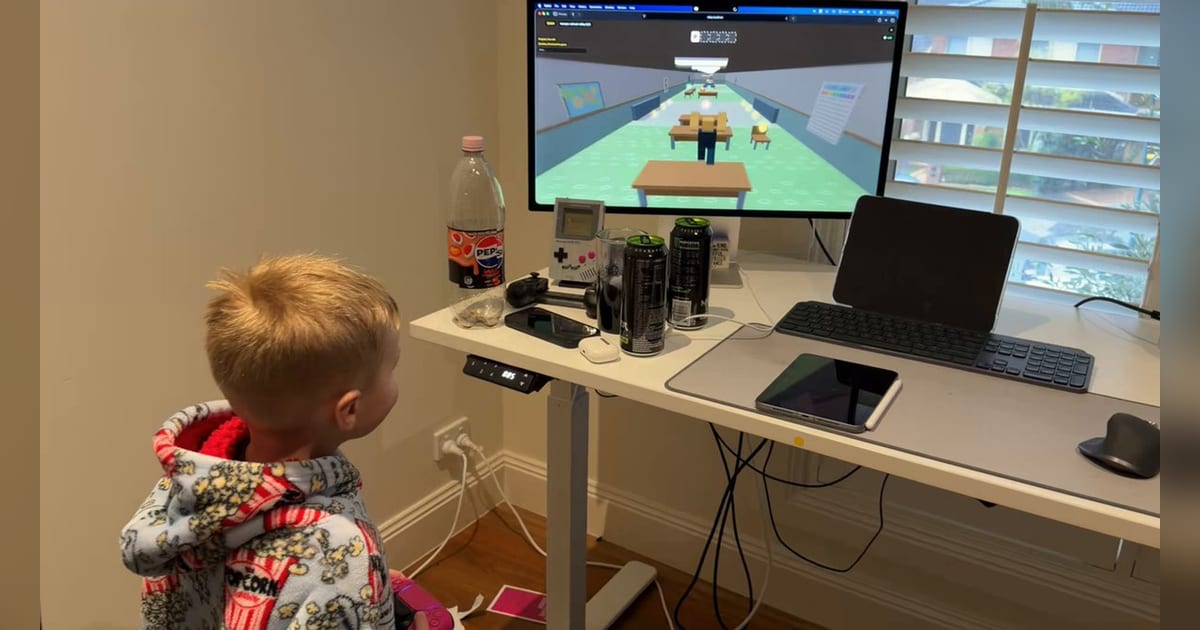
Adam Lyttle, a Melbourne-based solo developer, built a custom browser game for his son after deciding the child could not play Roblox because the family did not know who he might encounter there. His prototype points to a broader consequence of AI-assisted software development: parents can increasingly turn household rules, learning goals and a child's preferences into working software rather than waiting for a mass-market product to accommodate them.
Lyttle described the project as "vibecoded," a term commonly used for building software by directing AI coding tools. He used Three.js, the JavaScript 3D library for interactive browser scenes, to make a stripped-down imitation centered on "obbys," the obstacle-course format common across Roblox.
The game encodes one household safety rule in its architecture: Lyttle's son can experience a busy game world without being connected to strangers. Every other character is a recording of an earlier playthrough. They appear to run beside the child, though nobody else is connected at the same time. Lyttle said the current recordings were captured while he and his son tested the game.
That design preserves the movement and crowded screens of multiplayer while removing live chat, unpredictable behavior and direct contact with other players. Recorded players cannot harass the child or introduce new material, but they also cannot collaborate, communicate or provide genuine companionship.
AI-assisted coding changes the parent's available response. Instead of choosing between accepting a large platform's design and banning it outright, a technically capable parent can attempt to build a smaller alternative around one family's requirements. The product specification can be unusually personal: this child, this safety boundary and this preferred style of play.
Lyttle published the prototype on August 11 and released a rough playable build. He said he was working on generating more varied obstacle courses before creating additional levels and releasing the game more broadly.
The project also reflects Lyttle's experience as a parent-builder. His personal site says he has shipped more than 40 iOS apps, including educational games such as Piano Pals and the Spanish vocabulary game El Taxico. The prototype does not show that any parent can produce a polished game on demand. It does show how AI coding tools can compress the distance between a parent's idea and a playable piece of software, particularly when the builder already knows how to ship products.
The Roblox comparison has limits. Lyttle has demonstrated an obstacle-course game, not a replacement for Roblox's creation tools, user-generated catalog or social network. Roblox also offers parent-managed communication controls and lets account owners limit or disable chat. Lyttle's design takes the stricter route by eliminating the live social layer instead of managing it.
The opening video had accumulated more than 1.3 million views, 8,000 likes and hundreds of replies in the supplied snapshot. The immediate test is whether prerecorded activity can keep Lyttle's son's attention once the illusion becomes familiar. The longer-term question is what happens when custom family software becomes easier to make: games could be built for a child's interests, abilities and household boundaries, while products designed for millions face competition from experiences made for one.
That future would not eliminate the advantages of large platforms. Custom games still need design judgment, testing, maintenance and enough content to remain engaging. But Lyttle's prototype suggests that AI can shift some product decisions away from platform operators and toward parents, turning software from something families configure into something they increasingly build for themselves.