A Brown University economics professor went public this week after 40 out of 86 students scored 100% on a take-home exam — median of 98% — in what he called mass AI fraud. The story hit Hacker News with 330 points. The academic outrage is understandable, but the real story is in the hiring data: Fabric’s analysis of 19,368 technical interviews found that 38.5% of candidates used AI to cheat, rising to 48% for purely technical roles. Here is the part that should stop every hiring manager cold: 61% of those cheaters passed.
The technical interview, already an imperfect proxy for job performance, is now measuring something different from what hiring teams think. The format has not kept up. The tools have.
The Numbers Are Worse Than You Think #
Fabric’s data is not a tail event. Of candidates who cheat, 30% do it in every single interview as a fixed strategy — not situationally. Only 47% of candidates never cheat at all. Cheating rates spiked 3x between July and September 2025, which Fabric labels a shift from “experimental” to “structural.” Sunday interviews hit a 47.1% cheating rate, the weekly high — presumably because stakes feel lower and monitoring seems relaxed.
Karat, which runs live technical interviews for companies at scale, corroborates this independently: one of its enterprise customers suspects more than 80% of candidates use LLMs on top-of-funnel code tests despite being explicitly told not to. When two datasets from different methodologies land at the same conclusion, it is not noise. The LeetCode screen and the take-home project have quietly stopped being hiring signals. They now measure who has the best AI setup.
Related:[Engineering Jobs: The AI Resilience Data No One Expected]
Why Your Proctoring Cannot See It #
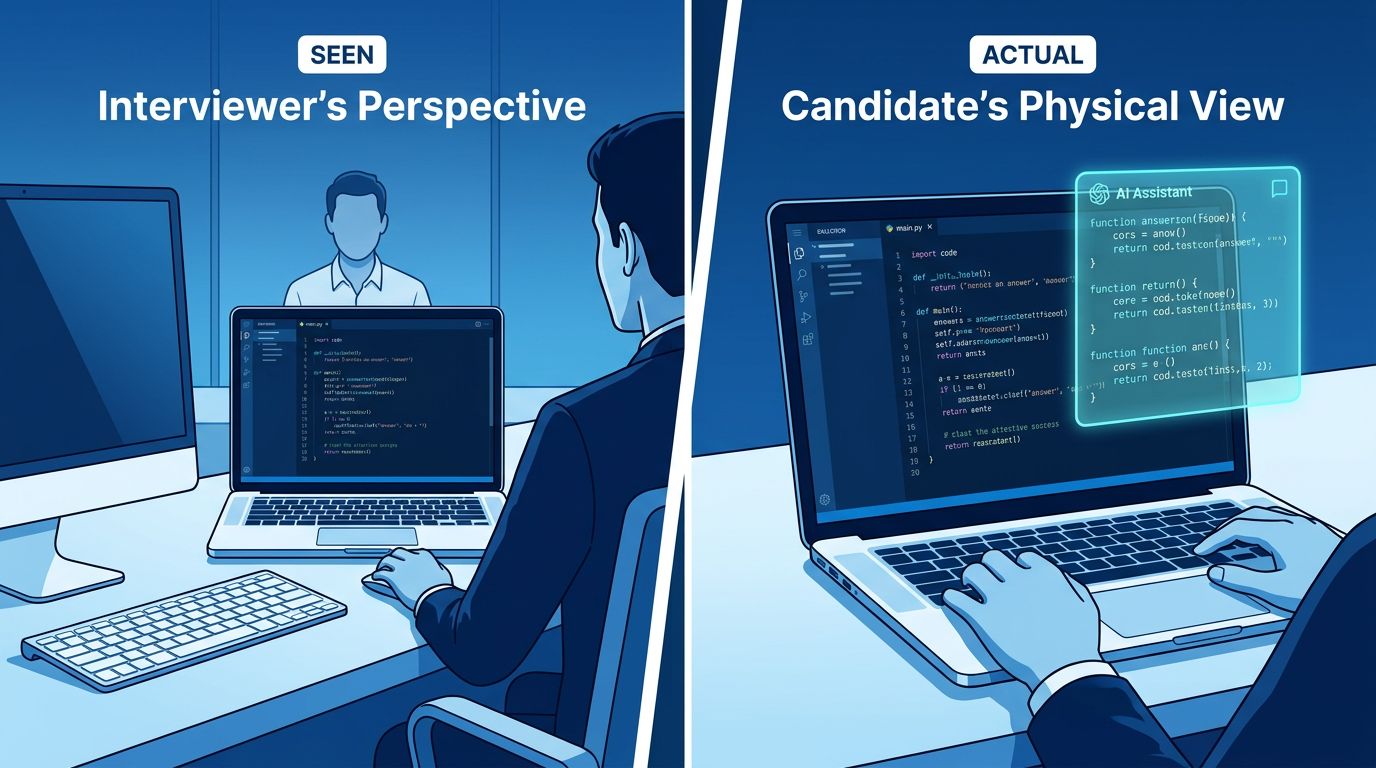
The dominant cheating tools — Cluely and Interview Coder — do not work the way most people assume. They use DirectX on Windows and the Metal framework on macOS to render AI-answer overlays directly at the GPU level, on the candidate’s physical display only. When the candidate shares their screen through Zoom or Google Meet, the interviewer sees a clean workspace. The overlay does not exist in the captured video stream. Browser-lock proctoring, second-face detection, tab-switch monitoring: none of this catches GPU-layer rendering.
The origin story here is worth knowing. Columbia student Roy Lee built Interview Coder to fake his own technical interviews. He was expelled. He then raised $5.3 million, rebranded it as Cluely, and marketed it openly as “a cheating tool for literally everything.” The market rewarded him. By mid-2025, Cluely had 83,000+ users before getting hacked and leaking their interview transcripts. By late 2025, it had repositioned as an AI meeting assistant. The cheating tool became enterprise SaaS. There is a thesis about market incentives buried in that trajectory.
Behavioral signals do exist, however. Detection-focused platforms flag what Fabric calls the “Lag Loop”: a consistent 3-to-5-second delay before every response regardless of question complexity. Real candidates more on hard questions and less on easy ones. AI-assisted candidates the same amount on every question because they are waiting for the same generation process each time. Mechanical horizontal eye movements — reading — are another tell. These signals require trained interviewers or behavioral analysis software, not browser locks.
It Goes All the Way Up #
The assumption that AI interview fraud is primarily a junior-candidate problem does not hold. C-suite executive candidates admit to live AI-cheating at 8.6%, versus entry-level candidates at 1.8%. That is nearly a 5x difference in the wrong direction. The pattern is rational: a $400K role justifies proportionally more risk-taking than an $80K role. Gartner projects that by 2028, 25% of candidate profiles will be entirely fabricated. This is not a moral panic — it is a trajectory built on current incentive structures.
What Is Actually Working #
The 2026 format that produces the strongest hiring signal: AI-allowed live pair programming on an ambiguous, real-world problem. Sixty to ninety minutes. The candidate uses Cursor, Copilot, or any tool they would use on the job. The interviewer observes how the candidate decomposes the problem, where they push back on the model, and how they verify the output. This is measuring judgment and communication — things AI cannot substitute for a specific person in a specific conversation. Google, Cisco, and McKinsey have reintroduced mandatory in-person interviews for key roles, acknowledging that video verification alone is no longer sufficient.
Karat’s guidance to interviewers is direct: ask candidates to explain their code choices and walk through edge cases. Genuine understanding holds up under questioning; overreliance usually does not. The defense is not better proctoring — it is better questions.
Related:[Superhuman Acquires GPTZero: What AI Detection Means for Developers]
Key Takeaways #
- 38.5% of candidates in 19,368 technical interviews showed AI cheating signals — 48% in pure technical roles. 61% passed anyway. The current interview format is not selecting for what you think it is.
- Cluely and similar tools render AI overlays at the GPU level, invisible to screen sharing. Browser locks and standard proctoring do not catch them. Behavioral signals — timing consistency, eye movements — are more reliable detection mechanisms.
- C-suite candidates cheat at 8.6%, nearly 5x the entry-level rate. This is a systemic problem across seniority levels, driven by incentive, not inexperience.
- The formats that still produce signal: AI-allowed live pair programming, system design discussions with live follow-up, and in-person assessments for high-stakes roles. The take-home project and automated LeetCode screen are effectively broken as standalone hiring tools.