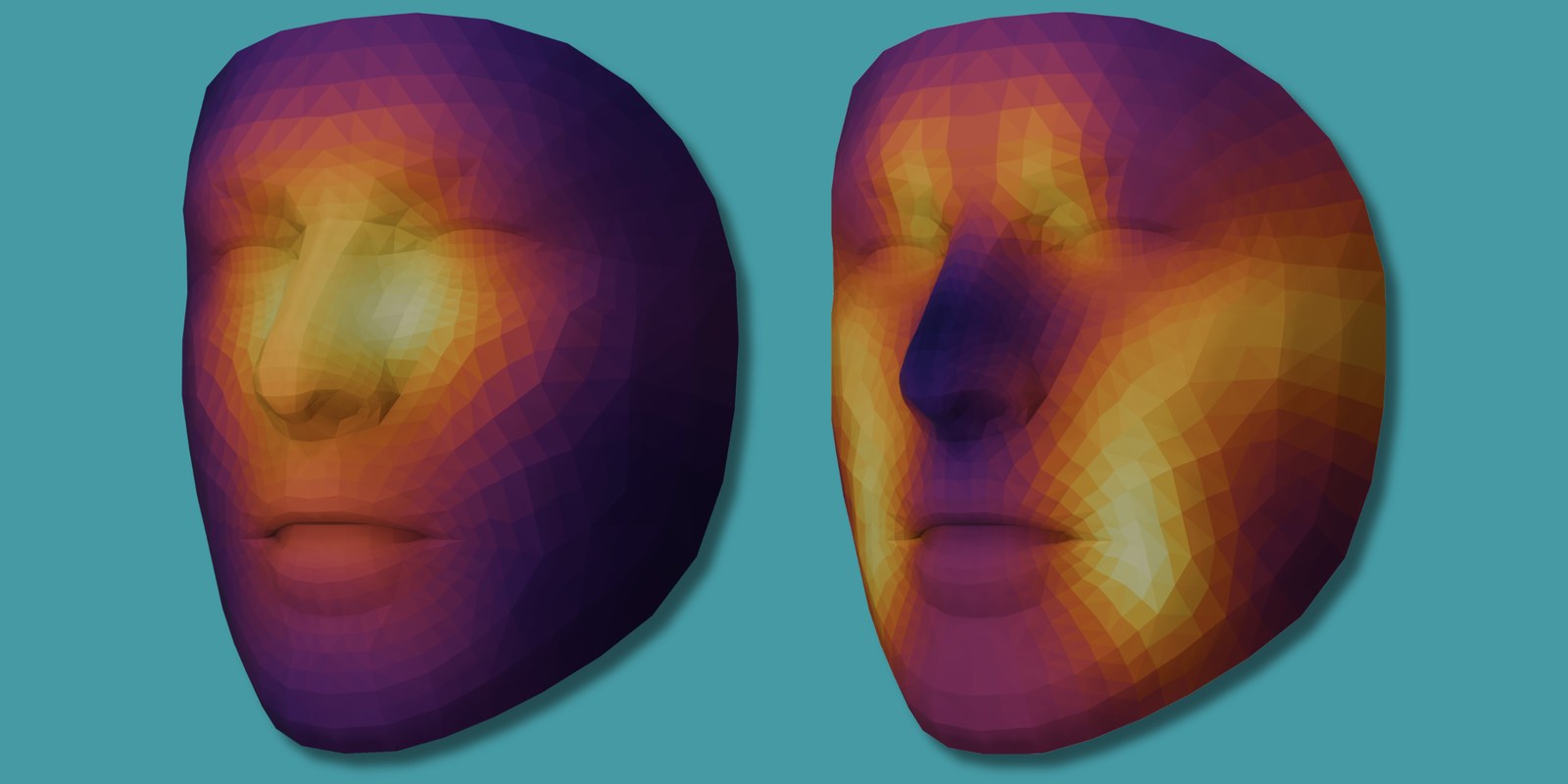
Attention maps from the FAHR-Face study: the survival model (left) focuses below the eyes and around the bridge of the nose, the age model (right) on the nose-to-mouth creases, forehead and temples. Image: Mass General Brigham
An AI trained on more than 40 million faces can tell how likely a cancer patient is to survive from a single photograph of their face, researchers at Mass General Brigham in Boston have found. Their study, published in The Lancet Digital Health on Monday, says the model picked out patients at the highest risk of dying even after allowing for their age, sex, race and type of cancer.
The team calls its model FAHR-Face, short for Foundation Artificial Intelligence for Health Recognition. It first learned what faces look like from a research dataset of more than 40 million images, then was fine-tuned into two tools: FAHR-FaceAge, which estimates how old a person looks, and FAHR-FaceSurvival, which predicts survival directly from the photo.
Looking five years older meant a 21% higher risk #
The researchers tested FAHR-FaceAge on 38,183 cancer patients treated with radiotherapy at Harvard-affiliated hospitals. Patients the AI judged to look five or more years older than their real age had a 21% higher risk of death than the rest, once other factors were taken into account. Those who looked five or more years younger had a 17% lower risk.
FAHR-FaceSurvival, trained on 34,363 patient photos, went further. In a test group of 3,820 patients, those in its highest-risk quarter died at more than three times the rate of those in the lowest (an adjusted hazard ratio of 3.23). Among the 122 patients it scored as highest risk, 64 (52.5%) died within 90 days, compared with 20 of 975 (2.1%) at the other end of the scale.
Both tools held up in a second group of 4,892 patients at the Maastro radiotherapy clinic in Maastricht, in the Netherlands. The two looked at different parts of the face: FAHR-FaceAge at the creases from nose to mouth, the forehead and the temples, and FAHR-FaceSurvival at the area below the eyes and around the bridge of the nose. Used together, they predicted survival better than either did alone.
The research also found that heavy drinking, drug use and above all smoking were linked to looking older. Current smokers looked older than former smokers, who in turn looked older than people who had never smoked.
‘Rather than replace physician judgment’ #
The team says the aim is to help doctors decide who is fit enough for gruelling treatment. Raymond Mak, a radiation oncologist at Mass General Brigham Cancer Institute and the study’s corresponding author, said in a statement:
Our goal is to make face photograph-based health assessment more quantitative, consistent and scalable so it can support personalized treatment decisions rather than replace physician judgment.
Raymond Mak, Mass General Brigham
Hugo Aerts, who directs the Artificial Intelligence in Medicine program at Mass General Brigham and co-led the study, said: “To our knowledge, this is the first demonstration that an AI model can directly predict cancer survival from a simple photograph.” The paper suggests a photo could flag patients unlikely to cope with aggressive therapy, especially where formal frailty tests are impractical.
It builds on FaceAge, an earlier tool from the same group published last year. That model was built mainly for patients over 60 in a mostly white group; the researchers say the new one works across the whole lifespan and every major racial group they tested.
Not selfies, and not ready for clinics yet #
The patient photos were not selfies: they were taken during routine hospital care and analysed afterwards; an ethics board waived consent because the data already existed and many patients had died. The paper describes them as “consumer-grade” photographs, and says the model coped with changes in pose, lighting, expression, make-up and most cosmetic surgery, with only a small shift after nose jobs.
The authors list clear limits. All the patients had cancer and most were treated in wealthy countries, the age measure separated risk less sharply for Black and Hispanic patients than for white and Asian patients, and the team says prospective trials are needed before doctors rely on it. Mass General Brigham has filed a provisional US patent on the algorithms.
The group is also running an online FaceAge Research Study where anyone can upload a photo, get a research readout of their face age and add to the data.
AI is moving into hospitals in other ways too: Britain has agreed to bring AI into the NHS sooner, and ChatGPT recently named a toddler’s ultra-rare condition before tests confirmed it.
Why it matters #
Doctors already judge how frail a patient looks before choosing treatment; this study suggests an AI can put a number on that from a single photo, and do it better than age alone. It also shows how much a face can give away, which will matter as such tools move beyond research hospitals.
Sources: Haugg et al., The Lancet Digital Health (FAHR-Face study), Mass General Brigham, Bontempi et al., The Lancet Digital Health (FaceAge, 2025).