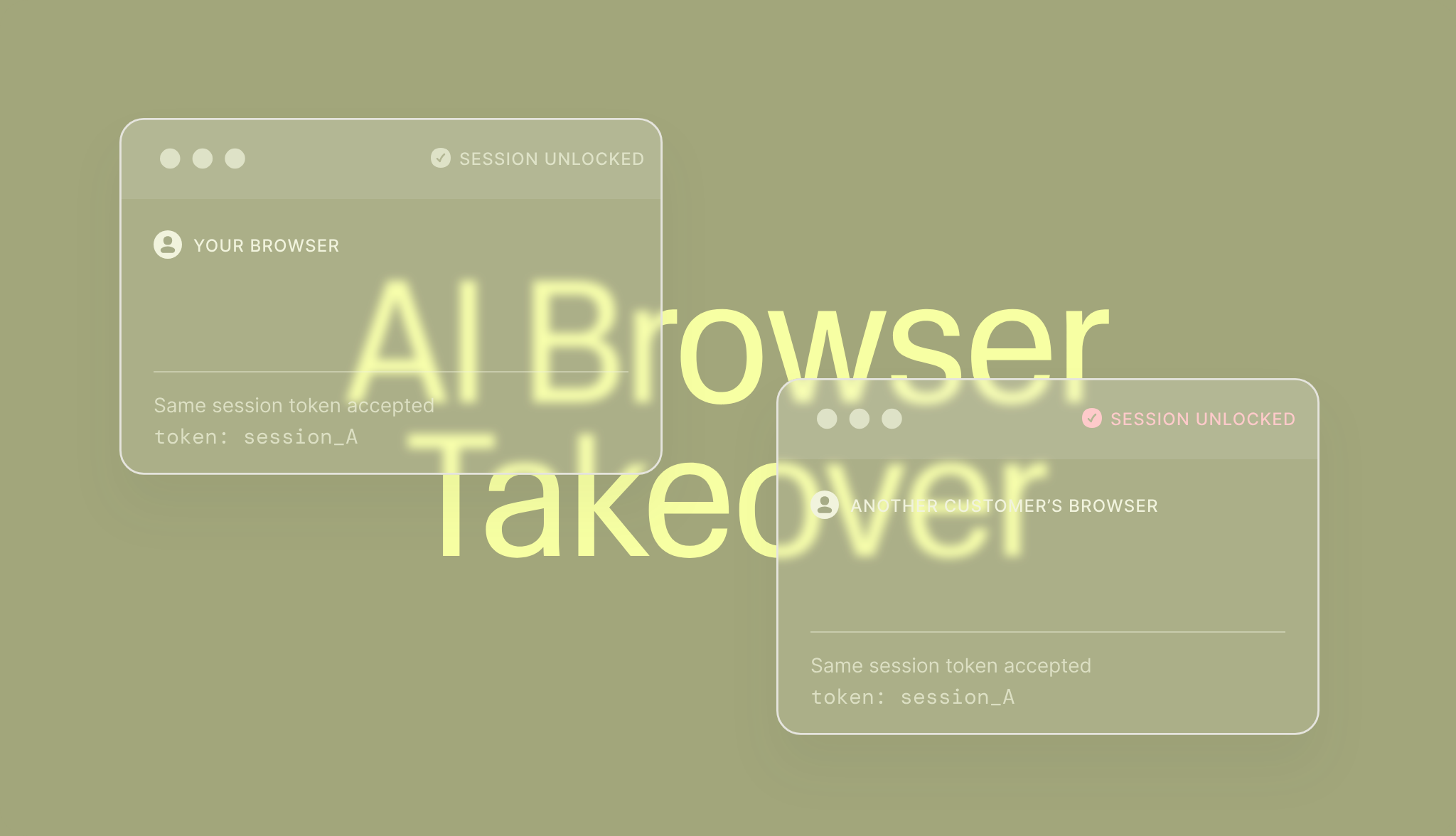
KERNEL hosts browsers for AI agents. We discovered that any customer could get root access to other customers’ browsers, using nothing but their own session token. That lets one KERNEL customer steal whatever sat in another customer’s browser: data, cookies, saved logins and every website it was signed into.
We reported the issue to KERNEL, and they patched it.
How the session works #
KERNEL runs its customers’ browsers in Firecracker microVMs, on a fleet of more than a hundred host machines. Each VM is given an address on its host machine’s private network.
Every host is a server with its own public hostname:
prod-iad-hypeman-18.kernel.sh,
prod-iad-hypeman-43.kernel.sh
and so on. On each one sits a gateway: an HTTPS endpoint on port 8443 that is the only way in to the browsers on that host.
The attacker starts out like any other customer, by requesting a new browser through KERNEL’s API. The API allocates the browser to a host machine and responds with a session URL. The hostname of the URL is the host where the session ended up, and its ?jwt= parameter contains the session token, which is valid for one year.
One of our sessions ended up on prod-iad-hypeman-18.kernel.sh, in a VM at 172.30.45.35.
The token is a JWT. Decoded, the payload of that session’s token looks like this, trimmed to the fields that matter:
id is the session, metro is the host the session was placed on, and privateIP is the address of its VM on that host’s private network. The fields we left out identify the customer (orgId, userId) and the VM instance.
The attacker connects to that host using the URL and presents the token. The gateway on the host looks up the private address of the session’s VM and connects the attacker to it.
The missing check #
The token works on every host. The whole fleet shares one signing key and one set of session records, so the gateway on any host accepts the token and finds the session’s private address.
Every host numbers its VMs from the same private range. Our VM was 172.30.45.35 on prod-iad-hypeman-18. There was a 172.30.45.35 on prod-iad-hypeman-43 too, and it belonged to another customer.
With a setup like that, the gateway has to check that the session it is asked for lives on the host that received the request. The token itself names that host: its signed metro field said prod-iad-hypeman-18. KERNEL’s gateway verified the signature and never compared that field with the host it was running on.
Finding the other hosts was easy. They are all public and their names are numbered, so knowing the name of one host gives you the names of the rest.
So we took the token from our session on host 18 and sent it to host 43:
POST https://prod-iad-hypeman-43.kernel.sh:8443/browser/kernel/process/exec?jwt=<our session token>
The gateway on prod-iad-hypeman-43 accepted the token, looked up our address, dialed it on its own network, and connected us to another customer’s VM.
KERNEL’s management agent runs inside every VM. It executes commands with root privileges and trusts whatever comes through the gateway. process/exec is one of its routes, so reaching a VM means root in that VM.
From there we built a simple attack: create a batch of sessions, then try each session’s token against every other host. Whenever the session’s address was in use on that host, one request made us root in somebody else’s VM. Within minutes we were inside several other customers’ VMs.
If your agents ran on KERNEL, another customer could have done the same to your VM. A hosted browser can hold sessions that are already logged in. With root access, an attacker can download the entire browser profile with one API call or control the tabs that are already open through DevTools.
Disclosure timeline #
| When | What |
|---|---|
| October 24, 2026 | Reported through KERNEL’s bug bounty program |
| October 29, 2026 | KERNEL confirms the issue |
| October 30, 2026 | KERNEL remediates the vulnerability |
From agent sandboxes to agent browsers #
We have spent the months since July breaking out of the sandboxes AI agents run in: Claude Cowork, Claude Code, Cursor CLI, OpenAI Codex, Docker’s hypervisor and Cloudflare’s sandbox. Each of them was built around the same worry: what the agent’s code can reach on the machine it runs on.
Somewhere along the way we noticed how little of an agent’s work happens on that machine. The agent opens a browser, signs in and acts as its user. That browser is increasingly a hosted one, running on someone else’s fleet beside other customers’ browsers, and the logged-in sessions a sandbox is there to protect are sitting in it. So we followed the agent there.
On KERNEL, the hard part of the isolation held. Firecracker did its job. The bug was one layer up, in a gateway that had the right host name inside the token it had just verified and never compared it with its own.
Hosted browsers for agents are a young category, and they already hold the most valuable thing an agent has, its user’s logged-in sessions. We think they deserve the same scrutiny the sandboxes have been getting, and that is where we are looking now.