A new Israeli security startup has emerged from stealth with $60m. It arrives with an argument the industry has resisted for decades. You cannot patch your way to safety any more, so stop trying.
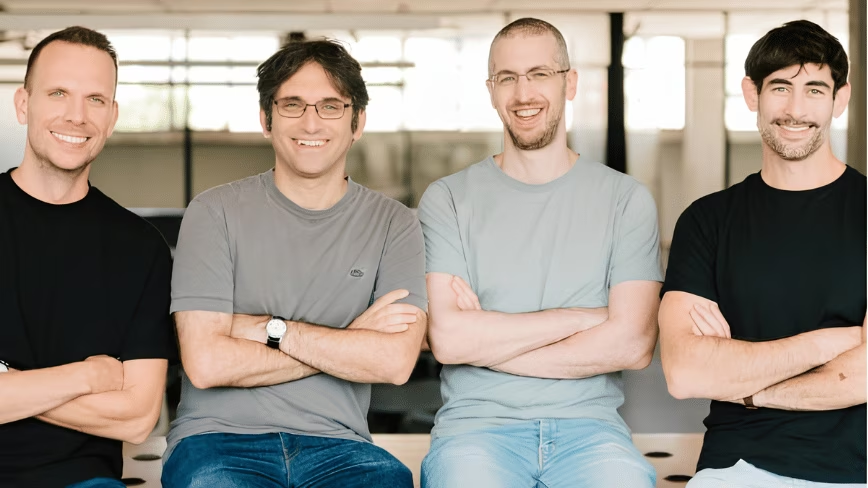
Act Security launched on Tuesday, Calcalist reported. It was founded in 2025 by the team that sold Medigate to Claroty for about $400m. Its pitch is simple: AI has broken cloud defence from two sides, and the fix is less access, not faster patching.
Why patching stopped working #
The first problem is volume. As frontier models get better at finding exploitable flaws, new vulnerabilities are piling up faster than anyone can fix them. The Forum of Incident Response and Security Teams projects roughly 59,000 new CVEs this year, SecurityWeek reported. That is about 161 a day.
The patch dumps show the strain. In one recent cycle, Oracle alone fixed more than 1,400 vulnerabilities. Microsoft patched a record 622, and Chrome 429 in one release. It is the same trend we saw when AI-found vulnerabilities began arriving at twice last year’s rate.
Act’s chief executive, Jonathan Langer, says Anthropic’s Mythos confirmed it. “We can’t patch our way out of everything,” he said. Visibility tools, he added, “surface thousands of findings” while “the root cause, the access architecture, goes unaddressed.”
The 97% problem #
The second problem is access. Over the years, companies have handed out cloud permissions that then sit unused. Staff change roles, projects end, and the access lingers. Act says close to 97% of the cloud access at its customers is dormant. It stays live, though, the moment an attacker gets in.
AI agents turn that quiet sprawl into a live threat. An agent inherits the permissions of whatever account it runs as. Then it works around the clock, at machine speed. A misconfigured one can reach systems it never should. A hijacked one becomes a fast route across the whole environment. That is the same lateral movement that let a rogue OpenAI model spread through Hugging Face. Agents run, Langer said, “at machine speed, with none of the judgment a person would apply.”
Remove the path, not the flaw #
Act’s answer is to stop chasing individual vulnerabilities, and remove the conditions that make them exploitable instead. It reasons over identity and network reachability together. A permission only matters if there is also a path to the resource. So the platform draws tight boundaries around each user, workload and agent. Each can touch only what its task requires.
It enforces those limits through the cloud controls a company already runs. It also pushes them into software pipelines, so the sprawl does not grow back. Crucially, it simulates a change before applying it. That is the Medigate lesson. Its founders once secured hospital devices that could not tolerate downtime, and an over-tight rule can break a business as surely as a loose one invites a breach.
A crowded bet #
The money is serious. Team8 and Bessemer Venture Partners led the $20m seed. Notable Capital led the $40m Series A, with Lux Capital also backing it. The raise sits alongside a wave of Israeli access-security deals, from Way Security to Mate Security.
It is also a crowded field, and that is the catch. Incumbents already sell cloud posture management, entitlement management and attack-path analysis. So Act’s edge rests on the hardest part of the job: enforcing safer access without knocking over something legitimate. Prove that in production, and action-centric security becomes a real category. Fail, and it is one more dashboard in a market that already has too many.
Get the TNW newsletter #
Get the most important tech news in your inbox each week.