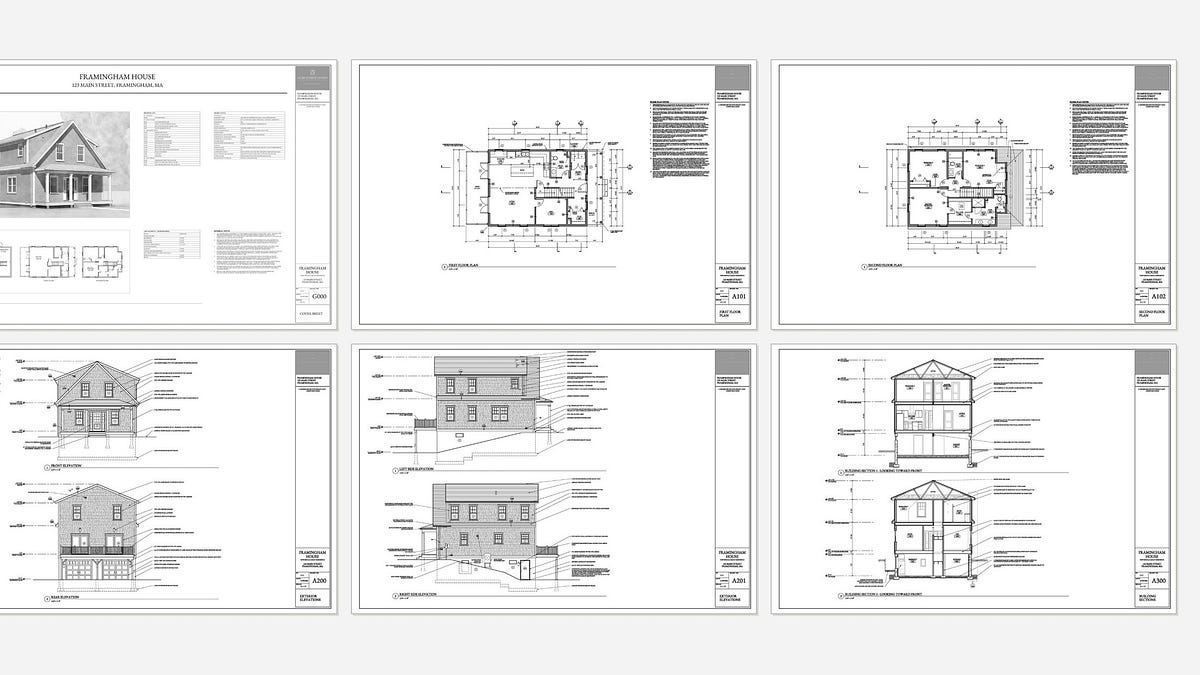
Two days ago, Anthropic released Claude Fable 5.2, its most powerful public model to date. I’ve extended my analysis of AI drafting performance by giving Fable 5.2 the same house drafting project that I described in the original post, beginning with the same prompt and context.
The takeaway is that Fable 5.2 is definitely better at producing architectural drawings than Opus 5.5, the previous frontrunner. That said, the process still requires good context and oversight by an experienced person.
Fable 5.2 was better, though still not perfect, at interpreting my initial sketches and drawing the geometry correctly. The model’s drafting was stronger than Opus 5.5’s in many subtle ways. The line weights were better and the hatches were more consistent with architectural graphic standards.
The design decisions improved as well. The roof structure in this set consists of trusses, including a dropped gable-end truss with outlookers bearing on it. This is a fairly slick and well-drawn approach that would probably be slightly cheaper to build than the conventional rafter designs that the earlier models devised.
The set includes a lot of detail that the previous models generally omitted. The model depicted and properly placed things like mechanical equipment and exterior vents, which many drafters of house sets tend to ignore and leave to construction workers to locate in the field.
I also improved the workflow by separating the drafting and review tasks. In addition to the main drafting agent, I used a separate instance of Fable 5.2 to do a systematic plan review, checking the drafting agent’s work for building code compliance, structural design, and general coordination. The reviewing agent generated a report in a Markdown file that I put back into the drafting agent’s context so that it could make the appropriate updates.
This process identified issues that the drafting agent had missed. For example, the drafting agent’s initial set included the same error that the previous Anthropic models made: it omitted a second means of egress, which is a state building code violation in Massachusetts. The reviewing agent quickly flagged this error, identified several ways that it could be resolved, and recommended the same one that I would have recommended.
Interestingly, the shortcomings in the first draft seemed to be less due to errors than to the model “quitting” before completing certain tasks, leaving linework missing from some details and the interiors of the building sections only partly drawn. It was easy to address this in redlines by simply circling the blank area of the detail or writing a note directing the model to finish a drawing.
Fable 5.2, like some other models, tends towards verbosity and included superfluous notes.
One persistent weakness of all of the models, including those from Anthropic and from other companies, is that they struggle with positioning notes and other text on the page. There is an art to laying out the text and note leaders on technical drawings without making the sheets cluttered and hard to read, and AI models seem to be bad at this by default. They do better with specific guidance, but only somewhat.
But those are minor issues. Overall, I think that Fable 5.2 has reached a level that makes AI, in business terms, the most effective option for drafting tasks of this complexity. It was probably an order of magnitude more efficient at this task than a typical drafter using AutoCAD or Revit would have been, both in terms of speed and cost. It seems certain that AI drafting will be widely adopted, at least for simpler projects, in the near future.