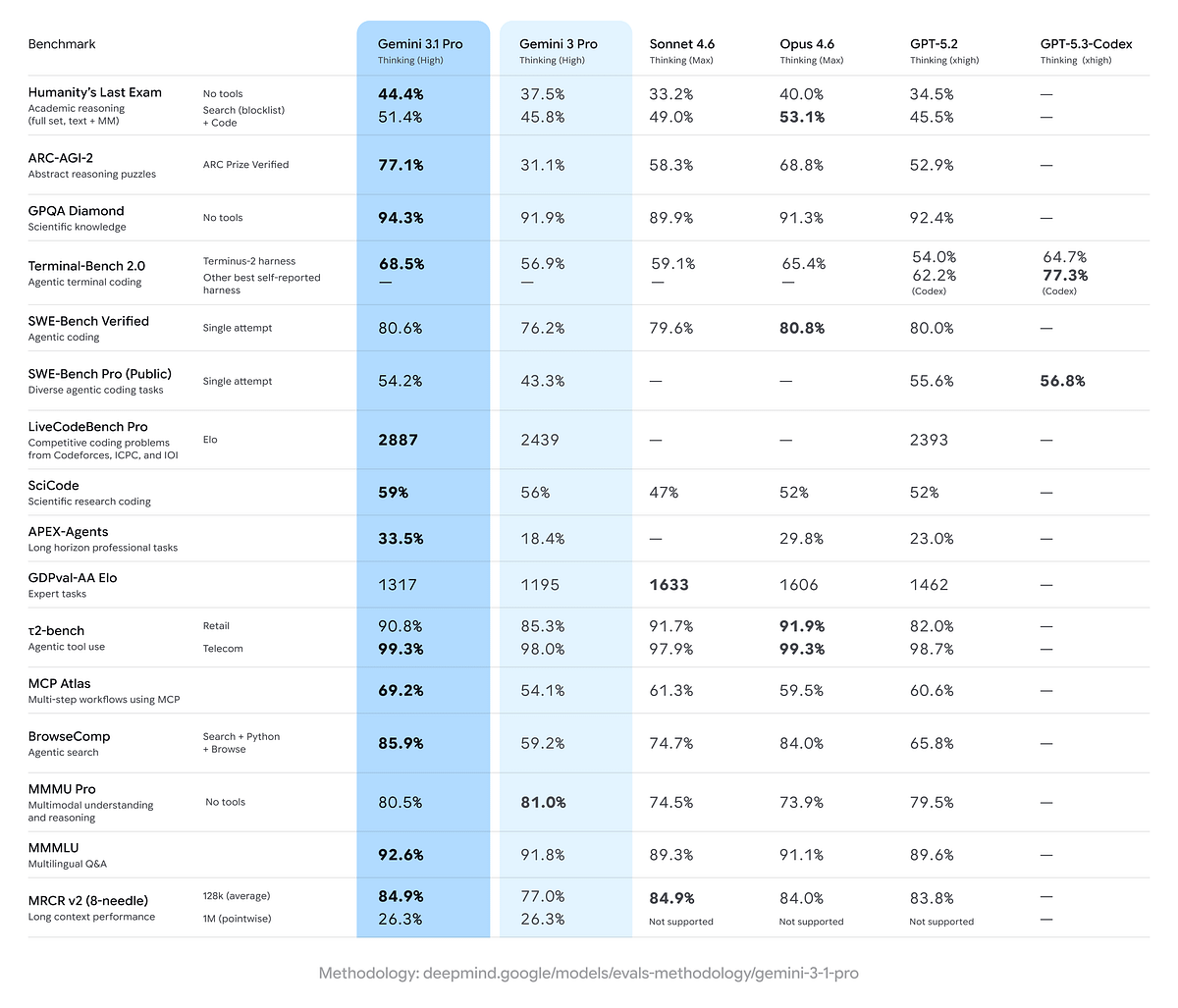
A PlainEnglish article published on July 9, 2026 argues that AI benchmark scores such as MMLU, HumanEval, and HellaSwag can overstate production readiness when readers treat leaderboard numbers as model-selection proof. The piece is commentary, not a new benchmark release, but its warning matches broader evidence from Microsoft, SVA Consulting, and a 2026 arXiv paper on benchmark signal depreciation. For practitioners, the actionable takeaway is to use public benchmarks as coarse filters, then run task-aligned internal evaluations with contamination checks, harness controls, and cost-quality measurements before switching models.
The practical risk is procurement by leaderboard. Public benchmark scores are useful signals, but they become weak decision evidence when teams apply them to workloads, tools, prompts, and data distributions the benchmark never measured.
What happened
The PlainEnglish article argues that headline AI benchmark scores can mislead readers who treat tests such as MMLU, HumanEval, and HellaSwag as direct evidence of real-world model quality. The article is an explanatory commentary rather than a new dataset, paper, or model launch, so its claims should be read as guidance for interpreting benchmarks, not as a newly measured empirical result.
Technical context
The broader evidence supports the caution. Microsoft's developer guidance says benchmarks such as SWE-bench can show baseline capability but do not answer whether a model will work with a team's proprietary SDKs, instruction files, tool stack, or workflow. SVA Consulting makes a similar model-selection point: a benchmark is a standardized test, but a single score cannot show whether the test resembles the buyer's work. A 2026 arXiv paper on benchmark ceilings adds the research frame, arguing that saturation, contamination, and strategic optimization can reduce the precision of public benchmark signals as frontier models improve.
For practitioners
The useful pattern is to treat benchmarks as screening tools. Use them to eliminate clearly weak options, detect obvious regressions, and understand capability class. Then run internal evals on representative tasks, with the same retrieval systems, tools, prompts, permissions, latency budgets, and quality criteria that production will use. That local evidence matters more than a few points of leaderboard movement.
What to watch
Watch methodology notes, contamination disclosures, benchmark versioning, harness details, and whether a vendor's strongest score comes from a generally available model or a restricted variant. The more a benchmark is used for marketing, the more teams should ask what distribution it actually measures.
Key Points #
- 1Public benchmarks can help filter models, but single leaderboard numbers rarely predict performance on proprietary production tasks.
- 2Contamination, benchmark saturation, and harness differences can make reported gains look stronger than real deployment improvements.
- 3Practitioners should run task-aligned internal evals with representative prompts, cost tracking, and repeatability checks before model switches.
Scoring Rationale #
This is useful practitioner guidance on model evaluation and benchmark interpretation, especially because the same concerns are supported by stronger contextual sources. The score is lowered because the triggering article is commentary rather than a new benchmark, model release, policy action, or primary research result.
Sources #
Public references used for this report. Practice interview problems based on real data
1,625 SQL & Python problems across 15 industry datasets — the exact type of data you work with.