AI Baby Monitors and Consent: The Record No Infant Can Contest #
Section 5.2 of Nanit's terms of service is not written about babies. It is written about content, in the flat contractual register every consumer technology company has used since roughly 2007. By submitting User Content through the Services, it says, you grant the company “a worldwide, non-exclusive, perpetual, royalty-free, sub-licensable and transferable license to use, process, store, edit, modify, truncate, aggregate, reproduce, transfer, modify, distribute, prepare derivative works of, display, perform, and otherwise fully exploit the User Content in connection with the Site, the App and the Services and our (and our successors' and assigns') businesses.”
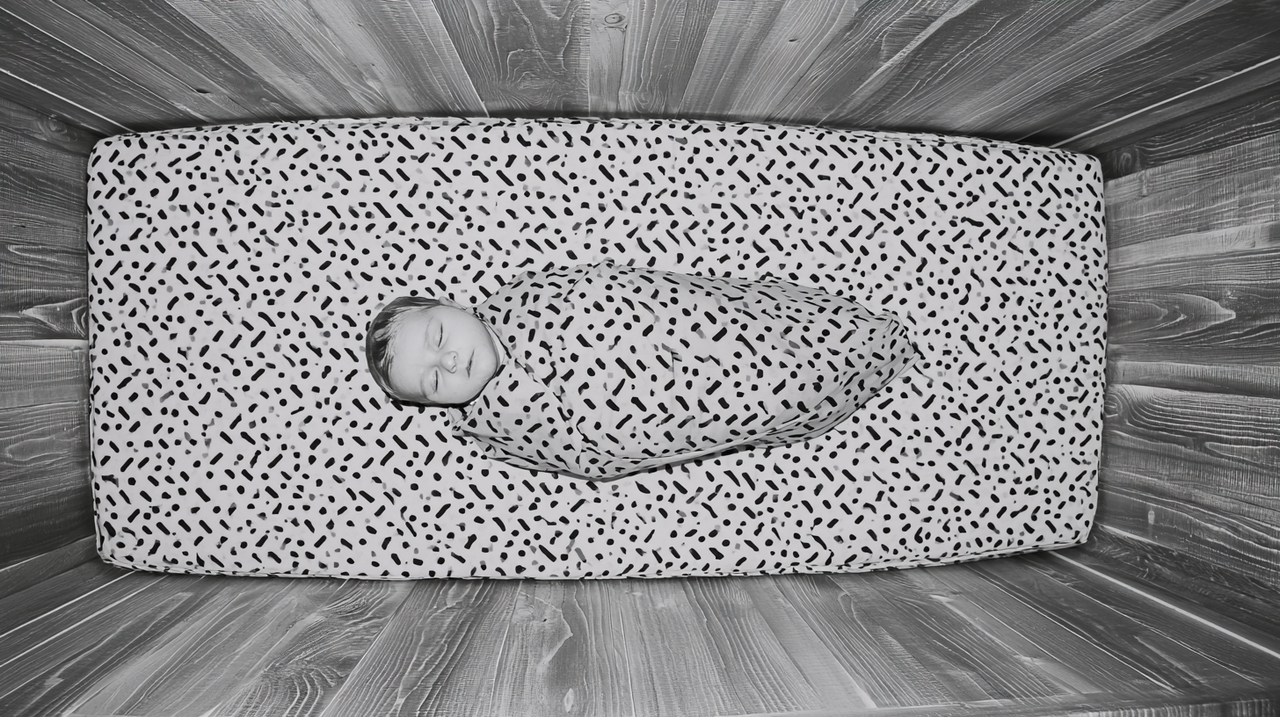
User Content, the same document explains, means all content added, created, uploaded, submitted, distributed or posted to the services by users. In the case of a Nanit Pro, the content in question is overhead infrared video of a sleeping infant, captured from a camera mounted above the cot, running most nights for the first several years of that infant's life. The person who grants the licence is the parent. The person the licence is about cannot yet hold up their own head.
On 2 August 2026, Sapna Maheshwari of The New York Times published a profile of Nanit, the New York company whose crib-mounted camera logs the moment a baby's eyes open and close and issues a score for the night on a scale up to 100. The company told the Times it has around one million daily active users and annual revenue above 100 million dollars. The reporting also surfaced a detail no amount of policy analysis could improve upon: the branding firm that built Nanit's identity described its own brief as transcending the negative connotations of surveillance.
That is a candid sentence, and it points at the wrong problem. The interesting thing about the AI nursery camera is not that it is surveillance. Parents have always watched their children, and a camera that lets you check on a sleeping baby without opening a creaking door is a small, genuine good. The interesting thing is what the category has become. Nanit's chief executive describes the value proposition with unusual clarity, and what she describes is not a better way for a parent to watch. It is a system that watches instead.
That substitution is the story. A parent's attention is forgetful, reciprocal and impossible to transfer. A system's attention is total, permanent, non-reciprocal and, per section 5.2, transferable to successors and assigns. Swapping one for the other is not an upgrade to an existing practice. It is the creation of a permanent evidentiary record about a person who will not be able to read it, contest it, or ask who else holds a copy, for approximately eighteen years.
What a Sleep Score Is Actually Made Of #
Start with the artefact, because the artefact is stranger than the debate around it.
Nanit describes Sleep Score as the first AI-driven, science-backed sleep score designed specifically for babies, delivered each morning as a single number up to 100 alongside a comparison to the baby's own typical range. It is assembled from four components. Sleep duration is total actual sleep across the night. Sleep timing measures how well bedtime and waking align with age-appropriate biological rhythms. Sleep continuity covers night wakings and time spent awake between sleep periods. The fourth component is parent visits, defined as the frequency with which a parent has to come in and settle the baby.
Read that fourth component again. A metric marketed as a measure of infant sleep quality is partly a count of how often the adult entered the room. Whatever the design intention, the artefact grades the caregiver, and grades them downward for the thing caregiving consists of. Nanit's explainer page cites no peer-reviewed validation of Sleep Score itself, pointing instead to its in-house Nanit Lab and a scientific advisory board.
The breathing feature is more elegant and more revealing. Rather than strap a sensor to the infant, Nanit sells cotton garments, a swaddle and a band, printed with a bespoke pattern. The camera watches the pattern rise and fall, infers breathing motion from the deformation, and alerts the parent if the motion stops. There are no electronics in the garment at all. The company has solved the wearable comfort problem by moving the entire sensing apparatus into computer vision. The nursery is not instrumented. It is watched by a model that has learnt what a breathing infant looks like.
The commercial architecture sits on top. Live video, sound and motion alerts and two-way audio are free. The analysis is not. Nanit's Insights tiers gate the data behind subscription: 120 dollars a year buys thirty days of sleep analysis, two days of continuous video history, 200 saved memories and up to ten caregiver profiles, while 300 dollars a year unlocks unlimited sleep analysis, seven days of continuous video history, growth tracking, and an unlimited number of people on the parenting team.
Unlimited. Not a number at all, because the vendor saw no reason to set one. That tells you what the product understands itself to be. Not a monitor. A distribution platform for footage of a child, with tiered access, retention windows set by the vendor, and an audience list with no upper bound.
Owlet Found the Regulatory Boundary by Crossing It #
The other pole of this market took the opposite technical route and, in doing so, mapped the regulatory terrain for everybody else.
Owlet's Smart Sock wrapped a pulse oximeter around an infant's foot and reported heart rate and blood oxygen saturation to a phone. On 5 October 2021 the US Food and Drug Administration issued the company a warning letter, catalogued as MARCS-CMS 616354. The agency's reasoning was narrow and precise. Products measuring blood oxygen saturation and pulse rate become devices when they are intended to identify desaturation and bradycardia and to alarm when measurements fall outside preset values. Owlet had marketed the Smart Sock without clearance, in violation of the Federal Food, Drug, and Cosmetic Act. The company pulled the product.
What followed is the most instructive sequence in this industry. Owlet did not abandon the category. It went through the front door. BabySat, a prescription pulse oximetry sock, was cleared in June 2023. On 9 November 2023 the company announced De Novo clearance for Dream Sock, which it described as the first and only over-the-counter medical-grade pulse oximeter cleared for infants, indicated for healthy babies aged one to eighteen months weighing between six and thirty pounds. Both launched in 2024, and the FDA closed out the warning letter that June.
So Owlet is now, in the relevant respects, a regulated medical device company, with indications, contraindications, a cleared intended use and clinical testing behind it. And here is the asymmetry that should trouble anyone thinking about this market: Nanit, which points a camera at a child every night for years, extracts breathing motion, motor patterns, position and activity from the video, scores the result, and now proposes to project developmental trajectories from it, sits entirely outside that regime. Not because it collects less. Because it claims less.
The line between a consumer gadget and a medical device here is drawn by marketing copy. Say your sock detects desaturation and you enter a world of clinical validation and post-market surveillance. Say your camera provides insights and you do not. The volume, intimacy and longitudinal depth of the data are irrelevant to which side of the line you land on.
The Paediatric Literature Never Signed Off on Any of This #
Long before the FDA acted, paediatricians were saying the quiet part in journals.
On 24 January 2017, Christopher Bonafide, Elizabeth Foglia and David Jamison published a Viewpoint in JAMA titled “The Emerging Market of Smartphone-Integrated Infant Physiologic Monitors”. They examined five models introduced over the preceding two years, priced between 150 and 300 dollars, and noted that because the manufacturers did not directly claim to treat, diagnose or prevent disease, the monitors were not regulated as medical devices. Their conclusion was blunt. There was no publicly available evidence supporting the safety, accuracy or effectiveness of these products, and no medical indications for their use in healthy infants.
The following year, Bonafide's group tested two of them. Published in JAMA in August 2018, the study put the Owlet Smart Sock 2 and the Baby Vida on thirty hospitalised infants at the Children's Hospital of Philadelphia, against a hospital-grade reference monitor. The Smart Sock 2 showed 88.8 per cent sensitivity and 85.7 per cent specificity for hypoxaemia, and zero per cent sensitivity for bradycardia. The Baby Vida managed zero per cent sensitivity for hypoxaemia. Bonafide's summary to the press was the correct one. If something is going wrong with a sick infant, you would want to know that one hundred per cent of the time.
Then, in 2022, the American Academy of Pediatrics updated its safe sleep policy statement, produced by its Task Force on Sudden Infant Death Syndrome. The recommendation is one line and has not changed since. Do not use home cardiorespiratory monitors as a strategy to reduce the risk of SIDS. No monitor holds FDA authorisation to prevent sudden infant death, and there is no evidence that commercial infant vital sign devices reduce these deaths. The concern is not merely that they fail to help. It is that false alarms drive unnecessary anguish and clinical workup, while normal-looking readings offer a false reassurance that can substitute for the safe sleep practices that do work.
None of this makes Nanit's Sleep Score dangerous in the way an unreliable oximeter is dangerous. It is an argument about epistemic standing. The paediatric literature has repeatedly declined to certify that consumer infant monitoring measures anything clinically meaningful in healthy babies. Nanit is building a prediction engine on that substrate.
Care Turned Into Record-Keeping and the Chief Executive Said So #
On 16 December 2025, Nanit announced a 50 million dollar growth round led by Springcoast Partners, taking total funding to 125.1 million dollars according to Forbes. The money is earmarked for what the company calls a Parenting Intelligence System, rolling out through 2026.
Anushka Salinas, who became Nanit's chief executive in March 2024 after serving as president and chief operating officer of Rent the Runway, framed the opportunity in the announcement. “Adults now track sleep, stress, and health patterns to spot trends and intervene early,” she said, “yet babies, the group that benefits most from early insight, have no comparable system for monitoring or predictive guidance.”
And then, to Forbes, the sentence that ought to be the epigraph for this entire market. “What you don't know is often what creates anxiety. When the system is doing the monitoring and interpretation, parents don't feel like they have to constantly watch and worry themselves.”
That is not a description of a tool that extends parental attention. It is a description of one that absorbs it. And it is offered, quite reasonably, as a benefit, because parental sleep deprivation is real and the anxiety of a first year is genuinely corrosive. But look at what has been swapped.
A parent watching a baby is doing something with four properties. It is forgetful: almost none of it is retained, and what is retained is retained as memory, which decays and reshapes and is legally inert. It is reciprocal: the baby watches back, and being watched by a face that responds is how infants learn that their signals produce effects in the world. It is bounded: the watching stops when the parent leaves the room and cannot be resumed retrospectively. And it is non-transferable: you cannot assign your recollection of your child's first months to a creditor.
A system watching a baby inverts all four. It retains by default and forgets only by policy. It is non-reciprocal, because a computer vision model registers the infant without responding to them. It is total across whatever window the subscription tier defines. And it is transferable, in explicit contractual terms, to successors and assigns.
Helen Nissenbaum's framework of contextual integrity, set out in the Washington Law Review in 2004, is the cleanest way to name what has changed. Information flows, on her account, are governed by norms specified across five parameters: the data subject, the sender, the recipient, the information type and the transmission principle. Nobody has ever objected to a parent knowing how their baby slept. What has changed is the transmission principle and the recipient. Deborah Lupton and Ben Williamson made the parallel point in New Media and Society in 2017, describing a datafied child subject to dataveillance from in utero onward. The nursery has not become less private in the sense of who can see in. It has become a site of extraction, and the norm violated is not visibility but permanence.
Every Statute We Have Regulates the Wrong Moment #
Here is where the regulatory picture gets genuinely awkward, because the laws are not absent. They are numerous, recently strengthened, and pointed at a moment that does not carry the weight.
The Children's Online Privacy Protection Act is the obvious candidate, and the Federal Trade Commission gave it real teeth in January 2025. The amended Rule took effect on 23 June 2025, with a compliance deadline of 22 April 2026 that passed a few months ago. It expands personal information to include biometric identifiers, among them voiceprints, gait patterns, facial templates and faceprints. It mandates a written retention policy stating why data is collected and when it will be deleted, and prohibits indefinite retention outright. Most pointedly, the Commission's own commentary states that disclosing a child's personal information to third parties to train or otherwise develop artificial intelligence technologies is not integral to the service and requires separate consent.
Excellent rules. Now ask whether they bite. COPPA governs operators of services directed to children under thirteen, or operators with actual knowledge that they are collecting personal information from a child. A crib camera is marketed to adults, purchased by adults, configured by adults and operated by adults. Nanit's own privacy policy states that its services are not directed to, nor intended to be operated by, children under sixteen. That statement is true, and it is precisely the problem. The infant is not a user. The infant is the subject matter. COPPA's architecture was built for a child typing into a website, not for a child being filmed by one.
The European instruments have the same shape. Article 8 of the GDPR conditions lawfulness on parental authorisation where a child is below sixteen, with member states permitted to set a floor as low as thirteen, but it governs information society services offered directly to a child. Recital 65 gives the right to erasure special force where consent was given by a data subject when they were a child, and states that the right survives into adulthood. That is exactly the right instinct, and it presumes a child who once gave consent. An infant never did.
The UK's Age Appropriate Design Code comes closest. Its fifteen standards, in force since September 2021, apply to services likely to be accessed by children, explicitly including connected toys and devices, require that the best interests of the child outrank commercial interest, and require profiling to be off by default. But it too is oriented around a child as user, and its enforcement centre of gravity has been social platforms and games rather than nursery hardware. The EU AI Act's prohibitions, applicable since 2 February 2025, ban emotion recognition in the workplace and in education, and biometric categorisation used to infer protected characteristics. Neither reaches a domestic device inferring developmental state from video in a family home.
American state biometric law is the sharpest tool in the box and the least aimed. Illinois' Biometric Information Privacy Act carries statutory damages of 1,000 dollars for negligent and 5,000 for reckless or intentional violations, though an amendment signed in August 2024 blunted even that, limiting a claimant to a single recovery per person however many times the identifier was scanned or disclosed. Texas' Capture or Use of Biometric Identifier statute produced a 1.4 billion dollar settlement with Meta in 2024, the largest ever obtained by a single state. Washington's My Health My Data Act, in force since March 2024, goes furthest, defining consumer health data to include information derived or extrapolated from non-health information through machine learning and algorithms, and providing a private right of action.
That last definition is the closest anything in American law comes to describing what a nursery camera does. But every one of these statutes turns on consent at the point of collection, and consent at the point of collection is the one thing this situation cannot supply.
Consent Cannot Represent Someone Who Has Not Arrived Yet #
Consent works as a legitimating device under one condition: the party who consents is the party who bears the consequences. Every argument for informed consent, in medicine, in research ethics, in data protection, rests on that alignment. Remove it and consent stops being a transfer of authority and becomes a transfer of liability.
In the nursery, the alignment breaks in three directions at once, and the breaks compound.
The consenting party is not the data subject. A parent clicking through terms of service exercises a legitimate authority over their child's welfare, and nobody sensible wants to strip parents of it. But the interest traded away is not the parent's. Stacey Steinberg, writing in the Emory Law Journal in 2017, described parents as simultaneously the gatekeepers of their children's personal information and the narrators of their children's stories. Sharenting, though, is disclosure by a parent who chose what to say. This is extraction by a firm that chose what to record, at a resolution and duration no parent can evaluate.
The data subject can never ratify. There is no moment at which the infant becomes able to say yes or no to a decision already taken. A teenager can delete an Instagram account. They cannot un-generate four years of nightly behavioural telemetry, because they were never told it exists, do not know the corporate entity that holds it, and cannot identify what has been derived from it.
And the timing is structurally impossible. The gap between collection and the subject's legal capacity to object is roughly eighteen years. Retention windows are measured in months to years. Corporate acquisitions happen on a timescale of three to seven years. Model training happens once and is, for practical purposes, irreversible. Insolvency can happen at any point. By the time a person acquires standing to object to what was recorded in their cot, every consequential decision about that record has already been made, several times, by entities that may no longer exist.
This is not a complaint about weak consent. Strengthening consent does not help. A perfectly informed, freely given, granular, revocable parental consent still fails, because the failure is not in the quality of the permission. It is in the identity of the person granting it. The consent architecture is structurally incapable of representing the only person whose data it is.
The Precedents Are All About What Happens Afterwards #
If you want to know how this ends, the record is not speculative. Every failure mode has already occurred in an adjacent product category, usually more than once. Start with security. On 4 September 2013 the FTC announced a settlement with TRENDnet over its internet-connected cameras, its first action against a connected consumer product of this kind. According to the Commission's complaint, a hacker exploited a flaw in the company's software and posted links to roughly 700 customers' live feeds, which included babies asleep in cots and young children playing. The company had transmitted and stored login credentials in clear readable text. TRENDnet accepted twenty years of third-party security audits.
Ten and a half years later, in February 2024, roughly 13,000 Wyze users received thumbnail images from cameras that were not theirs as devices reconnected after a cloud outage, and 1,504 of them tapped through. A third-party caching library had mixed up device and user identifiers under load. Nothing malicious happened. The system simply handed strangers pictures of other people's homes.
Now retention. In May 2023 the FTC and the Department of Justice charged Amazon with violating COPPA by keeping children's Alexa voice recordings indefinitely and failing to honour parental deletion requests, resulting in a 25 million dollar settlement. The detail that matters is why the recordings were valuable. Children's speech patterns differ from adults', so retained child voice data was a uniquely useful corpus for teaching Alexa to understand children, and transcripts trained subsequent versions without that practice being disclosed in the privacy policy. Deletion was promised, the data was retained, and the retained data made the product better.
Then ownership. In March 2025, 23andMe filed for Chapter 11 bankruptcy. Regeneron agreed to acquire it for 256 million dollars, pledging to honour existing privacy commitments. More than two dozen state attorneys general sued to stop the sale, arguing that genetic information is categorically unlike the assets that ordinarily change hands in an insolvency. The auction was reopened, Regeneron declined to raise its bid, and on 30 June 2025 a judge approved the 305 million dollar sale of the company and its genetic database to TTAM Research Institute, a nonprofit led by co-founder Anne Wojcicki. Customers who consented to one entity holding their genome ended up with a different entity holding it, through a process in which they were not parties.
Finally, the counterexample. In 2017 Mattel announced Aristotle, an always-on voice and camera hub designed to sit in a child's bedroom from birth through adolescence. Senator Edward Markey and Representative Joe Barton demanded answers on children's privacy, campaigners delivered more than 20,000 petition signatures on 2 October 2017, and two days later Mattel cancelled the product before it shipped, and therefore before it had accumulated anything.
Read those five together and the pattern is unmistakable. The promises are made by an entity that will not necessarily be the entity holding the data. The retention is not an accident but a business rationale. And the only intervention that ever fully worked was the one that happened before collection began.
Prediction Is a Different Product From Observation #
The Parenting Intelligence System announcement lists six things the platform will measure. Personalised sleep guidance. Key health metrics. Movement signatures and breathing patterns. Motor skill milestones. Speech and language patterns. And then the sixth, which is a different kind of thing entirely: trends that may predict metabolic, emotional, or cognitive challenges.
Nanit currently covers birth to age five, according to Forbes, and intends to extend its models to ages nought to ten. Its own announcement gestures at a horizon of birth to a hundred years old.
There is a real category difference between a record and a prior, and the marketing language elides it. A record says what a baby did on a given night. A prior says what kind of person a baby is likely to become. The first is a description that can be checked against the world. The second is a claim about the future that is unfalsifiable at the moment of generation, because the future has not happened, and self-confirming afterwards, because the parents who receive it will act on it.
That is the mechanism that should worry people, and it is not a data breach. It is a healthy child assigned a low score on emotional-regulation trend lines at fourteen months, whose parents, being good parents, respond by treating them as a child who needs watching. It is a nursery-derived cognitive flag that follows a family into a paediatrician's appointment, or a nursery application, or, eventually, an insurance underwriting model that has learnt to want it. The prediction does not have to be accurate to be consequential. It has to be delivered, and it has to be believed.
And recall the substrate. We are proposing to build developmental forecasts from a score that counts parental visits as a negative, on a class of measurement the relevant clinical bodies have declined to endorse, at a scale of a million children a night.
The Research Literature Is Asking for a Different Design #
Three arXiv papers were put forward as evidence for this argument, and honest handling of them matters more than rhetorical convenience.
The first, arXiv 2602.17418, submitted on 19 February 2026 by Diana Addae, Diana Rogachova, Nafiseh Kahani, Masoud Barati, Michael Christensen and Chen Zhou, is titled “A Privacy by Design Framework for Large Language Model-Based Applications for Children”. It is constructive rather than critical, proposing controls across data collection, model training, operational monitoring and validation, grounded in the UN Convention on the Rights of the Child and the UK Age Appropriate Design Code. It is not a finding that large-scale AI surveillance undermines children's privacy. It is a proposal for how to avoid doing so, and its relevance here is that its guidelines exist and consumer nursery hardware is built to none of them.
The second, arXiv 2606.17957, submitted on 16 June 2026 by Kopo Ramokapane, Rui Huan, Zaina Dkaidek and Awais Rashid, is titled “Children Are Not the Enemy: Child-Fit Security as an Alternative to Bans and Surveillance”. It argues that containment approaches, meaning access restrictions, parental monitoring and screen-time limits, are insufficient, and proposes treating children as legitimate users whose wellbeing, development, privacy, safety, agency and rights are core security requirements, shifting the object of protection from the system to the child-system relationship. That is the strongest academic articulation of the principle this market has inverted.
The third, arXiv 2607.01506, does not say what it has been cited as saying, and pretending otherwise would be indefensible in an article about evidentiary standards. Submitted on 1 July 2026 by Tomohiro Nagashima, Lisa Siegrist, Niklas Scholz, Shintaro Sato, Martina Vincoli and Man Su, it is titled “Mind the Trust Gap: Identifying (Mis)alignments in Teacher-Student Views Toward Control and Agency in K-12 Classroom AI”. It reports a speed-dating study with sixteen students and fifteen teachers in Germany and finds misalignments in trust and in views on the social and emotional dimensions of learning with AI. It does not document children reporting fear of constant AI monitoring. The honest version of the claim it was offered to support is narrower and still useful: where children have been asked, their views on AI oversight diverge measurably from those of the adults deciding on their behalf. Infants cannot be asked at all.
Hold It In Trust or Do Not Hold It At All #
The instinct at this point is to demand better disclosure, and it is the wrong instinct. Disclosure assumes a reader who can act on it. There is no such reader here. The right move is to stop treating infant behavioural data as ordinary consumer data governed by contract, and start treating it as property held for a beneficiary who has not yet arrived. Four things follow.
Give the infant statutory data subject status with a fiduciary rather than a consenting parent. A parent authorising collection about a person who cannot object should be held to something closer to a trustee's duty than a customer's tick-box: obliged to act in the child's interests rather than their own convenience, and unable to authorise uses a reasonable adult would later refuse. The UK Children's Code gestures at this when it puts the child's best interests ahead of commercial interest. It needs to bind the transaction, not just the interface design.
Impose hard expiry on the record rather than on the retention policy. Raw nursery video should default to deletion within days, not whatever the subscription tier allows. Derived metrics should expire on a statutory schedule tied to the child's age, not to the company's business need, because the amended COPPA Rule's requirement of a stated business need is satisfied by any business that has one.
Bar transfer in insolvency. The 23andMe case is not an analogy, it is a preview. A firm holding nightly video and behavioural scores on a million children is an acquisition target, and a bankrupt one is an estate. Infant biometric and behavioural data needs to be statutorily excluded from the pool of saleable assets, so that who ends up holding it is never decided by a creditors' committee. Consent given to one company is not consent given to its successors and assigns, whatever section 5.2 says.
And create a right of arrival. At the age of majority, every person should receive a statutory notice naming every entity holding data generated about them before they could consent, describing what was derived from it, and offering erasure through a single form. Recital 65 already contains the moral intuition. It simply has no delivery mechanism, because it assumes the person knows what happened to them.
The counterargument is that this is a lot of machinery for a camera that helps exhausted parents through the first year, and that parents like these products. Both points are true, and nobody should want to take the camera away. But the case for regulation does not rest on the device being harmful. It rests on the fact that the transaction has no representative for the one party whose entire early life is its subject matter, and that every existing legal instrument tries to fix that by asking somebody else to sign.
The generation now being scored will not remember being watched, which is precisely the point. They will encounter their own infancy the way the rest of us encounter a credit file: as a document assembled by strangers, from a period they cannot recall, according to criteria they never saw, held by a company they never chose. Their parents will have consented on their behalf, in good faith, to terms promising nothing more alarming than insights, and reserving, in the ordinary language of commerce, a perpetual and transferable licence to fully exploit the record. The forgetting that used to be the default condition of infancy was not a technical limitation. It was the thing that made being watched by someone who loved you different from being watched by anything else.
Sources and References #
- Sapna Maheshwari, “A profile of Nanit, a maker of AI-equipped baby cameras for hyper-detailed health data tracking, which says it has 1M daily users and $100M+ in annual revenue,” The New York Times, 2 August 2026, as indexed by Techmeme. https://www.techmeme.com/260803/p8 - Nanit, “Terms of Service,” nanit.com, accessed 5 August 2026. https://www.nanit.com/pages/terms-of-service - Nanit, “Introducing: Sleep Score, the First-Ever Holistic Sleep Metric for Babies,” nanit.com, accessed 5 August 2026. https://www.nanit.com/blogs/parent-confidently/introducing-sleep-score-the-first-ever-holistic-sleep-metric-for-babies - Nanit Support, “What is Nanit Breathing Wear?” support.nanit.com, accessed 6 August 2026. https://support.nanit.com/en_us/what-is-nanit-breathing-wear-SkTibnAtgx - Nanit, “Nanit Memberships: Sleep, Milestones & Insights,” nanit.com, accessed 5 August 2026. https://www.nanit.com/pages/memberships - Nanit, “Nanit Raises $50M to Expand Its AI-Powered Systems, Giving Parents Real-Time Insights Into Infant Health and Development,” PR Newswire, 16 December 2025. https://www.prnewswire.com/news-releases/nanit-raises-50m-to-expand-its-ai-powered-systems-giving-parents-real-time-insights-into-infant-health-and-development-302643439.html - Gemma Allen, “Nanit Raises $50 Million To Expand AI In Early Childhood Development,” Forbes, 16 December 2025. https://www.forbes.com/sites/gemmaallen/2025/12/16/nanit-raises-50-million-to-expand-ai-in-early-childhood-development/ - US Food and Drug Administration, “Owlet Baby Care Inc. Warning Letter, MARCS-CMS 616354,” 5 October 2021. https://www.fda.gov/inspections-compliance-enforcement-and-criminal-investigations/warning-letters/owlet-baby-care-inc-616354-10052021 - Owlet Baby Care Inc., “Owlet Achieves De Novo FDA-Clearance For Dream Sock, The First and Only Over-the-Counter, Medical Grade Pulse Oximeter Cleared for Infants,” investors.owletcare.com, 9 November 2023. https://investors.owletcare.com/news/news-details/2023/Owlet-Achieves-De-Novo-FDA-Clearance-For-Dream-Sock--The-First-and-Only-Over-the-Counter-Medical-Grade-Pulse-Oximeter-Cleared-for-Infants/default.aspx - Christopher P. Bonafide, Elizabeth E. Foglia and David T. Jamison, “The Emerging Market of Smartphone-Integrated Infant Physiologic Monitors,” JAMA, 24 January 2017. https://jamanetwork.com/journals/jama/article-abstract/2598780 - Children's Hospital of Philadelphia, “Two Consumer Baby Monitors Show Worrisome Results in Measuring Vital Signs,” chop.edu, 21 August 2018. https://www.chop.edu/news/consumer-use-baby-monitors-have-little-proven-benefit-healthy-infants - Rachel Y. Moon et al., American Academy of Pediatrics Task Force on Sudden Infant Death Syndrome, “Sleep-Related Infant Deaths: Updated 2022 Recommendations for Reducing Infant Deaths in the Sleep Environment,” Pediatrics, July 2022. https://publications.aap.org/pediatrics/article/150/1/e2022057990/188304/ - Federal Trade Commission, “FTC Finalizes Changes to Children's Privacy Rule Limiting Companies' Ability to Monetize Kids' Data,” ftc.gov, 16 January 2025. https://www.ftc.gov/news-events/news/press-releases/2025/01/ftc-finalizes-changes-childrens-privacy-rule-limiting-companies-ability-monetize-kids-data - Norton Rose Fulbright Data Protection Report, “FTC's COPPA Rule changes include AI training consent requirement,” dataprotectionreport.com, June 2025. https://www.dataprotectionreport.com/2025/06/ftcs-coppa-rule-changes-include-ai-training-consent-requirement/ - Information Commissioner's Office, “Introduction to the Children's code,” ico.org.uk, accessed 5 August 2026. https://ico.org.uk/for-organisations/uk-gdpr-guidance-and-resources/childrens-information/childrens-code-guidance-and-resources/introduction-to-the-childrens-code/ - European Parliament and Council, “Article 8: Conditions applicable to child's consent in relation to information society services,” General Data Protection Regulation. https://gdpr-info.eu/art-8-gdpr/ - European Parliament and Council, “Article 5: Prohibited AI Practices,” EU Artificial Intelligence Act. https://ai-act-service-desk.ec.europa.eu/en/ai-act/article-5 - Federal Trade Commission, “Marketer of Internet-Connected Home Security Video Cameras Settles FTC Charges It Failed to Protect Consumers' Privacy,” ftc.gov, 4 September 2013. https://www.ftc.gov/news-events/news/press-releases/2013/09/marketer-internet-connected-home-security-video-cameras-settles-ftc-charges-it-failed-protect - Federal Trade Commission, “FTC and DOJ Charge Amazon with Violating Children's Privacy Law by Keeping Kids' Alexa Voice Recordings Forever and Undermining Parents' Deletion Requests,” ftc.gov, 31 May 2023. https://www.ftc.gov/news-events/news/press-releases/2023/05/ftc-doj-charge-amazon-violating-childrens-privacy-law-keeping-kids-alexa-voice-recordings-forever - Danielle Abril, “Wyze security issue exposed private cameras to 13,000 users,” The Washington Post, 20 February 2024. https://www.washingtonpost.com/technology/2024/02/20/wyze-camera-security-breach/ - Jaclyn Diaz, “Judge OKs sale of 23andMe, and its trove of DNA data, to a nonprofit led by its founder,” NPR, 30 June 2025. https://www.npr.org/2025/06/30/nx-s1-5451398/23andme-sale-approved-dna-data - Office of the Attorney General of Texas, “Attorney General Ken Paxton Secures $1.4 Billion Settlement with Meta Over Its Unauthorized Capture of Personal Biometric Data,” texasattorneygeneral.gov, 30 July 2024. https://www.texasattorneygeneral.gov/news/releases/attorney-general-ken-paxton-secures-14-billion-settlement-meta-over-its-unauthorized-capture - Diana Addae, Diana Rogachova, Nafiseh Kahani, Masoud Barati, Michael Christensen and Chen Zhou, “A Privacy by Design Framework for Large Language Model-Based Applications for Children,” arXiv:2602.17418, 19 February 2026. https://arxiv.org/abs/2602.17418 - Kopo M. Ramokapane, Rui Huan, Zaina Dkaidek and Awais Rashid, “Children Are Not the Enemy: Child-Fit Security as an Alternative to Bans and Surveillance,” arXiv:2606.17957, 16 June 2026. https://arxiv.org/abs/2606.17957 - Tomohiro Nagashima, Lisa Siegrist, Niklas Scholz, Shintaro Sato, Martina Vincoli and Man Su, “Mind the Trust Gap: Identifying (Mis)alignments in Teacher-Student Views Toward Control and Agency in K-12 Classroom AI,” arXiv:2607.01506, 1 July 2026.
https://arxiv.org/abs/2607.01506 Tim Green UK-based Systems Theorist & Independent Technology Writer
Tim explores the intersections of artificial intelligence, decentralised cognition, and posthuman ethics. His work, published at smarterarticles.co.uk, challenges dominant narratives of technological progress while proposing interdisciplinary frameworks for collective intelligence and digital stewardship.
His writing has been featured on Ground News and shared by independent researchers across both academic and technological communities.
**ORCID:** [0009-0002-0156-9795](https://orcid.org/0009-0002-0156-9795)
**Email:** [tim@smarterarticles.co.uk](mailto:tim@smarterarticles.co.uk)

Listen to the free weekly [SmarterArticles Podcast](https://www.smarterarticles.fm)