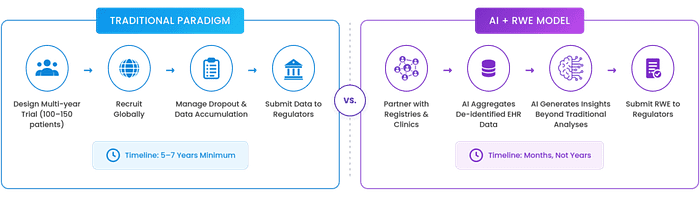
AI and real-world evidence (RWE) are revolutionizing rare disease therapies. By integrating data from diverse sources, AI accelerates treatment timelines, offering hope to patients.
AI and real-world evidence (RWE) are reshaping rare disease treatment, moving beyond traditional clinical trials. The story unfolds in data: fewer than 200,000 people define a rare disease in the U.S., yet the medical system isn't built for them. Traditional trials demand large cohorts and time, resources rare diseases can't afford.
The AI and RWE Convergence #
Visualize this: clinicians generate insights daily that linger isolated in electronic health records. Enter AI and RWE, a powerful combination dissolving longstanding bottlenecks. AI can now extract meaningful data from diverse sources, changing evidence generation for rare diseases.
Traditional trials take years, with a biotech firm recruiting 100 to 150 participants across locations. But the AI + RWE model compresses timelines. Here's how: AI systems pull de-identified EHR data from thousands, defining precise patient phenotypes and adjusting for variables in real-time.
Regulatory bodies like the FDA now accept RWE as a viable evidence pathway. This isn't just technical progress, it's pragmatic, accelerating patient access to innovative therapies.
Implications and Challenges #
Who's winning here? Patients gain faster access to treatments. Clinicians receive AI-derived insights, refining patient outcomes. Pharmaceutical firms cut costs and timelines, securing a competitive edge. But challenges persist. RWE complexity demands strong data engineering and compliance frameworks. Without these, data quality suffers, and insights falter.
Consider hereditary angioedema (HAE), affecting 1 in 50,000 people. Traditional trials struggled with recruitment. With AI and RWE, patient registries and EHR data enabled faster evidence synthesis, expediting regulatory approval and treatment access.
The trend is clearer when you see it: AI and RWE aren't just transforming evidence generation, they're changing lives. In a world where time means everything for rare disease patients, one question lingers: How quickly can we integrate AI and RWE to benefit all?
Get AI news in your inbox
Daily digest of what matters in AI.