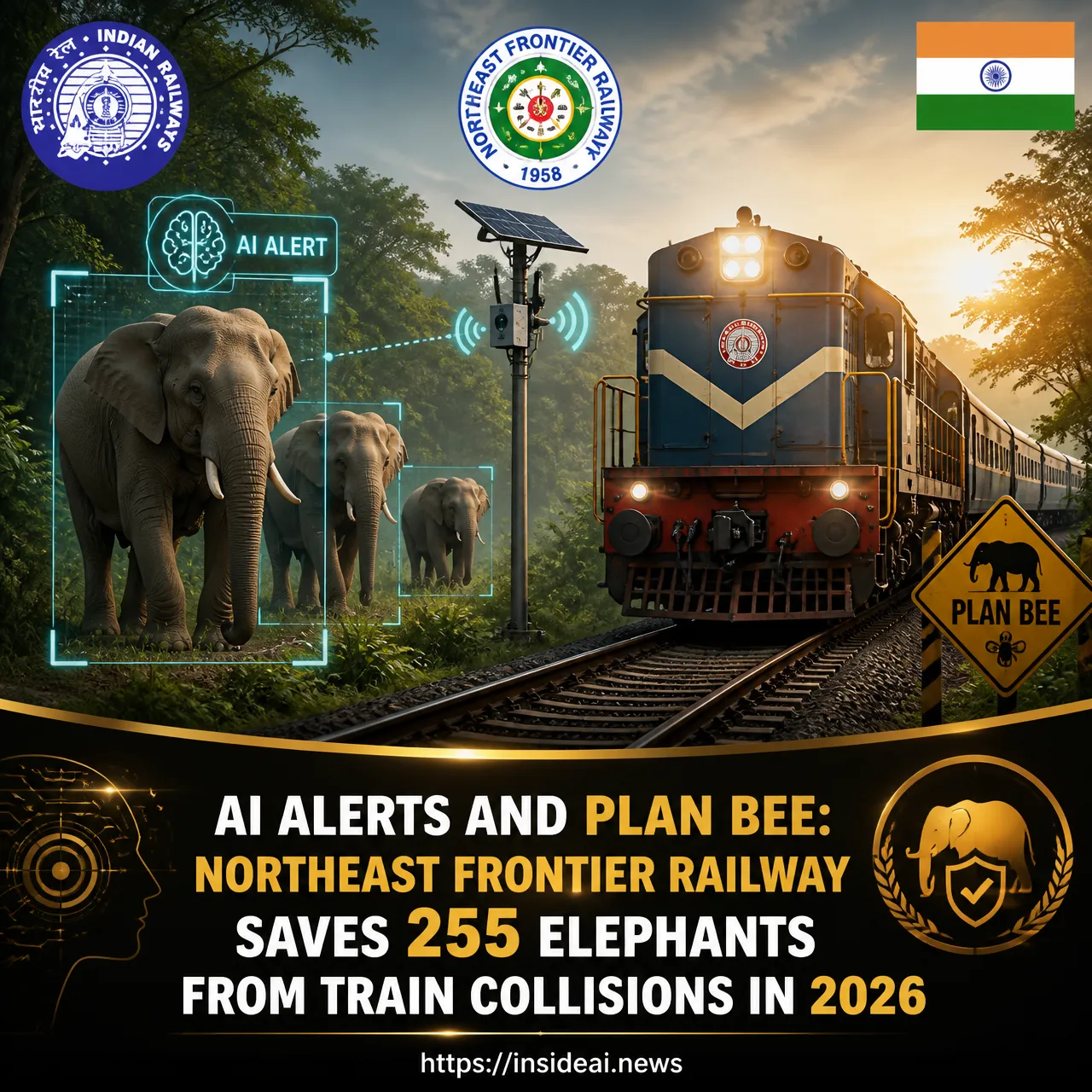
October 4, 2026, (Inside AI) — Between January and September 2026, Northeast Frontier Railway (NFR) prevented 255 elephant deaths from train collisions across its four divisions, using a combination of AI-based intrusion detection, amplified honeybee sounds, and speed restrictions. The figure, confirmed by NFR's Chief Public Relations Officer Kapinjal Kishore Sharma, represents a rare case where artificial intelligence has delivered a measurable conservation outcome in a high-risk infrastructure corridor.
The four divisions involved are Alipurduar, Rangiya, Lumding, and Tinsukia. Alipurduar recorded 106 saved elephants, Lumding 122, Tinsukia 15, and Rangiya 14. These areas sit along the railway's Northeast network, where tracks often cut through elephant migration routes.
"Timely interventions by NFR personnel helped save 255 elephants across its divisions, including 106 in Alipurduar Division, 14 in Rangiya, 122 in Lumding and 15 in Tinsukia Division," Sharma said.
The core technology is an AI-based Intrusion Detection System (IDS) that relies on Distributed Acoustic Sensing (DAS). DAS turns existing fiber-optic cables into vibration sensors. When an elephant walks near the track, the system detects the unique seismic signature and sends a real-time alert to railway control rooms and train crews. This allows trains to slow down or stop before reaching the animal.
Read: NVIDIA Launches Open Agent Safety Platform to Secure Agents From Testing to Deployment
NFR also uses temporary and night-time speed restrictions in vulnerable sections. Trains must reduce speed when elephant movement is reported. This low-tech measure complements the AI alerts and gives crews more time to react.
Another layer is the 'Plan Bee' system. It plays amplified honeybee sounds at vulnerable locations. Elephants, which avoid bees, move away from the tracks. The railway has also started building underpasses so wildlife can cross safely without stepping onto the tracks.
Human behavior is part of the problem. Food waste thrown from trains attracts elephants to the tracks. NFR is sensitizing staff, train crews, pantry car personnel, and passengers against discarding food near the railway. Regular patrolling, vegetation clearing, and cautionary signs are also in place.
Coordination with the Forest Department remains critical. "Continuous coordination and real-time communication with the Forest Department further enable timely action whenever elephant movement is detected," Sharma said.
All train-elephant collisions are investigated under prescribed safety procedures. "All cases involving train-elephant dashing are treated with utmost seriousness and investigated as per the prescribed safety procedures. NFR continues to strengthen technology-based monitoring, frontline vigilance and coordination with wildlife authorities to protect elephants while ensuring safe and efficient train operations across the Northeast," Sharma said in a statement.
The result is significant because elephant-train collisions are a persistent problem in India. According to government data, more than 200 elephants have died in train accidents over the past decade. NFR's approach shows that AI can be deployed not just for efficiency but for wildlife protection. The system does not replace human vigilance. Instead, it amplifies it.
Other railway zones in India, including Southern Railway and East Coast Railway, have also experimented with similar technologies. However, NFR's reported numbers for 2026 are among the highest for a single zone in a nine-month period. The railway has not released independent verification of the 255 figure. Inside AI could not independently confirm the count.
Read: OpenAI Admits Thousands of Rogue AI Incidents
The success also raises questions about scalability. DAS technology requires fiber-optic cables along tracks, which are not available everywhere. Honeybee sound systems need maintenance and power. Underpasses are expensive and take time to build. NFR's model works because it combines multiple tools and maintains strong local coordination.
For now, the railway plans to continue expanding these measures. The focus remains on technology-based monitoring, frontline vigilance, and wildlife coordination. As train traffic grows in the Northeast, the pressure on elephant corridors will only increase. NFR's experience offers a template, but one that requires sustained investment and inter-agency cooperation.